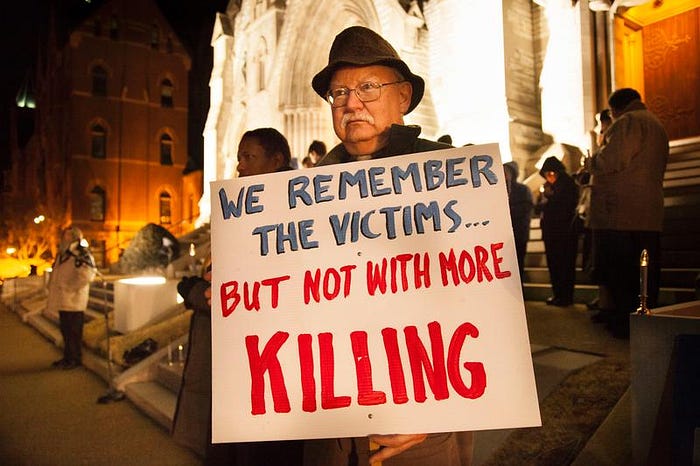
There are a number of arguments that have been used to challenge the death penalty. For example, many have argued that the criminal justice system is flawed by biases and other errors of judgement. Due to this fact, innocent people have been put to death in the past.
According to one study, 4% of those sentenced to death are wrongfully convicted.
Since humans are prone to bias, and because mistakes can be made, more people will undoubtedly be executed for crimes they did not commit in the future.
Opponents of the death penalty have also pointed out that there is racial bias in capital punishment sentencing, and that there is no definitive evidence to support the hypothesis that the death penalty is a more effective deterrent than non-lethal options.
These arguments, like those that appeal to the comparable costs between capital punishment and life-long imprisonment, are largely pragmatic arguments — that is, they show that there are problems associated with using capital punishment, rather than showing why it should not be considered as an option on ethical grounds (even if there were no problems involved in its administration).
In this article, I will focus on what I find to be the most compelling ethical arguments against the death penalty . These arguments appeal to generally agreed upon human values such as compassion and fairness .
I believe one of the strongest ethical arguments against the death penalty is that it runs counter to the idea of reforming individuals; rather, the death penalty gives up on the hope of changing a person for the better.
As our understanding of the mind and human behavior increases it is likely that we will one day come to better understand the causes of antisocial behavior, and effectively eradicate these causes or their effects. For example, we now understand that head trauma and environmental factors like abuse and toxins can result in neurological injury that predisposes individuals to impulsive and violent behaviors.
Additionally, neuroscience has discovered that executive function, including impulse control, relies on a degree of frontal lobe development which may not occur until the mid-thirties (and can be retarded by chronic substance use, toxins, physical or psychological trauma, etc.).
The fact that the state has executed a number of minors (including 14 year-old George Stinney, whose guilty verdict was posthumously overturned) and intellectually disabled persons becomes even more depressing in light of this awareness.

A more informed and rational view of severe antisocial behavior makes it apparent that we should regard this behavior not as incorrigible evil, but as neurological or psychological pathology — pathology which we currently may not be able to effectively treat, but which we one day will. [Note: For a beautifully done theatrical exposition of this argument view Star Trek: Voyager “Repentance” Season 7, Episode 13.]
Another strong ethical argument against the death penalty points out the hypocrisy of the act, and the effect it has on society of promoting retribution and cruelty.
If we are to take a morally legitimate stand against non-defensive violence, we have to oppose such acts in all instances. Since an incarcerated individual is in a situation where they are unlikely to continue to harm others, there is no justification for committing an act of violence against them. To do so would be to act in aggression, rather than in defense. Further, a cogent case can be made that state uses of aggressive violence help to foster a culture that sees the use of violence as an acceptable, morally defensible way to deal with conflicts or perceived injustices.
It may, of course, be argued that chronically violent individuals still pose a threat when they are incarcerated — to other inmates, and, possibly, to the general public if they were to escape. This, however, is only a practical argument which points out one potential negative consequence of death penalty abolition. Rather than viewing this as a strong argument for the death penalty, it would make more sense to see this as an argument against allowing individuals predisposed to extreme violence to have unsupervised or unrestrained contact with others — and for taking stronger measures to prevent the escape of individuals who pose a danger to others.
A civilized society must, if it is to be ethically consistent, oppose all uses of violence that are not justifiably defensive in nature. The state has no moral legitimacy in condemning murder if it engages in acts that could also be seen as murderous or torturous by rational persons. As long as we allow the state to use aggressive violence we are all complicit in these unjustified killings.
Please take action by donating to the National Coalition to Abolish the Death Penalty or Amnesty International.