The distinction between active and passive nihilism comes from Friedrich Nietzsche. Nietzsche explores this concept in several of his works, including Thus Spoke Zarathustra, Beyond Good and Evil, Twilight of the Idols, and The Will to Power.
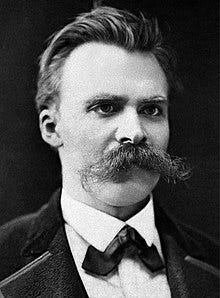
Nietzsche c. 1875, Wikimedia, Creative Commons Free License
Nietzsche saw that science and reason were destroying the traditional and religious forms of meaning and morality that sustained individuals and Western civilization in general. He saw this “death of God” as a necessary step in the moral evolution of humanity, but also as a great crisis that must be overcome. This crisis manifested as passive nihilism — a state of existential despair and anomie. Nietzsche was gravely concerned that if left unchecked, this crisis could destroy European civilization.
Passive nihilism, according to Nietzsche, is characterized by a sense of resignation, hopelessness, and the negation of life’s meaning. It arises when individuals confront the collapse of traditional meaning, values, beliefs, and morality, without offering alternative perspectives. Passive nihilism is marked by a disengagement from life, a sense of despair, and a loss of purpose — essentially, the denial of the will to live and the will to power.
For Nietzsche, the archetypal passive nihilist was his old respected professor, Arthur Schopenhauer, who adopted the Buddhistic view that denying the will to live was the path to liberation from suffering.
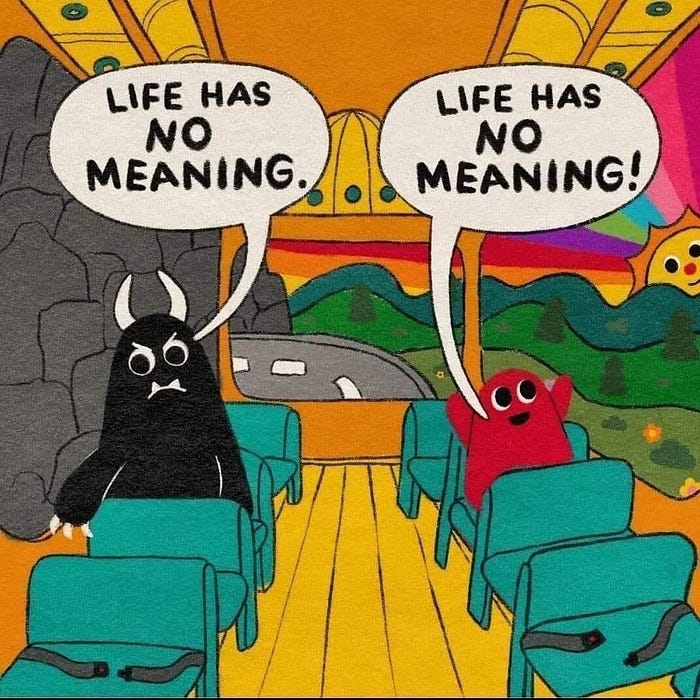
In contrast, Nietzsche describes active nihilism as a transformative response to the crisis of meaning — the will to power. Active nihilism, according to Nietzsche, involves a critical questioning of existing values and the courage to create new ones. It embraces the recognition of life’s inherent meaninglessness (existential nihilism), but sees it as an opportunity for self-empowerment and authenticity. Nietzsche argues that active nihilism can lead to the affirmation of life on one’s own terms and the creation of new values based on individual will and creativity.
I teach you the overman. Man is something that is to be surpassed. What have ye done to surpass man? All beings hitherto have created something beyond themselves: and ye want to be the ebb of that great tide, and would rather go back to the beast than surpass man? — Friedrich Nietzsche, Thus Spoke Zarathustra, Zarathustra’s Prologue, #3
As an atheist and antitheist (with regard to belief in personal deities) Nietzsche did not desire a descent back into the superstition of the past. Instead, he responded to the problem of passive nihilism by advocating the creation of new values and alternative sources of meaning. In Nietzsche’s view, art plays a crucial role in this transformative process. He saw art as both a powerful means to bring down the edifice of society’s decaying values, and as a way to construct new ones that would replace them.
In a hundred years it’s likely no one will know who you were, or anything you did.
Keeping adding years and the probability decreases even more.
Unless you are some Hegelian world historical figure, your identity will be swallowed by the abyss of time in a couple centuries for sure.
Even if you are some kind of big wig, you will still be forgotten in a cosmic blink of an eye. But so will all of your fuck ups, and all of your worries and pain.
These are some of the primary implications of existential and moral nihilism. In other words, the fact that we have no good epistemic reasons to believe that there is any inherent reason we are here on this rock in space, that we will somehow survive death, or that there are any objectively naughty or nice acts.
Some may lament the supposed pointlessness or futility of living a temporary life in a meaningless universe, but those of us who are active nihilists say au contraire! Realizing that you are living without a cosmic boss, without some universal rules, and realizing that you won’t always be burdened by existence is fucking liberating! Hell, it can even be joyous at times — joyous nihilism.
Without a belief in inherent meaning or moral values, we are free to live authentically and creatively. We can pursue our own goals and desires — unburdened by the pressure to conform to others’ expectations.
What’s the alternative?
A life with imposed meaning? If life had inherent meaning it would mean that someone or some thing imposed this meaning on you.
For the traditionally religious this means that meaning is imposed on you by an all-powerful boss. He / she / it sets the rules, and it’s “obey, or else…”
Imagine kissing some tyrannical god’s ass for 80 years in hopes that you can kiss his ass for an eternity? And if you piss off daddy he hands you off to someone else to get punished. I don’t know about you, but that’s not my kink…even if it was, I think it would get old.
In light of this, the one thing that should really matter to us is enjoying this one life — the only one we know we get. (Some of us might also add “making the world a better place for all”, but that is up to you.)
This doesn’t mean we should just do whatever: kill, maim, pillage, etc. We are social animals, and we evolved moral impulses that generally prevent us from wanting to do this, and they punish us with guilt or shame when we do.
Even if we don’t happen to have these impulses, or don’t feel compelled by them, there are practical, self-interested reasons not to be too naughty as well. Do you want to worry about the long arm of the law, or somebody hellbent on revenge?
Epicurus realized this 2,000+ years ago. He understood there was no objective reason to act in a certain way, but he knew it was in everyone’s best interest to be reasonably virtuous.
This doesn’t mean you have to perpetually self-flagellate over your screw-ups (this wouldn’t do you, or anyone else, any good), but you should learn from them and start living in accordance with your values / Epicurean enlightened self-interest before you make a mess of your life.
But even if you have made a big mess of your little life, it’s never too late to start living the sort of life you think you should. Take care of yourself and your companions in misery, and try to have fun until you buy the proverbial farm.
This short essay must be prefaced by stating that the Ataraxist life philosophy is indebted to Stoic insights. Many elements of Stoic wisdom are incorporated into our core principles and our practical philosophy. However, it is essential to recognize that Stoicism, even in its contemporary interpretations, has significant flaws. I will outline them, in brief, below.
Stoicism can be seen as a form of quietism (passive acceptance of the status quo without desiring or trying to change things).
Stoicism, going back to early founders like Epictetus, holds that one should passively accept what happens or “what is” as divinely mandated fate. This belief stemmed from the ancient Stoic notion that the universe is ordered by a vague cosmic intelligence known as the logos. This perspective has persisted, to some extent, in modern Stoicism.
Roman Emperor and Stoic, Marcus Aurelius
Compare this with another major Ataraxist influce: David Pearce’s suffering abolitionism. Pearce’s suffering abolitionist philosophy holds a more rational or parsimonious / scientific view of the nature of reality, seeing the circumstances of our existence as contingent facts. In other words, “what is” is not predetermined by a divine intelligence and should not be considered necessary or immutable; this view implies that we should actively work to change the unfavorable circumstances we find ourselves and others in. Both Pearcean suffering abolitionism and Ataraxism posit that we should strive to eliminate intense involuntary suffering throughout the universe — even by intervening in “nature” (see Reprogramming Predators for an ambitious example of this).
Some defenders of Stoicism will surely point out that one of the Stoic virtues is justice (social justice), and that the Stoics never intended for us to simply accept injustices in the world. It is challenging, however, to reconcile this with the pantheistic beliefs of ancient Stoics or the amor fati sloganeering of many modern Stoics. Moreover, it seems that the radical interventions proposed by Pearce and others do not resonate strongly with many Stoics. In fact, many Stoics adhere to the macho notion that suffering is necessary for character development, disregarding alternative means to cultivate character or wisdom. Also, consider that the issue of vegetarianism / veganism / animal rights is hotly debated within Stoic circles. This is likely due to the fact that Stoic ethics, unlike Ataraxist ethics, are not sentiocentric, and because many Stoics still seem to worship “nature”, and what is considered natural (see the appeal to nature fallacy), even if they do not see divinity or teleology behind it (see the Stoic Massimo Pigliucci on vegetarianism contra the Stoic Jeremy Corter on vegetarianism).
The Stoic concept of amor fati strikes me as odd, not only because this slogan is borrowed from Nietzsche — who was very critical of the Stoics and Stoic pantheism / ethics in particular — but also considering that various informal polls indicate that the majority of modern Stoics are atheists or agnostics. However, it does seem like many of these modern Stoics are conflating the passive acceptance of ancient Stoics with modern psychotherapeutic “reframing” — that is, attempting to view problems through a different, more positive perspective, or attempting to find possible positive aspects or opportunities within unfortunate states of affairs.
2. Ancient Stoicism was based on metaphysical speculation (forming beliefs without relying on reliabilist or evidentialist epistemic justifications), and this memetic baggage continues to manifest in various ways.
As mentioned earlier, ancient Stoicism was built on the belief that the universe is ordered by divine reason, known as the logos. According to this view, every event that happens or has happened is necessary because it was determined by an intelligence greater than our own. While the Stoics didn’t believe in a personal god like Christians do, they considered the universe itself to be God — that is, pantheism, or the belief that God is everything.
Although it appears that most modern Stoics are atheists or agnostics, many still hold onto the pantheistic ideas of ancient Stoicism. While I find Stoic pantheism to be much less problematic than the dogmatic theism of traditional religions, it can still have insidious effects, such as inspiring quietism or, more generally, fostering fatalism, status quo bias, or passivity.
On the other hand, Ataraxism is based on a parsimonious and scientific view of reality. It rejects the use of metaphysical speculation to shape our beliefs or guide our actions. While there may be a place for personal exploration and hypothesis formation involving metaphysical speculation, the life philosophy of Ataraxism is not grounded in such speculation. We do not allow it to dictate our approach to life.
3. Stoicism is often associated with a rigid or simplistic moralism.
Stoic morality, as preached by many followers, can appear overly rigid or simplistic. The focus on the four cardinal virtues (moderation, courage, justice, and wisdom) as the sole determinants of flourishing / ethics may neglect other essential elements, such as love, aesthetic appreciation, or the pursuit of personal sources of meaning. These virtues, of course, are very open to interpretation, which on one hand may be a good thing — to avoid rigidity — but, on the other hand, their vagueness means that they do not offer a great deal of determinacy or guidance in ethical situations.
In comparison, it could be argued that the Epicureans adopted a more sensible and pragmatic approach to morality. They believed in living justly because doing so serves one’s own well-being, but they also considered that happiness usually requires more than living a strict moral life.
Conclusion
In contrast to traditional pantheistic Stoicism, Ataraxism eschews metaphysical speculation and does not hold that one should simply accept the way the world is. We agree with the Stoics in holding that one should accept what they cannot control (see the “dichotomy of control”), but the vestiges of ancient Stoicism seem to engender a sort of passivity which may lead individuals to accept things that they can, or could, exert some control over.
Ataraxism also steers clear of rigid or simplistic moralizing. Reducing the “good life” to living virtuously is to neglect the complexity and various sources of meaning and pleasure that life has to offer. Ataraxists agree that attempting to live ethically is a necessary element to flourishing, but we do not believe that this is all that is required. We also do not believe that morality can be reduced to vague virtues. Our ethical commitments are also somewhat open to interpretation, but they are more detailed in explanation.
The concept of the state of nature has long been debated in political philosophy; the state of nature describes the hypothetical or actual condition individuals and groups existed in prior to the formation of formal governance or social contracts. On some views of the state of nature this condition was marked by conflicting interests and a perpetual violent struggle between individuals and groups. While modern, technologically-developed societies have developed norms and social contracts that facilitate relatively harmonious, rights-based interactions among humans, a stark contrast remains when it comes to our relations with non-human animals.
In this essay, I argue that instead of relying solely on ethical persuasion or vegan lifestylism to revolutionize our treatment of animals, we should focus more on abolishing the human-animal state of nature by advocating technological advancements such as in-vitro meat, alternatives to animal research, animal-free entertainment, and substitutes for animal products. By advocating for and embracing these innovations, we can transcend the violent state of nature that characterizes the status-quo of human-animal relations.
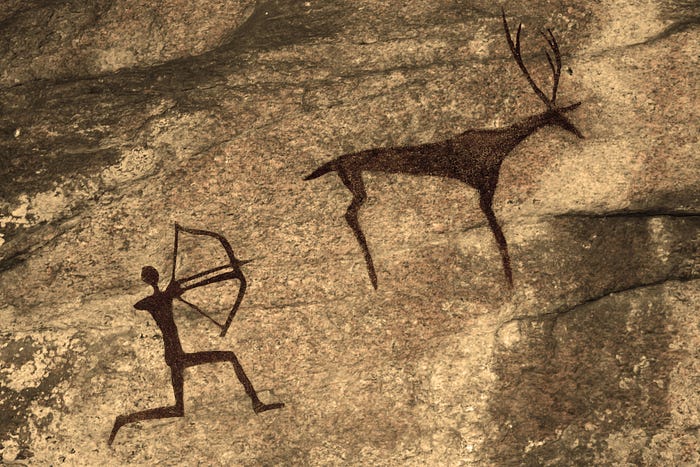
Hunter-gatherer Cave Painting — Aleksander Gerasimov
The State of Nature in Human Relations
The first well-known theorist to describe a state of nature characterized by violent conflict was Thomas Hobbes. He referred to this state as the bellum omnium contra omnes, or the “war of all against all.” Hobbes’ theory finds some support from paleoanthropological research (which is discussed in depth here, along with contrary views). According to many political theorists, the emergence of civilized society played a significant role in transitioning from the violent state of nature to a more peaceful order. This transition was facilitated by the establishment of centralized authority that could enforce the laws associated with the social contract.
However, what is often overlooked is the impact of technological advancements, particularly in agriculture, on these civilizational developments. Civilization and the concept of a social contract did not arise spontaneously; instead, technological progress created conditions that enabled the development of agriculture and reduced scarcity. These advancements allowed for the formation of stable and settled societies (the alignment of previously conflicted interests), which in turn facilitated the creation of systems aimed at decreasing interpersonal and inter-tribal violence.
It is my view, then, that technological development is the primary driver of revolutionary changes which eliminate prior conditions. This is essentially the same view taken by Karl Marx in his theory of historical materialism.
The State of Nature in Human-Animal Relations
In our present reality, human interests are usually in conflict with the interests of non-human animals. In other words, a relatively one-sided Hobbesian state of nature prevails in our treatment of non-human animals due to the fundamental conflict of interests and the imbalance of power between these two general groupings. Most non-human animals are subject to exploitation and intense suffering en masse as a result of animal research, animal entertainment, farming (especially industrial farming, also known as “factory farming”) and hunting, fishing, or trapping.
Animal rights advocates have traditionally argued that animal exploitation and harm results from our general indifference to animal suffering, rather than this state of nature / conflict of interests. This view ignores the fact that human survival necessitated killing and exploiting animals for food, clothing, and other needs for the vast majority of our species’ existence— and that this necessity still exists everywhere except in the developed nations of the world, or, at the least, in warm climates that allow for diverse plant-based agriculture.
These necessities guided our evolved psychology as well. Not only did necessity dictate that we not seriously consider the interests of non-humans, we also would not have survived if we evolved to feel deep compassion for those outside of our immediate sphere of similarity and shared interests. Compassion for non-human animals seems to require a high degree of cognitive empathy — something which our ancestors, and many of our contemporaries do not prioritize or have the time to cultivate in depth.
Returning to the pragmatism of a vegan lifestyle, even in the developed world adopting such a lifestyle is debatably difficult. For some individuals a vegan diet may not be sufficient for their nutritional needs, and even healthy individuals on a vegan diet require supplementation of certain nutrients like vitamin B12, and omega-3 fatty acids. These challenges are evidenced by research which indicates that most vegans / vegetarians go back to eating the animal products they chose to stop consuming. It may be argued, then, that the state of nature still persists to a considerable degree even in the developed world.
As long as a conflict of interests exists even those of us who are deeply concerned about non-human animals are forced to compromise our principles. For example, even the most hard-core vegans engage in self-interested activities which they know to cause indirect or direct harm to non-human animals (e.g., purchasing products from companies that invest some of their capital in animal agriculture, using drugs that were developed using animal research, killing problematic “pests”, etc.).
Technological Advancements as Agents of Change
As the suffering abolitionist philosopher David Pearce argues, to transcend this state of nature, we must look beyond traditional approaches centered on ethical persuasion alone. Technological advancements offer immense potential to reshape our relationship with non-human animals and establish a more sustainable future with less intense suffering.
In-Vitro Meat and Animal-Free Alternatives:
In-vitro meat, also known as cultured meat or cellular agriculture, holds the promise of providing a sustainable and ethical alternative that satisfies human dietary preferences and nutritional needs without harming animals en masse or devastating the environment, as animal agriculture does. By investing in and advocating for cellular agriculture, we can force agriculture corporations to adapt or fail. Additionally, advancements in plant-based alternatives, such as meat substitutes and dairy-free products, offer viable options to replace animal-derived foods without compromising taste or nutrition.
Alternatives to Animal Research and Entertainment:
Emerging technologies are also paving the way for alternatives to animal research and entertainment. Innovations like organs-on-chips, computer modeling, and in-silico testing methods provide alternatives to traditional animal testing, reducing the need for animal experimentation while still ensuring the safety and efficacy of products. Likewise, virtual reality exhibits offer engaging and cruelty-free alternatives to zoos, promoting empathy and awareness without exploiting or harming sentient beings.
Transcending the State of Nature
By embracing these technological advancements, we can create the preconditions which makes it feasible for us to abolish the state of nature which characterizes our current human-animal relations. Focusing on the development and adoption of these alternatives allows us to address the root causes of animal exploitation and suffering, bypassing the need to rely solely on ethical persuasion — which has been limited in its effectiveness, not only on this issue, but with regard to other moral issues such as slavery. [Consider that it was not just the ethics of slavery abolitionists that ended mass slavery; rather, it is likely that the technological means to industrialize production and use wage slaves (rent laborers) instead of chattel slaves (own laborers) was a greater factor in the abolition of slavery — at least in the US.]
Rather than relying solely on convincing others of the soundness of vegan or animal rights ethics, we should embrace technological advancement as a transformative force that enables us to transcend the state of nature and forge a realistic path toward animal liberation.