In the gospels we find in Jesus’ words and deeds some highly noble ethical precepts¹ and acts of beneficence, but also some of the most vile aspects of Judeo-Christian theology².
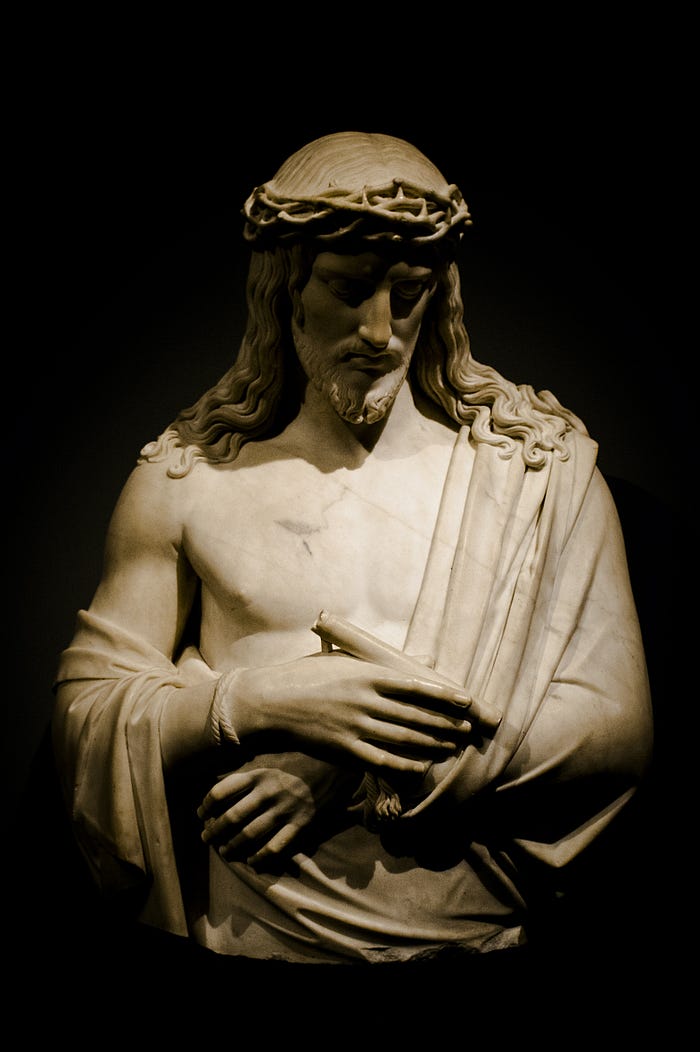
Jesus preached about the hypocrisy of rigid moralism and the importance of understanding and compassion in the story of the adultress³, but he also preached, in many instances, about eternal damnation, with vivid descriptions of never-ending torture, unquenchable flames, and gnashing of teeth.⁴
On the traditional religious view of Christianity this paradox is ultimately irreconcilable. In spite of the attempts of religious apologists and theologians, the idea of an all-loving, all-knowing, and all-powerful god cannot be reconciled with the conception of a universe where sentient beings not only suffer on Earth, but also, potentially, in an eternal hell realm, where the suffering is presumably much worse.
For non-believers the good of Christianity is usually discarded with the bad, unfortunately. (The good being the many admonishments in favor of understanding or forgiveness and against sanctimonious moralism; and that Christianity represented a progressive evolution of morals, a widening of the sphere of concern from the tribe to all persons—even those which you vehemently disagree with—which is best illustrated in the parable of the good Samaritan.)
A rationalist view that seeks to understand the genesis and importance of cultural myths circumvents the need to resolve this paradox. Such a view discards superstition and recognizes that myths are rarely wholly coherent. This view recognizes and preserves the good of Christian mythology, since it represents one of the most important shifts in Western morality—away from strict divine command moralism and toward compassionate humanism. In this view, the Biblical story of Jesus is mostly legendary, and it represents what we might call an archetype, in Jungian terms, rather than an accurate biography of a historical figure.
The symbolism of Jesus dying for humanity, a humanity that essentially votes to put him to death, is powerful, and it illustrates the perniciousness of sanctimonious groupthink—a social phenomenon which continues to inspire anger, hatred, persecution, and vindictive punishment in our time.
Our global society needs the example of Jesus more than ever—not the Jesus of religion, but the myth of the magnanimous and compassionate hero who forgave sinners and enemies, and criticized self-righteous dogmatists; the Jesus who, like Socrates, died in noble defiance of the hatred of the mob.
- See the Parable of the Good Samaritan; Galatians 5:14; Luke 6:31.
- This contrast is exemplified by Matthew 35:31–46; in this passage there is a beautiful and noble sentiment about taking care of “the least” of humanity (those without significant social status, those who are suffering the most), and then, in the latter part, Jesus is again discussing the hellfire that awaits the majority of humanity.
- Incidentally, this passage is seen by most scholars as being an interpolation — a piece of text added to the original canon at a later date. However, it seems plausible that if Jesus existed as a historical person (rather than a purely legendary figure), which is debatable, then such a story is indicative of his character. Regardless, this has been incorporated as a fundamental part of the Jesus mythos.
- Some Christians interpret these passages about Hell to be metaphorical, however, this interpretation does not seem plausible due to the fact that in many cases the language seems to imply literal meaning. For more on the metaphorical interpretation see the religious scholar Bart Ehrman’s work.