The concept of the state of nature has long been debated in political philosophy; the state of nature describes the hypothetical or actual condition individuals and groups existed in prior to the formation of formal governance or social contracts. On some views of the state of nature this condition was marked by conflicting interests and a perpetual violent struggle between individuals and groups. While modern, technologically-developed societies have developed norms and social contracts that facilitate relatively harmonious, rights-based interactions among humans, a stark contrast remains when it comes to our relations with non-human animals.
In this essay, I argue that instead of relying solely on ethical persuasion or vegan lifestylism to revolutionize our treatment of animals, we should focus more on abolishing the human-animal state of nature by advocating technological advancements such as in-vitro meat, alternatives to animal research, animal-free entertainment, and substitutes for animal products. By advocating for and embracing these innovations, we can transcend the violent state of nature that characterizes the status-quo of human-animal relations.
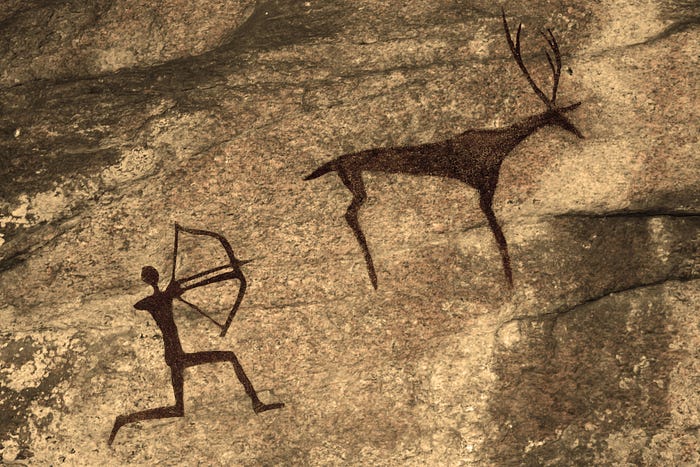
The State of Nature in Human Relations
The first well-known theorist to describe a state of nature characterized by violent conflict was Thomas Hobbes. He referred to this state as the bellum omnium contra omnes, or the “war of all against all.” Hobbes’ theory finds some support from paleoanthropological research (which is discussed in depth here, along with contrary views). According to many political theorists, the emergence of civilized society played a significant role in transitioning from the violent state of nature to a more peaceful order. This transition was facilitated by the establishment of centralized authority that could enforce the laws associated with the social contract.
However, what is often overlooked is the impact of technological advancements, particularly in agriculture, on these civilizational developments. Civilization and the concept of a social contract did not arise spontaneously; instead, technological progress created conditions that enabled the development of agriculture and reduced scarcity. These advancements allowed for the formation of stable and settled societies (the alignment of previously conflicted interests), which in turn facilitated the creation of systems aimed at decreasing interpersonal and inter-tribal violence.
It is my view, then, that technological development is the primary driver of revolutionary changes which eliminate prior conditions. This is essentially the same view taken by Karl Marx in his theory of historical materialism.
The State of Nature in Human-Animal Relations
In our present reality, human interests are usually in conflict with the interests of non-human animals. In other words, a relatively one-sided Hobbesian state of nature prevails in our treatment of non-human animals due to the fundamental conflict of interests and the imbalance of power between these two general groupings. Most non-human animals are subject to exploitation and intense suffering en masse as a result of animal research, animal entertainment, farming (especially industrial farming, also known as “factory farming”) and hunting, fishing, or trapping.
Animal rights advocates have traditionally argued that animal exploitation and harm results from our general indifference to animal suffering, rather than this state of nature / conflict of interests. This view ignores the fact that human survival necessitated killing and exploiting animals for food, clothing, and other needs for the vast majority of our species’ existence— and that this necessity still exists everywhere except in the developed nations of the world, or, at the least, in warm climates that allow for diverse plant-based agriculture.
These necessities guided our evolved psychology as well. Not only did necessity dictate that we not seriously consider the interests of non-humans, we also would not have survived if we evolved to feel deep compassion for those outside of our immediate sphere of similarity and shared interests. Compassion for non-human animals seems to require a high degree of cognitive empathy — something which our ancestors, and many of our contemporaries do not prioritize or have the time to cultivate in depth.
Returning to the pragmatism of a vegan lifestyle, even in the developed world adopting such a lifestyle is debatably difficult. For some individuals a vegan diet may not be sufficient for their nutritional needs, and even healthy individuals on a vegan diet require supplementation of certain nutrients like vitamin B12, and omega-3 fatty acids. These challenges are evidenced by research which indicates that most vegans / vegetarians go back to eating the animal products they chose to stop consuming. It may be argued, then, that the state of nature still persists to a considerable degree even in the developed world.
As long as a conflict of interests exists even those of us who are deeply concerned about non-human animals are forced to compromise our principles. For example, even the most hard-core vegans engage in self-interested activities which they know to cause indirect or direct harm to non-human animals (e.g., purchasing products from companies that invest some of their capital in animal agriculture, using drugs that were developed using animal research, killing problematic “pests”, etc.).
Technological Advancements as Agents of Change
As the suffering abolitionist philosopher David Pearce argues, to transcend this state of nature, we must look beyond traditional approaches centered on ethical persuasion alone. Technological advancements offer immense potential to reshape our relationship with non-human animals and establish a more sustainable future with less intense suffering.
In-Vitro Meat and Animal-Free Alternatives:
In-vitro meat, also known as cultured meat or cellular agriculture, holds the promise of providing a sustainable and ethical alternative that satisfies human dietary preferences and nutritional needs without harming animals en masse or devastating the environment, as animal agriculture does. By investing in and advocating for cellular agriculture, we can force agriculture corporations to adapt or fail. Additionally, advancements in plant-based alternatives, such as meat substitutes and dairy-free products, offer viable options to replace animal-derived foods without compromising taste or nutrition.
Alternatives to Animal Research and Entertainment:
Emerging technologies are also paving the way for alternatives to animal research and entertainment. Innovations like organs-on-chips, computer modeling, and in-silico testing methods provide alternatives to traditional animal testing, reducing the need for animal experimentation while still ensuring the safety and efficacy of products. Likewise, virtual reality exhibits offer engaging and cruelty-free alternatives to zoos, promoting empathy and awareness without exploiting or harming sentient beings.
Transcending the State of Nature
By embracing these technological advancements, we can create the preconditions which makes it feasible for us to abolish the state of nature which characterizes our current human-animal relations. Focusing on the development and adoption of these alternatives allows us to address the root causes of animal exploitation and suffering, bypassing the need to rely solely on ethical persuasion — which has been limited in its effectiveness, not only on this issue, but with regard to other moral issues such as slavery. [Consider that it was not just the ethics of slavery abolitionists that ended mass slavery; rather, it is likely that the technological means to industrialize production and use wage slaves (rent laborers) instead of chattel slaves (own laborers) was a greater factor in the abolition of slavery — at least in the US.]
Rather than relying solely on convincing others of the soundness of vegan or animal rights ethics, we should embrace technological advancement as a transformative force that enables us to transcend the state of nature and forge a realistic path toward animal liberation.