Essays, Articles, Videos & News

Category: Culture War

My Thoughts on the Charlie Kirk Assassination

I intend this to be a brief post since I already wrote about my views on political violence in general here.

I am writing this as a form of self-therapy to express my thoughts and emotions about this event.

For me, writing is both a therapeutic form of expression, and a way of organizing and deliberating on my own thoughts. So, I write more for myself than for an audience — which is a helpful way of framing things, since I will probably never be a celebrated “great writer.” Accepting that writing is more for me than for reaching others, or being applauded by others, is a great way to keep me devoted to this beneficial activity. If I thought otherwise — for example, if I thought one should only write if they were exceptionally good at it, or only if they received popular praise for their work — then I would have quit long ago and lost the personal benefits that I gain from writing. Framing things in this way also keeps me authentic — it keeps me from trying too hard to fit into what I think other people want from a writer.

In this case, I found it helpful to write on the topic because I have been somewhat distressed by having to listen to people celebrate the violent death of another person. Given the nature of my professional work, I have mostly kept this to myself, but I wanted to be able to discuss how I feel and why I think this (people celebrating violence) is very concerning.

Photo by Phoebe T on Unsplash

To briefly consider objections, I understand how some people might typically respond to my concern. They might mention other contemporary events that are more harmful in terms of a casualty count (the fallacy of relative privation — a fallacious appeal to “worse problems”), or they might appeal to specious utilitarian reasoning that argues that “hate speech” causes more harm than one death (operating on the false premise that Kirk engaged in hate speech, and assuming the conclusion that using violence to stifle hate speech is less net harmful than hate speech). I don’t intend to seriously consider these objections here, however, if anyone wanted me to expand on my parenthetical responses to these I could do that in the comments.

To return to my concern, I think celebrating any person’s death (outside of some extreme case circumstances) is possibly indicative of indoctrination with toxic ideology, or in some cases, psychopathology. On a human level, I can understand the urge or initial emotion of schadenfreude, relief, or even sadistic/vengeful satisfaction — but I consider these to be harmful impulses that are not in our, or society’s, best interest to assent to. An adaptive philosophy of life can instruct us on how to refrain from automatically reacting to initial thoughts, emotions, and other impulses, but instead to delay our reaction so that we are able to give critical consideration to whether these thoughts/impulses are rational or in-line with our values. (If you are interested in reading more about why I think toxic ideology is harmful to the individual and to society, and why adaptive philosophies of life are beneficial you can read my article on Helpful Philosophies of Life vs. Toxic Ideologies.)

Given how much of this sadistic celebration of Kirk’s death that I have witnessed in my personal life, my professional life, and in social media / on the news, I think there is prima facie justification to consider the possibility that toxic ideology is pervasive in our society and in the world.

This is an obvious concern because toxic ideology that compels individuals to violence could pose an existential threat to our species. We live in the age of weapons of mass destruction, and the same hateful ideology that would compel one individual to assassinate someone could compel another to engage in mass terrorism. In the worst case scenario this mass terrorism would involve the use of CBRN (chemical, biological, radiological, or nuclear) weapons — we might also add electronic or cyber weapons to this list. Terrorist events are not likely to be existential threats in themselves, but they could plausibly contribute to instability and conflict that could escalate to regional and global levels. Even more concerning is the fact that in some cases we see the ruling factions of entire nations being corrupted by these toxic ideologies.

It is largely irrelevant, but in the spirit of full-disclosure, I should note that I did not agree with Charlie Kirk on many issues; from what I have seen of his videos I did not always like his approach to debating, but I mostly found him to be respectful and reasonable — certainly not the hate monger that many have painted him to be. As someone committed to philosophical investigation and discourse, I am opposed, in the strictest sense possible, to any attempt to stifle free expression, and any use of violence that is not legitimately last-resort defensive in nature.

In contrast to amoral or antisocial toxic ideologies that view acts of violence against “enemies” as a legitimate tool of change, an adaptive philosophy of life provides the individual with ethical, epistemic, and practical guidance. An adaptive philosophy of life serves to inoculate the individual against indoctrination or passively accepting erroneous or biased information, and it also inoculates against aggression by restricting the use of violence to only defensive or last resort situations. [Note: I wrote more on this here, on the Ataraxism website.]

My concern extends beyond the realm of pragmatic societal concerns, however. I am also concerned for the psychological wellbeing of people who celebrate violence — those who romanticize hate and anger and who hold onto hate and anger. When I encounter people that are stuck in this way of thinking (as I once was myself) I always think of the fifth century Buddhist scholar and monk Buddhaghosa’s parable on anger:

“By doing this you are like a man who wants to hit another and picks up a burning ember or excrement in his hand and so first burns himself or makes himself stink” (Visuddhimagga IX, 23).

When we hold onto anger or hate we are not only potentially harming others, we are also harming ourselves. This anger and hatred will come out in other areas of our lives and cause harm — it may come out in our relationships, in our general conduct and thinking, and it will cause us to suffer needlessly.

For me, the celebration of another person’s death is not simply tasteless, it reflects the deeper problem of toxic ideology at work in our culture — ideologies which embrace and celebrate anger and hate. While political, economic, and social factors all play a role in violence, I believe toxic ideology remains one of the most dangerous and corrosive forces we face, both for society and for the psychological wellbeing of individuals.

If nothing else, setting these thoughts to paper reminds me of why I write: not to impress others, but to clarify my own thinking and to resist the pull of anger, resentment, and despair. In this way, writing itself becomes an act of cultivating an adaptive philosophy of life — one grounded in reflection, compassion, and an effort toward understanding.

The Real Cause of Political Violence

Violence has always been a problem in human society. Political violence in particular is both a threat to stable society and, in the nuclear age, a possible low-level existential concern — since we know from historical example that it can lead to large-scale war between nations. In this essay I will argue that “toxic ideology” is one of the primary causes of political violence.

Photo by Mapping Memories Cambodia on Unsplash

Various explanations have been proposed to explain the human tendency for political violence and war. The most common explanatory hypotheses seem to be: human nature, socioeconomic conflict, and religion or ideology. [Note: Other, more minor hypotheses have been discussed, such as genetics, hormonal problems, pharmaceutical interventions, gun control issues, etc., but, for the sake of brevity, I will not consider these here.]

Considering the Hypotheses

Human nature. Violence appears deeply rooted in human nature. Primatologists like Richard Wrangham have extensively documented chimpanzee raiding and lethal aggression that resembles primitive warfare — suggesting that our evolutionary cousins share an innate capacity for organized violence. Human history itself testifies to a long and bloody record of conflict. And yet, there is also evidence that societies may have become less violent over time, at least in terms of large-scale warfare and homicide rates. Steven Pinker, in The Better Angels of Our Nature, argues that the long arc of history bends toward relative declines in violence, even if it never fully disappears. Whether one agrees with Pinker’s optimism or not, human nature alone does not explain the variations we see across different societies and eras.

Socioeconomic conflict. Another explanation for violence is socioeconomic struggle. Material deprivation, inequality, and exploitation create fertile ground for resentment and unrest. These conditions undergird political ideologies that promise radical transformation or retribution. Collectivistic movements, populist uprisings, and ethno-nationalist projects all draw strength from real or perceived economic grievances. Socioeconomic conditions are not the sole cause of violence, but they serve as fuel that ideological leaders can ignite.

Religion and ideology. While religious beliefs and ideologies have undeniably been used to justify or drive violence and war, it is not belief systems in themselves that cause violence. Rather, it is a certain type of belief — what I call toxic ideology. It is usually the combination of religion with toxic ideology — or the adoption of toxic ideology alone — that leads to cruelty and bloodshed.

Toxic Ideology as the Primary Driver of Political Violence

To understand what truly drives political violence, we must look beyond superficial or single-cause explanations, and our analysis must be multidimensional (that is, it must account for the complex interplay between the multiple factors involved). The multidimensional perspective I am proposing accepts that all of the above factors are a piece of the overall picture of causation, however, I argue that toxic ideology is one of the primary or leading causal factors, and the one we can most readily do something about.

At the heart of the issue is not simply belief, but the difference between adaptive (healthy on the psychological and sociological level) and toxic philosophies of life. An adaptive philosophy of life provides individuals with meaning, direction, and ethical grounding. It ideally contains three essential components (in a grounded or coherent form):

  • metaphysics (a basic account of reality and our place in it),
  • An epistemology (a standard for deciding what counts as knowledge), and
  • normative ethical theory (principles that guide action).

At the very least, an adaptive philosophy of life ought to contain a coherent and reasonably prosocial (neutral or beneficial to others/society) normative ethical theory and epistemic norms that contain mechanisms for error correction. Without this, people are left adrift and vulnerable to adopting maladaptive frameworks that confuse our thinking, justify cruelty, and erode human compassion. [Note: I wrote more extensively on adaptive philosophies of life vs. toxic ideologies here.]

By contrast, a toxic ideology operates like malware in the human mind. It often rests on unfalsifiable dogmas, fosters rigid black-and-white thinking, and rationalizes violence against outsiders. Toxic ideologies can be secular or religious, “Left-wing” or “Right-wing.” Toxic ideologies are dangerous because they promote a divisive and rigid us-against-them ethical framework, or because they lack an adaptive ethical framework altogether. Amoral toxic ideologies reject intersubjective principles of fairness and compassion and instead embrace the view that “the ends justify the means.”

Ethno-nationalist extremism (e.g., historical forms of fascism that engaged in mass killing), collectivistic extremism (e.g., historical forms of socialism or communism that engaged in mass killing), and certain extremist religious movements engaged in massive atrocities by adopting ends-justify-the-means thinking, and through mobilizing ressentiment, enforcing conformity, and dehumanizing opponents. Such systems do not merely fail to prevent violence — they sanctify it as a tool of purification, revenge, or revolution.

Seeing toxic ideology as one of the primary causes of political violence also challenges the common claim that “religion causes violence.” Religions (outside of those enforced by oppressive theocratic regimes, or new religious movements that haven’t been subjected to centuries-long selective processes that would filter out their most maladaptive elements ) are typically broad and flexible — they can be interpreted in adaptive or maladaptive ways. On the one hand, religious traditions often provide moral frameworks, rituals of compassion, and communal support that strengthen psychological and social well-being. On the other hand, when combined with toxic ideology — or absolutist certainty — religious belief can become divisive, a tool of oppression and violence. In the developed world, it is usually not religion itself, but religion plus toxic ideology, that generates the conditions for cruelty and violence.

Conclusion

If we want to understand — and ultimately reduce — human violence, we must learn to distinguish between adaptive and toxic philosophies of life. As Nietzsche warned, the “death of God” did not eliminate toxic dogmas but cleared the way for new, even more virulent secular ideologies to fill the void — often with catastrophic consequences. Conversely, as modern psychology suggests, adaptive frameworks grounded in rational inquiry, unconditional acceptance, and unconditional compassion can foster resilience, tolerance, and peace.

The problem of violence will likely never be solved — that is, until we transcend our current status quo biology — but it certainly will not be solved by abolishing religion, capitalism or through other simplistic and illusory solutions.

The use of violence proliferates when human beings, searching for meaning and stability, adopt toxic ideologies that confuse moral and general reasoning. The antidote is not dogmatic certainty but philosophical depth: coherent frameworks that integrate metaphysics, epistemology, and ethics in ways that promote humility, compassion, nuance, and balance / flexibility. Only by cultivating adaptive philosophies of life — whether secular or religious — can societies inoculate themselves against the malware of toxic ideology and the violence it engenders.

Helpful Philosophies of Life vs. Toxic Ideologies

A philosophy of life is essentially a cognitive framework — a set of principles that guide our thoughts and actions, and, in a less obvious way, our emotions. A coherent and adaptive (psychologically helpful) philosophy of life is critically important to the individual, and, through its distal effects, to society. In addition to providing individuals with ethical and practical guidance, it also helps a person to develop a sense of meaning, purpose, direction, and inspiration.

Additionally, a philosophy of life can foster a sense of connection to others who share similar values — serving as a source of identity and psychological stability. Without at least a rough working philosophy of life, individuals may find themselves adrift — lacking the direction needed to make wise decisions, endure hardship, and pursue self-actualization.

However, not all cognitive frameworks are equally beneficial. Some ideologies or religious systems may be “toxic” to the individual and to society as a whole — in a way that is analogous to how malware disrupts a computer system. Unfortunately, many people adopt toxic ideologies or toxic religious beliefs as their philosophy of life — to the detriment of themselves and society. We see this when people fall into extreme or rigid forms of religious or ideological belief. Often times toxic ideological views may be implicit — for example, a toxic subculture may not explicitly articulate its ideology, but rather signal it in various overt or subtle ways.

While every philosophy of life must rest upon certain “dogmas” or foundational axioms — as Sam Harris argued in one of his early debates with Jordan Peterson — “not all dogmas are equal.” Foundational axioms that are unfalsifiable, metaphysically complex, or disconnected from reason and evidence are more likely to support irrational or harmful conclusions. For example, dogmatic claims such as “divine revelation is the highest form of knowledge,” or “faith is superior to reason in matters of truth,” introduce untestable metaphysical assumptions that violate the principle of parsimony. Because these axioms are not grounded in evidence and logic, they resist revision and they tend to promote absolutistic or black-and-white thinking.

In contrast to these kinds of unfalsifiable or complex dogmas, a foundational axiom of Ataraxist philosophy of life (the philosophy of life I have been developing) holds that “Our understanding of the world is most likely to be accurate and useful when it is grounded in a rational, reliable way of analyzing the best available evidence.” This axiom is metaphysically simple, testable, and self-correcting.

I mentioned the example of dogmatic religion above, but I am not arguing that all religious belief is harmful; in fact, evidence supports the view that it is often beneficial on the individual level — likely because its helpful aspects outweigh its harmful ones, or because individuals adapt their religious beliefs to align with modern, near-consensus secular ethics or personal psychological needs. (Note: Whether a particular religion is adaptive on the individual level depends on a number of factors. The broader question of whether religion benefits society or geopolitical stability lies beyond the scope of this article.)

In addition to being rational and parsimonious, foundational axioms should ideally be helpful — that is, they should align with well-established principles of human flourishing, or at least be revisable in light of new evidence. At a minimum, an adaptive philosophy of life ought to contain a coherent and reasonably prosocial (neutral or beneficial to others/society) normative ethical code and epistemic norms that contain mechanisms for error correction, such as the principle: “No statement should be believed without justification in the form of sufficient evidence or sound reasoning.” This sort of epistemic standard engenders epistemic humility, and helps prevent ideological drift into rigidity, fanaticism, or harm. Put simply, an epistemology grounded in reliable ways of identifying and analyzing solid evidence innoculates the individual against toxic ideology; when a coherent and pro-social ethical code is added, the individual is highly immune to becoming indoctrinated with toxic ideology.

Many ideologies cannot be considered as helpful philosophies of life, either because they contain potentially harmful dogmas, and/or because they lack sufficient structure, in the form of an ethical code or epistemic principles, to guide behavior. Vague ideologies or value systems that emphasize goals without outlining a foundational theory or a rational means to achieve their stated goals are vulnerable to becoming toxic to individuals or society. For example, while feminism may aim for certain valuable goals, it does not, in itself, contain the philosophical foundations to ensure that the movement avoids misandry, and other forms of hatefulness and tribalism. The same could be said of any other goal-focused ideology that lacks a sound philosophical foundation. Similarly, many political and religious ideologies can devolve into hatefulness and promotion of harm if they lack foundational principles that promote reason and unconditional compassion.

Friedrich Nietzsche warned that the collapse of traditional religion — what he called the “death of God” — would leave a moral and spiritual vacuum that modern societies would rush to fill with new, secular ideologies. Without a sound ethical foundation, these ideologies risk becoming toxic secular religions: dogmatic systems that demand conformity and justify persecution.

Nietzsche developed the concept of ressentiment to describe a reactive cultural moral psychology rooted in perceived powerlessness — a festering envy that would engender a mob mentality hatred of those who hold power, or those who are perceived to hold power. Rather than bringing about a more just society, these ressentiment-based mass movements tend to engender a violent inversion of values and perceived power structures — where vengeful condemnation is directed at those who were seen as oppressors. Through the power of the State, the resentful masses enact their mass hatred. In Thus Spoke Zarathustra, Nietzsche famously warned that “the State is the coldest of all cold monsters,” a new idol that claims to embody the will of the people while manipulating them through fear and false virtue. From the struggle sessions of Maoist China to the dogmatic and demagogic excesses of modern cancel culture, we see how social justice movements, which lack philosophical rigor and the restraint provided by a coherent ethical system, can devolve into campaigns of moral absolutism and terror — echoing the very religious zealotry they replaced. The catastrophic death tolls of fascist and communist regimes, driven by such ideological fervor, remain a haunting testament to Nietzsche’s prescience.

As Albert Ellis argued in The Road to Tolerance, a healthy philosophy of life should be grounded in unconditional self-acceptance, other-acceptance, and life-acceptance. These values are not simply moral ideals, but practical cognitive frameworks that promote psychological resilience and ethical conduct. A helpful philosophy of life is rational, self-correcting, empirically grounded, and conducive to human flourishing. Where existing philosophies of life fail to meet these criteria, we would be wise to revise or replace them — and if we are not satisfied with any existing philosophy of life, we may want to consider developing our own.

The Fallacy of IQ Obsessiveness

The Intelligence Quotient (IQ) — as measured by empirically studied and generally accepted tests (most commonly the Wechsler Adult Intelligence Scale or the Wechsler Intelligence Scale for Children) — is one of the most predictive psychometrics available. In psychological jargon we would say that bona fide IQ tests have predictive validity.

Nevertheless, we cannot say that IQ tests have construct validity — that is, we do not know that they truly measure “intelligence”, because we do not have an agreed upon theory or definition of intelligence.

What we can say is that IQ is positively correlated with success in other academic domains, academics in general — and to a lesser degree, with occupational placement in cognitively challenging fields, life expectancy, and income. It would therefore be more fitting to refer to IQ as an academic / life “success” quotient (where success is very narrowly defined).

One could argue that success in academics, or at least the ability to be successful in academics, is a necessary condition for our most intersubjective definitions of intelligence, however, there are flaws with this argument.

To be brief, the biggest flaw with the above argument is that intelligence is a multidimensional and amorphous concept. Even our intersubjective definitions may be missing something that is fundamental to a philosophically sophisticated definition of intelligence.

In order to arrive at a more precise and comprehensive definition of intelligence the meta-discourse must move beyond the operational definition of intelligence that is confined to narrow measures of success. For example, a comprehensive definition of intelligence might include other facets of cognition that are disregarded by currently accepted IQ tests (e.g., creativity, social / emotional cognition, practical intelligence, wisdom, kinesthetic intelligence, knowledge integration, epistemic rigor, etc.).

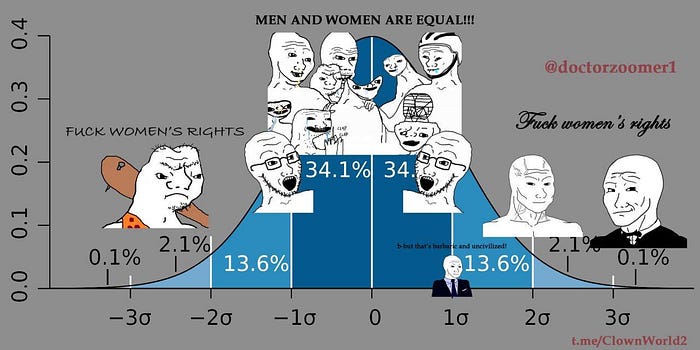
Another major problem with IQ obsessiveness is highlighted by a recent trend seen in counter-enlightenment circles: the mocking of so-called “midwits” — that is, those with average IQ scores.

Meme posted by doctorzoomer1

The general idea here is that our most reflexive human instincts are actually wise. In the above example, the implicit argument goes like this:

Premise 1) People with below average IQs tend to oppose women’s rights.
Premise 2) People with average IQs tend to support women’s rights.
Premise 3) People with above average IQs do not support women’s rights. Conclusion: Therefore, primitive impulses are vindicated by higher order intelligence, and women should not have rights.

According to this line of thinking, it is the persons with average or just-barely-above-average IQ that are confused by their superficial understanding of things; if they were really smart they would understand that there is logic and wisdom in the instincts of those whose thinking is not clouded by the dogma of modern secular progressivism. (The general idea is that those who are smart enough to comprehend ideologies and basic facts — but are not smart enough to think critically and deeply about the world — are confounded by a dearth of knowledge or an inability to integrate knowledge, a lack of comprehension, or by their indoctrination.)

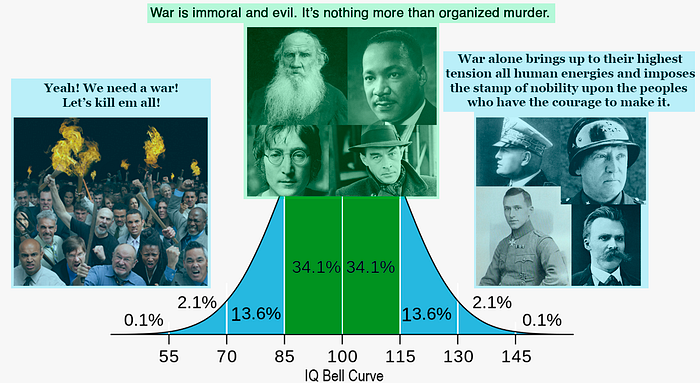
Another example:

Meme posted by connect_government_7 on Reddit

Here the poster is arguing that war is actually a noble endeavor, and that the war frenzy of those the “midwits” consider to be ignorant / stupid is actually wise.

There are a number of problems with the implicit arguments here, but first, I want to concede that there is a kernel of truth here, too. Yes, it seems that in many instances, those with a limited understanding do not recognize the wisdom of our evolved instincts, and instead are led astray by ideology or a merely superficial understanding. Nietzsche was making this claim when he stated, “There is more wisdom in your body than in your deepest philosophy” (Thus Spoke Zarathustra, Part 1, Chapter 4).

However, it is not always the case that our evolved heuristics and impulses are wise, nor is it always the case that individuals with average IQs have only a superficial understanding. The above examples hint at some vague defense of non-meritocratic patriarchy and militaristic fascism, respectively. These are, of course, ideologies that we have prima facie reasons to be skeptical of, just based on their historical record — not to mention the fact that war is an existential threat to our species, and any romanticization of war only serves to bolster this existential risk. [Note: these are just implicit arguments hinted at by the limited symbolic content of the memes; a steelmanned version of these arguments might have more cogency, however, this has not been the case in my experience in online interactions with counter-enlightenment figures.]

These “midwit” memes also consistently commit the fallacy of assuming the conclusion. Is it really the case that most above average IQ individuals support war, oppose women’s rights, believe in God…or whatever else is being claimed? Out of all of the “midwit” memes that I have surveyed they are almost always false — in that, there is either not enough quality data to support their claims, or the data clearly contradict their claims (see Debunking the Meme: Theism and IQ). Likewise, some of the claims made about below average IQ individuals are also dubious.

Another assumed conclusion in these “midwit” memes is that individuals with high IQs have more veridical views or possess more practical or ethical wisdom than individuals with average IQs. While it is likely that a certain degree of g factor intelligence is a necessary condition for rationality or epistemic rigor, it is not clear that above average IQ entails more epistemic rigor in all cases. In other words, a certain amount of intelligence as measured by IQ (presumably, at least average) is a necessary condition for rationality, but intelligence greater than or equal to this level is not a sufficient condition for rationality.

Interestingly, there is some evidence which suggests that higher than average IQ is positively correlated with cluster A traits or cluster A personality disorders (schizotypal, schizoid, paranoid), which are characterized by delusional, eccentric, odd, and / or paranoid beliefs (no link; see Weinberger, Farmer & Keilp, 2002 in the Journal of Clinical Psychology). This data underscores the fact that rationality is sufficient for a certain level of intelligence, but not the other way around (i.e., this sufficient condition is not reciprocal — that is, it is not biconditional). This correlation suggests that neuro-psychological epistemic dysfunction affects a certain segment of the high IQ population (hypotheses that might warrant investigation: problems due to over-confidence; overactive pattern detection/threat detection; an inability to utilize other modes of cognition beyond the analytical mode).

The issue of practical or ethical wisdom and its relationship to IQ would require another article, however, I think a case can be made that high IQ and its positive correlation with autistic traits might result in a delay or impede the development of what is generally considered to be wisdom in some individuals. Nor does IQ account for things like intellectual curiousity, which is necessary for the development of broad crystalized intelligence.

Further, as is evidenced by religious apologetics, and other forms of sophistic lawyering, we sometimes see that a high IQ affords individuals with the ability to rationalize more effectively or to take pleasure in the contrarian challenge of “making the weaker argument stronger” — perhaps for practical or emotional reasons, in addition to the association between high IQ and an affinity for novelty. There are a number of personality factors and cognitive styles that influence whether one places epistemic justifications for belief over pragmatic justifications, and it isn’t entirely clear how these relate to general cognitive ability.

Overall, this is a pretty silly propaganda technique that wouldn’t deserve this much proverbial ink if it weren’t so common. A bit of comical irony is that truly high IQ individuals should be able to spot the shoddy reasoning involved in these memes, so it doesn’t seem that they are likely progenitors. [Note: even high IQ individuals with a problematic epistemology can usually spot simple logical errors readily, and because of this they would seem less likely to include basic logical fallacies in their arguments.]

In summary, the obsession with IQ is misguided, and narrow-minded. In my view, a better way to conceptualize intelligence might resemble personality taxonomies like the Big Five, where cognitive abilities are measured in various domains — including some of those currently ignored by accepted IQ tests — to render a cognitive profile. This approach would be more conducive to acceptance of a variety of cognitive styles, and foster greater sociological understanding and self-knowledge.

Debunking the Meme: Theism and IQ

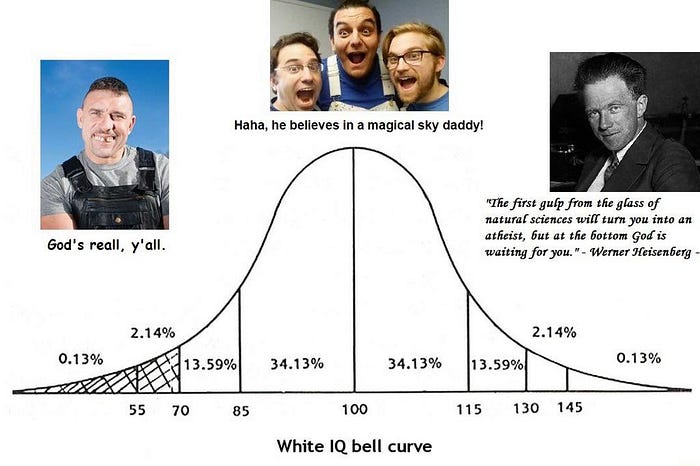
The “midwit” mocking meme below has become stock propaganda used by alt-righters and other counter-enlightenment types (there are many variations, this just happens to be the one I came across today).

It seems to imply that the greater levels of religiosity or theism professed by below average IQ individuals are vindicated by the fact that above average IQ individuals also have higher rates of religiosity or theism.

There are a number of problems with this meme, but the biggest one is that it is simply not true.

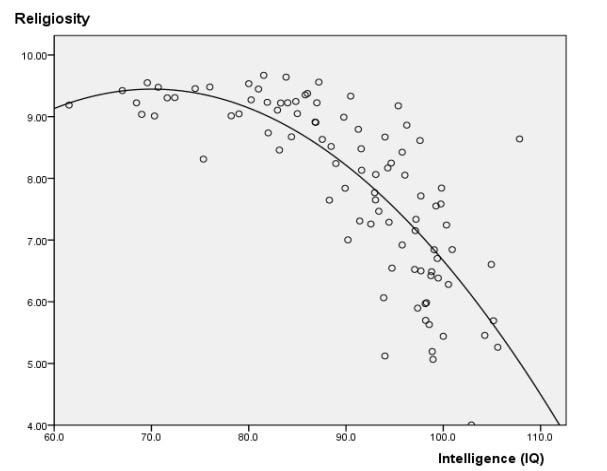
I surveyed psychological and sociological research in several databases to explore this issue. Of all of the rigorous studies I found on IQ and its relationship to religiosity / theism the opposite findings were reported: individuals with above average IQ scores report lower levels of intrinsic religiosity (religious belief, as opposed to religious behavior [e.g., church-going, church involvement] ), theism, and other supernatural beliefs than average or below average cohorts (see Alsan et al., 2020; Kanazawa, 2010; Saroglou et al., 2002; Woellert & Luttig, 2018; Zuckerman et al., 2013).

In other words, religious or theistic belief was negatively correlated with IQ scores — that is, as IQ score rises, religiosity / theism goes down (see the graph below).

Meisenberg et al., 2012

However, let’s make sure we are not strawmanning the implicit argument presented by this meme. In order to avoid this we will steelman it:

Premise 1: Below average IQ individuals report the highest levels of religiosity / theism.

Premise 2: Average IQ individuals report lower levels of religiosity / theism than below average IQ individuals.

Premise 3: Some above average IQ individuals report religious / theistic beliefs.

Conclusion: Therefore, religiosity or theism is not irrational.

This steelmanned version is valid, however, its soundness is questionable due to the complexity of the issue.

For instance, it is important to note that the religious, spiritual, or theistic beliefs of above average IQ individuals tends to be much different than those in the below average IQ cohort.

As discussed in Kanazawa (2010), above average individuals are more likely to have non-conforming or eccentric beliefs. That is to say, the theism or spiritual / religious beliefs professed by above average IQ individuals is much more likely to resemble the nuanced and freethinking views of EpicurusSpinozaEinstein, or Thomas Paine, than the dogmatic and supernatural views of the average Bible-believing religious person.

Other Problems:

The question of whether IQ tests fully capture intelligence (considering we don’t have a robust philosophical definition) is unresolved. Also, it is not clear that we have good reasons to consistently expect more epistemic rigor / rationality from high IQ persons, than from, say, high-average IQ persons. In fact, there is some evidence to suggest that a segment of the high IQ population may be predisposed to neuro-psychological epistemic dysfunction. I discuss both of these issues in my article The Fallacy of IQ Obsessiveness.

References:

Alsan, M., Phillips, M. R., & Wang, Q. (2020). Cognitive ability and religious beliefs: Evidence from the United States. Social Science Research, 95, 102336. https://doi.org/10.1016/j.ssresearch.2020.102336

Kanazawa, S. (2010). Intelligence and religious fundamentalism. Intelligence, 38(6), 669–674. https://doi.org/10.1016/j.intell.2010.06.007

Meisenberg, G., Patel, H., Woodley, M. A., & Rindermann, H. (2012). Is it smart to believe in God? The relationship of religiosity with education and intelligence. Temas em Psicologia, 20(1), 101–120.

Saroglou, V., Delpierre, V., Dernelle, R., & Dapy, X. (2002). Values and religiosity: A meta-analytic review of the nomological network of beliefs. Personality and Individual Differences, 33(5), 757–780. https://doi.org/10.1016/S0191-8869(01)00195-8

Woellert, A., & Luttig, M. (2018). Cognitive ability and religious fundamentalism: Evidence from the UK. Intelligence, 66, 1–7. https://doi.org/10.1016/j.intell.2017.11.009

Zuckerman, M., Silberman, J., & Hall, J. A. (2013). The relationship between intelligence and religiosity: A meta-analysis and some proposed explanations. Personality and Social Psychology Review, 17(4), 325–354. https://doi.org/10.1177/1088868313491624

The Biggest Mistake of the New Atheist Movement

The so-called new atheist movement has mostly died out, however, atheism, and other non-religious views, are continuing to grow. Atheists and other “nones” (those that don’t identify with any religion) are largely disorganized, in that they do not belong to communities or groups that may help represent their interests. This article explains why I believe new atheism, and other atheist movements, have failed to inspire mass affiliation and change minds.

The main mistake of the New Atheist movement, in my view, is that its leading proponents gave off the impression that they considered atheism to be a sufficient substitute for religion (except for Sam Harris, who is trying to build a movement for rational spirituality). Their vision of Utopia seemed to be one in which an educated, rational, and mostly atheistic populace would behave prosocially and with stoic equanimity in creating a world without religious conflict, war, bigotry, hunger, and poverty. This simply is not a psychological reality in our current world.

Atheism offers nothing to replace the ethical, practical, and existential framework that religion provides. It is simply an absence of belief in deities. And the stillborn “atheism plus” movement only offered simplistic “woke” virtue signaling, and the divisive / indignant condemnation of others that is characteristic of these new secular social justice movements — rather than a psychologically informed and philosophically grounded theory of social justice (see SJWs the New Moralists).

Although it may sound pessimistic, I don’t believe we are close to seeing dogmatic religion, and the conflict it inspires, disappear from the world. Realistically, there are many people that need the restraint and scaffolding of religion to act prosocially, and to cope with the existential problems entailed by the human condition. Some societies may collapse without this scaffolding (see Does Religion Increase Moral Behavior?).

Religion also offers benefits in the form of ethical and practical instruction, and a possible community to belong to. While some alternatives to religion (e.g., Humanism, modern Epicureanism or Stoicismsecular Buddhism) also provide these benefits, these worldviews or life philosophies are either too vague (for instance, Humanism) or not well known / developed — in addition to having few, if any, established communities outside of the internet.

Many intellectually sophisticated individuals can lead healthy, acceptably prosocial, and happy lives without religion, but the global community is not ready to give up the opium of the masses, nor would the world necessarily be in better shape if they did — at this point in time. It seems highly plausible that some people need the carrot and stick of religion to stay out of habitual antisocial behavior — on the individual and collective level — and to assuage their existential malaise.

In order to reach something approximating an atheistic Utopia, there are many changes that need to be made in education, reproduction, and our socioeconomic systems, etc., but perhaps most importantly, we need to further build alternatives to religion — such as those mentioned above (see Why It Is Important to Have a Philosophy Of Life).

© 2026 Max Severin

Theme by Anders NorenUp ↑