The Intelligence Quotient (IQ) — as measured by empirically studied and generally accepted tests (most commonly the Wechsler Adult Intelligence Scale or the Wechsler Intelligence Scale for Children) — is one of the most predictive psychometrics available. In psychological jargon we would say that bona fide IQ tests have predictive validity.
Nevertheless, we cannot say that IQ tests have construct validity — that is, we do not know that they truly measure “intelligence”, because we do not have an agreed upon theory or definition of intelligence.
What we can say is that IQ is positively correlated with success in other academic domains, academics in general — and to a lesser degree, with occupational placement in cognitively challenging fields, life expectancy, and income. It would therefore be more fitting to refer to IQ as an academic / life “success” quotient (where success is very narrowly defined).
One could argue that success in academics, or at least the ability to be successful in academics, is a necessary condition for our most intersubjective definitions of intelligence, however, there are flaws with this argument.
To be brief, the biggest flaw with the above argument is that intelligence is a multidimensional and amorphous concept. Even our intersubjective definitions may be missing something that is fundamental to a philosophically sophisticated definition of intelligence.
In order to arrive at a more precise and comprehensive definition of intelligence the meta-discourse must move beyond the operational definition of intelligence that is confined to narrow measures of success. For example, a comprehensive definition of intelligence might include other facets of cognition that are disregarded by currently accepted IQ tests (e.g., creativity, social / emotional cognition, practical intelligence, wisdom, kinesthetic intelligence, knowledge integration, epistemic rigor, etc.).
Another major problem with IQ obsessiveness is highlighted by a recent trend seen in counter-enlightenment circles: the mocking of so-called “midwits” — that is, those with average IQ scores.
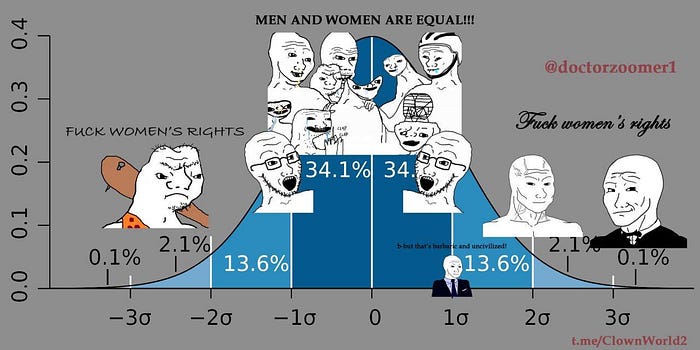
The general idea here is that our most reflexive human instincts are actually wise. In the above example, the implicit argument goes like this:
Premise 1) People with below average IQs tend to oppose women’s rights.
Premise 2) People with average IQs tend to support women’s rights.
Premise 3) People with above average IQs do not support women’s rights. Conclusion: Therefore, primitive impulses are vindicated by higher order intelligence, and women should not have rights.
According to this line of thinking, it is the persons with average or just-barely-above-average IQ that are confused by their superficial understanding of things; if they were really smart they would understand that there is logic and wisdom in the instincts of those whose thinking is not clouded by the dogma of modern secular progressivism. (The general idea is that those who are smart enough to comprehend ideologies and basic facts — but are not smart enough to think critically and deeply about the world — are confounded by a dearth of knowledge or an inability to integrate knowledge, a lack of comprehension, or by their indoctrination.)
Another example:
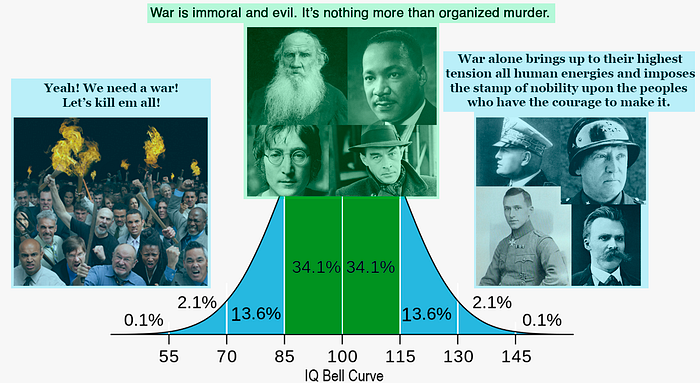
Here the poster is arguing that war is actually a noble endeavor, and that the war frenzy of those the “midwits” consider to be ignorant / stupid is actually wise.
There are a number of problems with the implicit arguments here, but first, I want to concede that there is a kernel of truth here, too. Yes, it seems that in many instances, those with a limited understanding do not recognize the wisdom of our evolved instincts, and instead are led astray by ideology or a merely superficial understanding. Nietzsche was making this claim when he stated, “There is more wisdom in your body than in your deepest philosophy” (Thus Spoke Zarathustra, Part 1, Chapter 4).
However, it is not always the case that our evolved heuristics and impulses are wise, nor is it always the case that individuals with average IQs have only a superficial understanding. The above examples hint at some vague defense of non-meritocratic patriarchy and militaristic fascism, respectively. These are, of course, ideologies that we have prima facie reasons to be skeptical of, just based on their historical record — not to mention the fact that war is an existential threat to our species, and any romanticization of war only serves to bolster this existential risk. [Note: these are just implicit arguments hinted at by the limited symbolic content of the memes; a steelmanned version of these arguments might have more cogency, however, this has not been the case in my experience in online interactions with counter-enlightenment figures.]
These “midwit” memes also consistently commit the fallacy of assuming the conclusion. Is it really the case that most above average IQ individuals support war, oppose women’s rights, believe in God…or whatever else is being claimed? Out of all of the “midwit” memes that I have surveyed they are almost always false — in that, there is either not enough quality data to support their claims, or the data clearly contradict their claims (see Debunking the Meme: Theism and IQ). Likewise, some of the claims made about below average IQ individuals are also dubious.
Another assumed conclusion in these “midwit” memes is that individuals with high IQs have more veridical views or possess more practical or ethical wisdom than individuals with average IQs. While it is likely that a certain degree of g factor intelligence is a necessary condition for rationality or epistemic rigor, it is not clear that above average IQ entails more epistemic rigor in all cases. In other words, a certain amount of intelligence as measured by IQ (presumably, at least average) is a necessary condition for rationality, but intelligence greater than or equal to this level is not a sufficient condition for rationality.
Interestingly, there is some evidence which suggests that higher than average IQ is positively correlated with cluster A traits or cluster A personality disorders (schizotypal, schizoid, paranoid), which are characterized by delusional, eccentric, odd, and / or paranoid beliefs (no link; see Weinberger, Farmer & Keilp, 2002 in the Journal of Clinical Psychology). This data underscores the fact that rationality is sufficient for a certain level of intelligence, but not the other way around (i.e., this sufficient condition is not reciprocal — that is, it is not biconditional). This correlation suggests that neuro-psychological epistemic dysfunction affects a certain segment of the high IQ population (hypotheses that might warrant investigation: problems due to over-confidence; overactive pattern detection/threat detection; an inability to utilize other modes of cognition beyond the analytical mode).
The issue of practical or ethical wisdom and its relationship to IQ would require another article, however, I think a case can be made that high IQ and its positive correlation with autistic traits might result in a delay or impede the development of what is generally considered to be wisdom in some individuals. Nor does IQ account for things like intellectual curiousity, which is necessary for the development of broad crystalized intelligence.
Further, as is evidenced by religious apologetics, and other forms of sophistic lawyering, we sometimes see that a high IQ affords individuals with the ability to rationalize more effectively or to take pleasure in the contrarian challenge of “making the weaker argument stronger” — perhaps for practical or emotional reasons, in addition to the association between high IQ and an affinity for novelty. There are a number of personality factors and cognitive styles that influence whether one places epistemic justifications for belief over pragmatic justifications, and it isn’t entirely clear how these relate to general cognitive ability.
Overall, this is a pretty silly propaganda technique that wouldn’t deserve this much proverbial ink if it weren’t so common. A bit of comical irony is that truly high IQ individuals should be able to spot the shoddy reasoning involved in these memes, so it doesn’t seem that they are likely progenitors. [Note: even high IQ individuals with a problematic epistemology can usually spot simple logical errors readily, and because of this they would seem less likely to include basic logical fallacies in their arguments.]
In summary, the obsession with IQ is misguided, and narrow-minded. In my view, a better way to conceptualize intelligence might resemble personality taxonomies like the Big Five, where cognitive abilities are measured in various domains — including some of those currently ignored by accepted IQ tests — to render a cognitive profile. This approach would be more conducive to acceptance of a variety of cognitive styles, and foster greater sociological understanding and self-knowledge.