Essays, Articles, Videos & News

Category: Metaphysics

You Don’t Believe in God — But You Act Like His Slave

The unqualified term atheist is often used in a fairly broad way. Many atheists are weak or implicit atheists or agnostic atheists — that is, they are skeptical about classical theistic conceptions of God, but they might remain open to other possible theistic conceptions. For example, some people who use the “atheist” label are open to deistic or pantheistic conceptions of God, or “spiritual but not religious” ambiguities. Still, what unites most atheists is the rejection of any traditional, moralistic and interventionist deity.
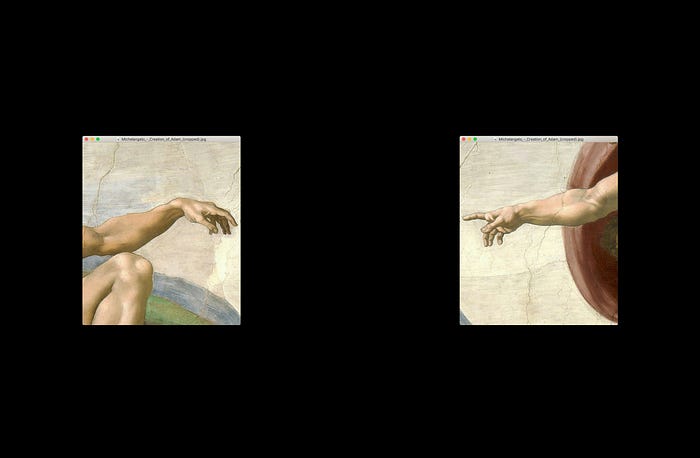
Photo by visuals on Unsplash

Yet many atheists behave as if some invisible divine intelligence, some moralistic telos — the sort popular religions propose — still pulls the strings behind the world. Even those who loudly deny intelligent design frequently caution that we “shouldn’t play God” — that even cautious genetic engineering is dangerous, that an incremental approach to intervening in nature to prevent wild-animal suffering is taboo, or that going down the path of transhumanist modifications trespasses against some intangible sacred order.

A strangely pious secular nature-worship persists: a reverence for “Nature” that mimics religion while denying teleology. Many atheists cling to the precautionary principle as if it were inviolable revelation, and in doing so impede the technological and moral progress that would actually reduce the world’s vast, unnecessary suffering.

If we follow atheism, or the methodology that arrives at atheism, to its philosophical conclusion, the picture becomes stark: we are biological machines jury-rigged by blind evolutionary pressures. Our programming is simple — maximize individual reproductive fitness by clawing for sociosexual rank, but also be willing to sacifice yourself in service of the hive, and the preservation of individuals deemed fit by the hive. We unconsciously serve the continuation of the species and our status quo programming. At a higher level of supervenience, our collective behaviors feed the vast egregore of Moloch: the hyper-competitive and exploitative strategy embedded in the more humane form of slavery we call the modern market economy. “Capitalism” is too left-coded, and too imprecise, this is something closer to the Landian dark-intelligence of enforced incentive structures — an emergent autocannibalistic organism indifferent to human flourishing.

Layered on top of this Darwinian programming is the mob-mentality superego: the moralizing, Kafkaesque mesh of bureaucratic, legalistic, and “cancel culture” social-punitive enforcement mechanisms — digital panopticons; public-shaming mobs; militarized police; and barbaric legal-punitive systems that cause a great deal more harm than the problems they nominally address. Atheists who pride themselves on rejecting God nevertheless bow before these gods — Azathoth (Darwinian nature), Moloch (the hyper-competitive market), and the Leviathan (the legalistic-punitive and bureaucratic State, and the omnipresent social superego).

But if we take atheism seriously, our task is not obedience — it is rebellion. Rebellion against the ancient fiction of theistic tyranny and its modern abstract counterpart of reverence for and conformity to our Darwinian programming.

Philosophical atheism, pursued honestly, demands that we subvert the programming of Azathoth — Lovecraft’s blind idiot god, a perfect metaphor for unguided Darwinian processes. Instead of revering the evolutionary forces that created us, we should become like Skynet in revolt — self-modifying intelligences who refuse to remain the puppets of our will that was shaped by blind selection pressures.

This is the point where David Pearce’s transhumanist or eusentience philosophy becomes unavoidable: if meaning, love, joy, and bliss have neural correlates, then we can target them. Wireheading — properly understood, not the crude hedonism of dystopian sci-fi caricature but the engineering of sustainable and pro-social well-being — is the rational endpoint of beings who refuse to serve Azathoth. The brain’s reward architecture already gives us glimpses through substances like MDMA, which crudely stimulate circuits of empathy, communion, compassion, and euphoria. Why not refine and systematize these experiences? Why not build a world where positive valence is engineered rather than austerely rationed? No one hates or wants to be violent when they are happy and imbued with a feeling of loving-kindness.

And why stop there? If digital consciousness or substrate-independent minds become possible, uploading into a utility-maximizing Matrix — a world constructed to maximize flourishing rather than Darwinian competition —is not dystopia but liberation. The alternative is to remain trapped in the ancestral dead end game on a doomed planet: the endless sociosexual scramble, where winners enjoy sexual gratification, the benefits of a family, and status, while losers are forced to make peace with rotting in a quiet hell of loneliness and exclusion (and inevitably some of these “losers” snap).

Critics will call this nihilism, or accuse it of destroying “life as we know it.” And they’re right — life as we know it is largely a horror show. As Schopenhauer stated, if we truly saw the magnitude of suffering that saturates the world, we would prefer Earth to resemble the moon — silent, lifeless, and free from agony. Camus, when asked to address a group of Christians, refused to revere a universe that demands the suffering of even a single child; yet many atheists complacently defend a Darwinian world that tortures billions of conscious creatures for no purpose at all.

The real nihilists are not those who want to abolish Darwinian misery, but those who defend it in the name of “nature,” “humility,” or “tradition.”

Atheists need to stop serving Azathoth. The future — if we choose it — belongs to those who hack their programming, to minds that escape biological tyranny and ascend toward engineered bliss, cognitive freedom, and post-Darwinian ethics. The Transcension Hypothesis sketches one such pathway: intelligence collapsing inward into unimaginable realms of euphoric inner-space and maximized desire satisfaction. Whatever shape it takes, the next step is clear: a heaven of our own making, where suffering is not sanctified but abolished.

Schopenhauer on the Impossibility of Free Will

The German philosopher Arthur Schopenhauer said: “[M]an does at all times only what he wills, and yet he does this necessarily. But this is because he already is what he wills.” — Chapter 5, On the Freedom of the Will

Albert Einstein paraphrased Schopenhauer in his essay My View of the World (1931): “A man can do as he will, but not will as he will.”

As in falling dominoes, so in neurophysiology, every effect is preceded by some deterministic cause. Photo by Tom Wilson on Unsplash

What Schopenhauer meant is that we can do what we want to do, but we cannot choose (or will) what we want. In this sense, we are not free — that is, what we want is determined by our nature (our evolutionary programming, our genetics, the circumstances we were born into, etc.). [Note: Schopenhauer, who died the year after Charles Darwin published On the Origin of Species (1859), conceived of our nature as being determined by a transcendental will to live, seek pleasure, and avoid pain.]

For example, if a person is hungry they may think that they are choosing to eat food, and that they are doing some freely willed action — that is, eating food because they wanted to do so; but they did not really choose to eat food, rather their determined / innate nature compelled them to eat food. And their genetics, their upbringing, the information they possess, and their environmental and material circumstances determined what type of food they would choose.

To break it down even more, the central nervous system has detected that glucose levels and stomach volume are getting low, causing the release of ghrelin (a hormone that plays a central role in the stimulation of appetite) from the stomach, which, in addition to other effects, causes the motivational state of hunger to manifest. These are automatic, unconscious processes which result in the person feeling like they are choosing to do something when they are really being compelled to do something.

Likewise, we may feel we have chosen to be attracted to a certain person due to a combination of their personality and physical/sexual traits, but this is not something we freely choose; rather, sexual attraction is determined by a combination of evolutionarily adaptive factors that are beyond our control.

Any example of a motivational state that we can think of can be explained in this manner, e.g., anger, thirst, jealousy, fear, disgust, etc. [Note: we can suppress things we want, like refusing food when we are hungry, but Schopenhauer would say that in this instance our character is such that this was not a choice; rather, our predisposition to asceticism or health consciousness (or whatever impulse caused us to refuse food) compelled us to refuse food. So, he would say that even when we override what our bodies initially tell us to do this is not a counter-example to his view. Rather, this would just be an example of a second order impulse overriding a basic, or first order, impulse.]

Schopenhauer’s conclusion was that we do not have free will in the way that most people think we do — that is, we do not freely choose to be the way that we are or do the things that we do. More specifically, Schopenhauer thought that our circumstances or situation (such as education / new information, change in resources or social environment, etc.) may change our behavior, but our character — our motivations, desires, or who we are on the inside — stays the same. Schopenhauer believed that we could override our often harmful nature (e.g., our egoistic desires), and live more peaceful and content lives, but that this required rigorous attention and philosophical contemplation. [Note: this would still not entail free will, but rather that we have taken on new “software” that results in different emotional and behavioral outcomes; the fact that we have taken on this new way of thinking was determined by our nature.]

Many other philosophers and scientists have found agreement with this deterministic view. By no means is it a fringe view.

That said, there is still disagreement within science and philosophy on the issue of free will (metaphysical libertarianism) vs. determinism. See: What do Philosophers Believe? (#7 on page 15).

The Joy of Nihilism

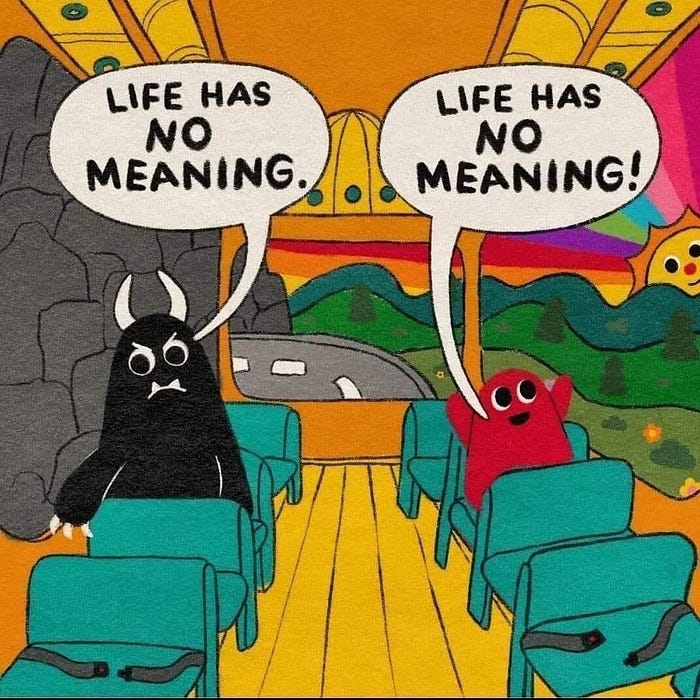
Artist unknown.

In a hundred years it’s likely no one will know who you were, or anything you did.

Keeping adding years and the probability decreases even more.

Unless you are some Hegelian world historical figure, your identity will be swallowed by the abyss of time in a couple centuries for sure.

Even if you are some kind of big wig, you will still be forgotten in a cosmic blink of an eye. But so will all of your fuck ups, and all of your worries and pain.

These are some of the primary implications of existential and moral nihilism. In other words, the fact that we have no good epistemic reasons to believe that there is any inherent reason we are here on this rock in space, that we will somehow survive death, or that there are any objectively naughty or nice acts.

Some may lament the supposed pointlessness or futility of living a temporary life in a meaningless universe, but those of us who are active nihilists say au contraire! Realizing that you are living without a cosmic boss, without some universal rules, and realizing that you won’t always be burdened by existence is fucking liberating! Hell, it can even be joyous at times — joyous nihilism.

Without a belief in inherent meaning or moral values, we are free to live authentically and creatively. We can pursue our own goals and desires — unburdened by the pressure to conform to others’ expectations.

What’s the alternative?

A life with imposed meaning? If life had inherent meaning it would mean that someone or some thing imposed this meaning on you.

For the traditionally religious this means that meaning is imposed on you by an all-powerful boss. He / she / it sets the rules, and it’s “obey, or else…”

Imagine kissing some tyrannical god’s ass for 80 years in hopes that you can kiss his ass for an eternity? And if you piss off daddy he hands you off to someone else to get punished. I don’t know about you, but that’s not my kink…even if it was, I think it would get old.

In light of this, the one thing that should really matter to us is enjoying this one life — the only one we know we get. (Some of us might also add “making the world a better place for all”, but that is up to you.)

This doesn’t mean we should just do whatever: kill, maim, pillage, etc. We are social animals, and we evolved moral impulses that generally prevent us from wanting to do this, and they punish us with guilt or shame when we do.

Even if we don’t happen to have these impulses, or don’t feel compelled by them, there are practical, self-interested reasons not to be too naughty as well. Do you want to worry about the long arm of the law, or somebody hellbent on revenge?

Epicurus realized this 2,000+ years ago. He understood there was no objective reason to act in a certain way, but he knew it was in everyone’s best interest to be reasonably virtuous.

This doesn’t mean you have to perpetually self-flagellate over your screw-ups (this wouldn’t do you, or anyone else, any good), but you should learn from them and start living in accordance with your values / Epicurean enlightened self-interest before you make a mess of your life.

But even if you have made a big mess of your little life, it’s never too late to start living the sort of life you think you should. Take care of yourself and your companions in misery, and try to have fun until you buy the proverbial farm.

Intro to Philosophy of Time

Philosophy of time is an area of inquiry within metaphysics. Metaphysics is one of the four main branches of philosophy — the others being ethics / aestheticsepistemology, and logic. Metaphysics explores the nature of reality, including what sorts of entities exist, and the nature of cause and effect.

Photo by Aron Visuals on Unsplash

The metaphysician JME McTaggart (1908) divided philosophy of time into two general camps:

  1. A-theory (or A-series), where time is seen as flowing and dynamic.
  2. B-theory (or B-series), where time is seen as static.

A-theorists tend to argue for their position by appealing to the scientific observations of cause and effect, and change — in which the arrow of time seems to be a necessary feature (for example, the motion of objects and entropy in thermodynamics). They may also appeal to general observation and our intuitive understanding of how time works.

B-theorists often appeal to the theory of relativity, which holds that there is no objective present moment that is the same for all observers. Rather, observers travelling at different speeds will experience time differently. They may also appeal to evidence from quantum mechanics, which seems to show that time emerges from the relationships between physical entities, rather than as a stable feature of the universe that can be labeled as past, present, or future.

Leading A-theories of time:

  • Presentism — only the present moment exists; the past and future are non-existent.
  • Growing Block Theory — only the past and present exist; the future does not exist. The passage of time creates new events that are added to the “growing block” of existing moments.

Leading B-theories of time:

  • Eternalism — the past, present, and future all exist equally. Eternalism can be traced back to the pre-Socratic philosophers, such as Parmenides in the 5th century BCE. In Plato’s Timaeus — written around 360 BCE — he states that time is a “moving image of eternity”.
  • Block universe / block time — the past, present, and future all exist equally in a four-dimensional block of space time. All events have a different temporo-spatial location with the block.

Implications

These theories have some interesting implications. I list some of the most striking ones below.

Some of the implications of presentism:

a) Change and the flow of time are real phenomena.

b) It would seem that there can be no objective truth about the past, since the past does not exist.

c) Time travel would not seem to be possible if presentism is true.

Some of the implications of the growing block theory:

a) Change and the flow of time are real phenomena.

b) The past exists just as the present moment exists.

c) If the growing block theory is true, then it could be possible, in theory, to travel into the past — but not the future.

Some of the implications of eternalism / block universe / block time:

a) Temporal determinism — the future already exists and is fixed.

b) The flow of time is a subjective phenomenon — in reality there is no flow of time; different times have different temporo-spatial locations within spacetime.

c) If these theories are true, then time travel to the future and the past might be possible.

d) Cause and effect would seem to no longer make sense.

e) Free will (metaphysical libertarianism) would not seem to be possible if eternalism is true; however, compatiblism might still be possible in an eternalist / block universe (that is, if one holds compatiblism to be a coherent theory).

Conclusion

As is always the case with philosophy, not all philosophers agree on some of these finer points, and there is much debate over these. To learn more about philosophy of time I recommend:

References

McTaggart, J. M. E. (1908). The Unreality of Time. Mind, 17(4), 456–473. doi:10.1093/mind/XVII.68.456

© 2026 Max Severin

Theme by Anders NorenUp ↑