Essays, Articles, Videos & News

Category: Theism

The Fallacy of IQ Obsessiveness

The Intelligence Quotient (IQ) — as measured by empirically studied and generally accepted tests (most commonly the Wechsler Adult Intelligence Scale or the Wechsler Intelligence Scale for Children) — is one of the most predictive psychometrics available. In psychological jargon we would say that bona fide IQ tests have predictive validity.

Nevertheless, we cannot say that IQ tests have construct validity — that is, we do not know that they truly measure “intelligence”, because we do not have an agreed upon theory or definition of intelligence.

What we can say is that IQ is positively correlated with success in other academic domains, academics in general — and to a lesser degree, with occupational placement in cognitively challenging fields, life expectancy, and income. It would therefore be more fitting to refer to IQ as an academic / life “success” quotient (where success is very narrowly defined).

One could argue that success in academics, or at least the ability to be successful in academics, is a necessary condition for our most intersubjective definitions of intelligence, however, there are flaws with this argument.

To be brief, the biggest flaw with the above argument is that intelligence is a multidimensional and amorphous concept. Even our intersubjective definitions may be missing something that is fundamental to a philosophically sophisticated definition of intelligence.

In order to arrive at a more precise and comprehensive definition of intelligence the meta-discourse must move beyond the operational definition of intelligence that is confined to narrow measures of success. For example, a comprehensive definition of intelligence might include other facets of cognition that are disregarded by currently accepted IQ tests (e.g., creativity, social / emotional cognition, practical intelligence, wisdom, kinesthetic intelligence, knowledge integration, epistemic rigor, etc.).

Another major problem with IQ obsessiveness is highlighted by a recent trend seen in counter-enlightenment circles: the mocking of so-called “midwits” — that is, those with average IQ scores.
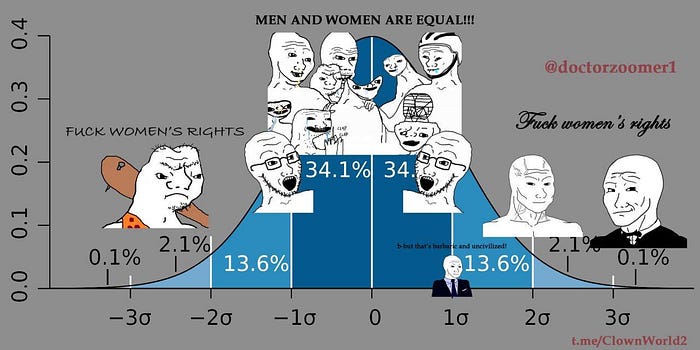
Meme posted by doctorzoomer1

The general idea here is that our most reflexive human instincts are actually wise. In the above example, the implicit argument goes like this:

Premise 1) People with below average IQs tend to oppose women’s rights.
Premise 2) People with average IQs tend to support women’s rights.
Premise 3) People with above average IQs do not support women’s rights. Conclusion: Therefore, primitive impulses are vindicated by higher order intelligence, and women should not have rights.

According to this line of thinking, it is the persons with average or just-barely-above-average IQ that are confused by their superficial understanding of things; if they were really smart they would understand that there is logic and wisdom in the instincts of those whose thinking is not clouded by the dogma of modern secular progressivism. (The general idea is that those who are smart enough to comprehend ideologies and basic facts — but are not smart enough to think critically and deeply about the world — are confounded by a dearth of knowledge or an inability to integrate knowledge, a lack of comprehension, or by their indoctrination.)

Another example:
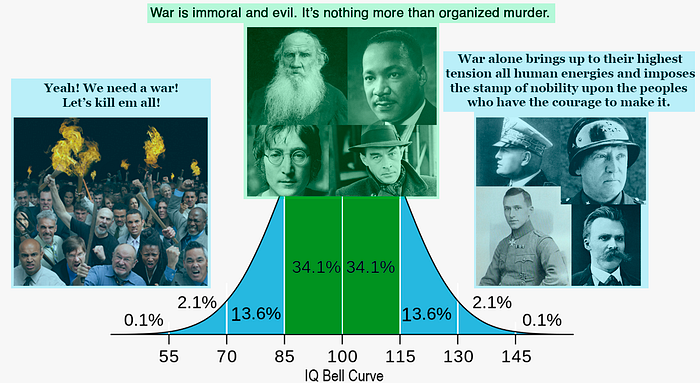
Meme posted by connect_government_7 on Reddit

Here the poster is arguing that war is actually a noble endeavor, and that the war frenzy of those the “midwits” consider to be ignorant / stupid is actually wise.

There are a number of problems with the implicit arguments here, but first, I want to concede that there is a kernel of truth here, too. Yes, it seems that in many instances, those with a limited understanding do not recognize the wisdom of our evolved instincts, and instead are led astray by ideology or a merely superficial understanding. Nietzsche was making this claim when he stated, “There is more wisdom in your body than in your deepest philosophy” (Thus Spoke Zarathustra, Part 1, Chapter 4).

However, it is not always the case that our evolved heuristics and impulses are wise, nor is it always the case that individuals with average IQs have only a superficial understanding. The above examples hint at some vague defense of non-meritocratic patriarchy and militaristic fascism, respectively. These are, of course, ideologies that we have prima facie reasons to be skeptical of, just based on their historical record — not to mention the fact that war is an existential threat to our species, and any romanticization of war only serves to bolster this existential risk. [Note: these are just implicit arguments hinted at by the limited symbolic content of the memes; a steelmanned version of these arguments might have more cogency, however, this has not been the case in my experience in online interactions with counter-enlightenment figures.]

These “midwit” memes also consistently commit the fallacy of assuming the conclusion. Is it really the case that most above average IQ individuals support war, oppose women’s rights, believe in God…or whatever else is being claimed? Out of all of the “midwit” memes that I have surveyed they are almost always false — in that, there is either not enough quality data to support their claims, or the data clearly contradict their claims (see Debunking the Meme: Theism and IQ). Likewise, some of the claims made about below average IQ individuals are also dubious.

Another assumed conclusion in these “midwit” memes is that individuals with high IQs have more veridical views or possess more practical or ethical wisdom than individuals with average IQs. While it is likely that a certain degree of g factor intelligence is a necessary condition for rationality or epistemic rigor, it is not clear that above average IQ entails more epistemic rigor in all cases. In other words, a certain amount of intelligence as measured by IQ (presumably, at least average) is a necessary condition for rationality, but intelligence greater than or equal to this level is not a sufficient condition for rationality.

Interestingly, there is some evidence which suggests that higher than average IQ is positively correlated with cluster A traits or cluster A personality disorders (schizotypal, schizoid, paranoid), which are characterized by delusional, eccentric, odd, and / or paranoid beliefs (no link; see Weinberger, Farmer & Keilp, 2002 in the Journal of Clinical Psychology). This data underscores the fact that rationality is sufficient for a certain level of intelligence, but not the other way around (i.e., this sufficient condition is not reciprocal — that is, it is not biconditional). This correlation suggests that neuro-psychological epistemic dysfunction affects a certain segment of the high IQ population (hypotheses that might warrant investigation: problems due to over-confidence; overactive pattern detection/threat detection; an inability to utilize other modes of cognition beyond the analytical mode).

The issue of practical or ethical wisdom and its relationship to IQ would require another article, however, I think a case can be made that high IQ and its positive correlation with autistic traits might result in a delay or impede the development of what is generally considered to be wisdom in some individuals. Nor does IQ account for things like intellectual curiousity, which is necessary for the development of broad crystalized intelligence.

Further, as is evidenced by religious apologetics, and other forms of sophistic lawyering, we sometimes see that a high IQ affords individuals with the ability to rationalize more effectively or to take pleasure in the contrarian challenge of “making the weaker argument stronger” — perhaps for practical or emotional reasons, in addition to the association between high IQ and an affinity for novelty. There are a number of personality factors and cognitive styles that influence whether one places epistemic justifications for belief over pragmatic justifications, and it isn’t entirely clear how these relate to general cognitive ability.

Overall, this is a pretty silly propaganda technique that wouldn’t deserve this much proverbial ink if it weren’t so common. A bit of comical irony is that truly high IQ individuals should be able to spot the shoddy reasoning involved in these memes, so it doesn’t seem that they are likely progenitors. [Note: even high IQ individuals with a problematic epistemology can usually spot simple logical errors readily, and because of this they would seem less likely to include basic logical fallacies in their arguments.]

In summary, the obsession with IQ is misguided, and narrow-minded. In my view, a better way to conceptualize intelligence might resemble personality taxonomies like the Big Five, where cognitive abilities are measured in various domains — including some of those currently ignored by accepted IQ tests — to render a cognitive profile. This approach would be more conducive to acceptance of a variety of cognitive styles, and foster greater sociological understanding and self-knowledge.


The Biggest Mistake of the New Atheist Movement

The so-called new atheist movement has mostly died out, however, atheism, and other non-religious views, are continuing to grow. Atheists and other “nones” (those that don’t identify with any religion) are largely disorganized, in that they do not belong to communities or groups that may help represent their interests. This article explains why I believe new atheism, and other atheist movements, have failed to inspire mass affiliation and change minds.

The main mistake of the New Atheist movement, in my view, is that its leading proponents gave off the impression that they considered atheism to be a sufficient substitute for religion (except for Sam Harris, who is trying to build a movement for rational spirituality). Their vision of Utopia seemed to be one in which an educated, rational, and mostly atheistic populace would behave prosocially and with stoic equanimity in creating a world without religious conflict, war, bigotry, hunger, and poverty. This simply is not a psychological reality in our current world.

Atheism offers nothing to replace the ethical, practical, and existential framework that religion provides. It is simply an absence of belief in deities. And the stillborn “atheism plus” movement only offered simplistic “woke” virtue signaling, and the divisive / indignant condemnation of others that is characteristic of these new secular social justice movements — rather than a psychologically informed and philosophically grounded theory of social justice (see SJWs the New Moralists).

Although it may sound pessimistic, I don’t believe we are close to seeing dogmatic religion, and the conflict it inspires, disappear from the world. Realistically, there are many people that need the restraint and scaffolding of religion to act prosocially, and to cope with the existential problems entailed by the human condition. Some societies may collapse without this scaffolding (see Does Religion Increase Moral Behavior?).

Religion also offers benefits in the form of ethical and practical instruction, and a possible community to belong to. While some alternatives to religion (e.g., Humanism, modern Epicureanism or Stoicismsecular Buddhism) also provide these benefits, these worldviews or life philosophies are either too vague (for instance, Humanism) or not well known / developed — in addition to having few, if any, established communities outside of the internet.

Many intellectually sophisticated individuals can lead healthy, acceptably prosocial, and happy lives without religion, but the global community is not ready to give up the opium of the masses, nor would the world necessarily be in better shape if they did — at this point in time. It seems highly plausible that some people need the carrot and stick of religion to stay out of habitual antisocial behavior — on the individual and collective level — and to assuage their existential malaise.

In order to reach something approximating an atheistic Utopia, there are many changes that need to be made in education, reproduction, and our socioeconomic systems, etc., but perhaps most importantly, we need to further build alternatives to religion — such as those mentioned above (see Why It Is Important to Have a Philosophy Of Life).

My Views On Theism

Nearly every philosophical question hinges on ultimate metaphysical questions — such as, “Why does something exist, instead of nothing?” Or, “Is the universe intelligently designed?” How one answers these questions will determine, to a great extent, their views on other metaphysical questions, on epistemology, and on ethics.

Many people throughout history have answered these ultimate questions through various conceptions of theism — that is, various conceptions of an entity or entities possessing higher order intelligence and other extraordinary powers. The most common term used to describe such entities is “god” or “deity”.

Photo by Davide Cantelli on Unsplash

When it comes to the origin of theism, or religion / spirituality in general, we do not have a lot of definitive answers. The precise time period and the exact nature of the first religion / spirituality is obscured by the fog of time, however, anthropological evidence suggests that some of the earliest forms of religion or spirituality may have involved sun / lunar worship, ancestor worship, and animal / nature worship. Some of these proto-religions evolved over time to become more organized and explicitly theistic.

Over the millennia, theism and religion have evolved through a selection process similar to that which biological organisms are subjected to. Tens of thousands of gods and religions are dead — no one, or nearly no one, believes in them. The religious belief systems which have outcompeted rival systems usually involve classical theism, a moralistic deity or deities, an afterlife involving rewards and punishments, and duties to proselytize.

Despite the fact that the world’s most successful religions (Islam and Christianity), and increased knowledge of the natural world, have virtually relegated some forms of theism — such as solar / lunar worship — to anthropological history, there are still several other active forms of theism (e.g., deism, polytheism, pantheismpandeism, etc.).

With so many forms of theism, it does not seem tenable for one to hold just one position. Therefore, the position that I take with regard to theism depends on the form of theism in question.

With regard to the traditional form of theism posited by the world’s most successful religions — Christianity and Islam — I am a strong atheist, and, in a sense, an antitheist.

I take the position of strong atheism because, as I argue in this article, in some instances absence of evidence is evidence of absence. In other words, I object to traditional Christian or Islamic theism on evidentialist grounds. Further, the dominant form of these religions entails classical theism and classical theism entails untenable logical contradictions. I outline some of these in my article on the Epicurean paradox. (Note: There are many other strong arguments that can be leveled against this form of theism, but I consider the arguments stated here to be the primary reasons why I reject this view.)

I take the position of antitheism toward the traditional form of Christian / Islamic theism because I believe it may be harmful on an individual level (depending on the specifics of the belief system), and on a wider, societal level (e.g., stifling scientific progress, inspiring bigotry against sexual minorities, providing rationalizations for systemic animal abuse, etc.). Moreover, the clash of major religions — in the modern age — is a strong contributor to the existential threat posed by global conflict involving weapons of mass destruction. (Note: This doesn’t mean I directly try to get individuals to change their religious beliefs — there are a number of reasons why this is unlikely, and, further, why it may not be helpful. In fact, in some instances, it could be harmful. My take on antitheism is resistance to these belief systems in general — that is, arguing against these belief systems, rather than directing critical arguments toward any specific individual without that person desiring a philosophical discussion on this subject.)

Polytheistic conceptions of gods vary from tradition to tradition and individual to individual. The ancient philosopher Epicurus, for instance, may have believed in the gods of the ancient Greek pantheon, but, as Tom Robinson argues, it seems that he may have conceived of them in a metaphorical or quasi-metaphorical sense — that is, as something similar to Platonic or Jungian archetypes. Also, polytheism does not usually entail the four attributes of classical theism, so the logical contradictions discussed above do not necessarily apply. Depending on the conception of polytheism in question, I would take the position of weak atheismtheological non-cognitivism, or strong atheism.

Stated briefly, I would take the position of theological non-cognitivism if the conceptions posited are unfalsifiable, since if it is not possible to falsify a hypothesis, neither is it possible to prove it; further, if we cannot falsify a hypothesis, then we are discussing a logical absurdity with no actual meaning. Weak atheism stops short of stating that these conceptions of god are existentially impossible, but objects to them on evidentialist grounds (we do not have good epistemological reasons to believe in them). If the form of polytheism in question made falsifiable claims about their conception of gods, then, barring some sufficient evidence, I would take the position of strong atheism.

Regarding more vague conceptions of god — such as those entailed by deism, pantheism, pandeism, or ill-defined “spiritual” conceptions — I am either a theological non-cognitivist or a weak atheist (for the same reasons outlined in the preceding paragraph), depending on the particulars of the conception. Theological non-cognitivism, on my view, would apply to any sort of theism which does not provide a meaningful (clear / intelligible / coherent) or falsifiable definition of god/s.

Sometimes Absence of Evidence is Evidence of Absence

“Absence of evidence is not evidence of absence.”

This common aphorism is usually employed by theists who believe it overrides evidentialist objections to theism. In regards to situations where an occurrence or existence would entail the presence of evidence — for instance, like the existence of a god that interferes or has interfered in human affairs in very salient ways (e.g., disrupting natural laws or causing other types of miraculous events) — it is absolutely false.

Photo by Alexander Andrews on Unsplash

Logically, if something is said to have interacted with the world in ways that would produce evidence, and a thorough investigation fails to produce non-controversial evidence, then this becomes strong (probabilistic) evidence against the existence or occurrence being asserted.

When this aphorism is addressing occurrences or existences that would produce no evidence, then it is true, but if something produces no evidence we cannot have a meaningful dialogue about its existence or non-existence because we are dealing with an unfalsifiable absurdity. The only appropriate response to such an absurdity is non-cognitivism. Or, more pragmatically, we could use Hitchen’s razor: “That which can be asserted without evidence, can be dismissed without evidence.”

If a person claims that an occurrence or existence does produce evidence, but that this evidence is somehow cryptic or indirect, then the burden of proof rests on the person making the extraordinary claim (see Russell’s Teapot), not on the person who does not believe the assertion.

In summary: While the aphorism holds true in instances where evidence is likely to be cryptic — this is not the case with most religious conceptions of god/s. The world’s most popular religions posit the existence of a deity which has, and/or continues to, interfere with the known world in striking or noticeable ways; and in such cases, the absence of evidence is strong probabilistic evidence against the existence of such entities.

Regardless of whether the aphorism holds true or not, it does not entail a good reason to believe in something. If the person arguing for the existence of some elusive entity wants to convince others, they must show how this existence can be plausibly inferred in some other way besides direct evidence. This is why we say the burden of proof rests on the person making an extraordinary claim.

The Epicurean Paradox Refutes Classical Theism

The Epicurean paradox points out the contradiction between the existence of evil in the world and the supposed existence of a god who is omniscient (all-knowing), omnipotent (all-powerful), omnibenevolent (all-loving), and omnipresent (present everywhere). The Epicurean Paradox is one formulation of the problem of evil.

Most of the world’s monotheistic religions (e.g., Islam, Judaism, Christianity) describe their gods as having the four attributes described above. This is generally known as classical theism.

As for what philosophers mean by “evil,” it is just a general term of art to describe things we consider to be really bad. In moral philosophy, evil is separated into two general categories: moral and natural.

Examples of moral evil are torture and murder — some very salient examples would be the various acts of mass murder and genocide that have occurred throughout human history. Examples of natural evil would be things like earthquakes, tsunamis, pandemics, famines, etc. — which are capable of killing hundreds of thousands or millions of people over a short span of time. Natural evil also includes the more banal, but still horrible facts of reality (e.g., that we all die and suffer; that many animals are forced to kill other animals to survive; the sheer fact that parasites, predators, and pathogenic organisms exist).

Starving Child in Sudan — “The Struggling Girl”; Kevin Carter / Fair Use

The Epicurean Paradox points out that we would expect the world to be very different from the way it is if a god having these 4 traits were the designer. The fact that the world is the way it is presents a paradox to the traditional religious believer.

Here is how the Epicurean Paradox puts the problem:

“God, [Epicurus] says, either wishes to take away evils, and is unable; or He is able, and is unwilling; or He is neither willing nor able, or He is both willing and able. If He is willing and is unable, He is feeble, which is not in accordance with the character of God; if He is able and unwilling, He is envious, which is equally at variance with God; if He is neither willing nor able, He is both envious and feeble, and therefore not God; if He is both willing and able, which alone is suitable to God, from what source then are evils? Or why does He not remove them?”

(Note: The Epicurean Paradox is named after its purported originator, the ancient Greek philosopher Epicurus; however, this authorship is unconfirmed. The paradox is not found in any existing copies of Epicurus’ works, though many of Epicurus’ works have been lost — including an extensive work about his views on theism. Notably, the passage above is preserved through the Christian writer Lactantius, who attributed it to Epicurus while arguing against it — a fact that adds an ironic dimension to its survival.)

Every classical theistic religion facing this problem has some explanation for the existence of evil in the world. A justification of evil is referred to as a theodicy (theos = god; dikē = justice). A theodicy is essentially a defense of the classical theist’s conception of god. There are many theodicies employed by classical theists, however, none of these are widely seen to be satisfactory by the skeptical.

For example, Christians usually say that God did not bring evil into the world, rather, they say that it was man that brought evil into the world. The story goes something like this: God gave man free will, he misused it, and evil is the result.

This explanation has some pretty clear problems. For one, why did God create a world where the existence of evil is a possibility? He could have created the world however he wanted if he is all powerful. For instance, one could ask, “why give man free will?” Surely an all-powerful God could create a being that didn’t have free will, but was still happy / fulfilled (this is not a logical contradiction). Alternatively, he could have created beings with free will, but placed them in a universe where sin was impossible.

Moreover, the free will defense fails entirely when confronted with natural evil. Human free will cannot account for earthquakes, tsunamis, childhood cancer, or the existence of parasites that blind and kill millions. These horrors exist entirely independently of human choice, and no appeal to free will can explain why an omnibenevolent, omnipotent God would permit — let alone design — a natural world so indifferent to suffering.

There are plenty of other holes to poke in the traditional Christian explanation of evil, but apologists will likely respond that it doesn’t really matter if there is evil in this world, because this world is only temporary — God has offered us a way out of evil and suffering through accepting Jesus as our savior. We are told that if we accept Jesus, we will go to Heaven and there will be no evil there; but part of this story is that there is another place where we will go if we don’t accept Jesus — Hell. Hell, according to the traditional or popular interpretation, is said to be a place of eternal torment. In some versions of the Bible it is described as a “lake of fire,” where there will be unimaginable suffering for those sent there — suffering that will last forever.

So, even if we grant that there is some way for the classical theist to resolve the Epicurean Paradox, there is an even bigger aspect of the problem of evil for their beliefs: the problem of Hell.

Why would an omniscient, omnipotent, omnipresent and omnibenevolent god create a place of eternal torment? Why would this god create a certain individual, knowing (remember, omniscience entails knowing everything, both past, present, and future) that this person will spend an eternity in Hell? Why wouldn’t such a god just not create any person that will end up in Hell? Why create Hell in the first place, or why not just send everyone to Heaven from the start? Ultimately, we must ask why would such a god create anything at all, if even one person has to be subjected to eternal torment? Wouldn’t a universe devoid of conscious experience (besides God’s) be preferable to one in which any conscious beings experience infinite suffering? None of these questions can be satisfactorily answered by traditional religious believers.

It is worth noting that some theologians attempt to soften this problem by reinterpreting Hell not as a place of active eternal torment, but as annihilation — the simple cessation of existence — or as a state of self-chosen separation from God. These reinterpretations, however, fare little better. A god who creates beings he knows will choose annihilation or permanent alienation from all goodness remains difficult to reconcile with omnibenevolence. The problem does not dissolve — it merely changes shape.

So, the Epicurean Paradox, with the Problem of Hell taken into consideration, points out that the typical religious conception of god presents an apparently irresolvable contradiction. Theologians and religious apologists have proposed various solutions to this paradox, however, none of them appear to withstand serious scrutiny.

© 2026 Max Severin

Theme by Anders NorenUp ↑