In a hundred years it’s likely no one will know who you were, or anything you did.
Keeping adding years and the probability decreases even more.
Unless you are some Hegelian world historical figure, your identity will be swallowed by the abyss of time in a couple centuries for sure.
Even if you are some kind of big wig, you will still be forgotten in a cosmic blink of an eye. But so will all of your fuck ups, and all of your worries and pain.
These are some of the primary implications of existential and moral nihilism. In other words, the fact that we have no good epistemic reasons to believe that there is any inherent reason we are here on this rock in space, that we will somehow survive death, or that there are any objectively naughty or nice acts.
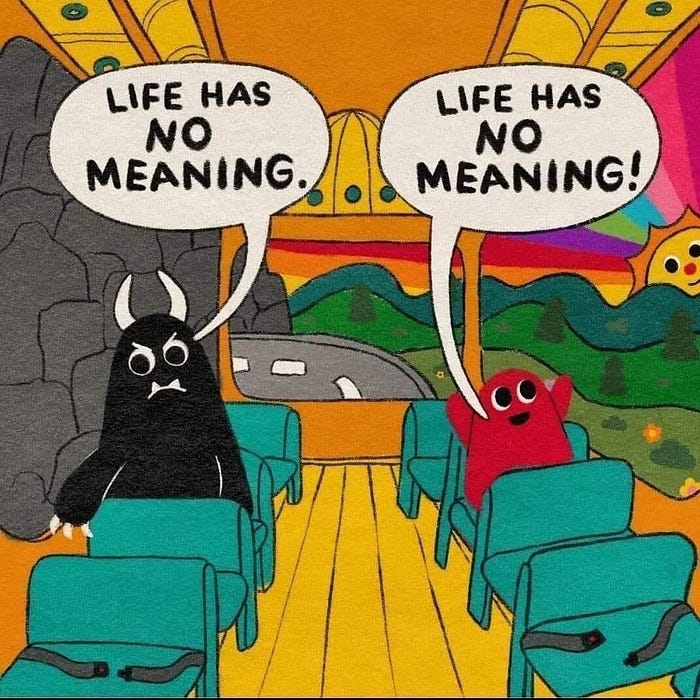
Some may lament the supposed pointlessness or futility of living a temporary life in a meaningless universe, but those of us who are active nihilists say au contraire! Realizing that you are living without a cosmic boss, without some universal rules, and realizing that you won’t always be burdened by existence is fucking liberating! Hell, it can even be joyous at times — joyous nihilism.
Without a belief in inherent meaning or moral values, we are free to live authentically and creatively. We can pursue our own goals and desires — unburdened by the pressure to conform to others’ expectations.
What’s the alternative?
A life with imposed meaning? If life had inherent meaning it would mean that someone or some thing imposed this meaning on you.
For the traditionally religious this means that meaning is imposed on you by an all-powerful boss. He / she / it sets the rules, and it’s “obey, or else…”
Imagine kissing some tyrannical god’s ass for 80 years in hopes that you can kiss his ass for an eternity? And if you piss off daddy he hands you off to someone else to get punished. I don’t know about you, but that’s not my kink…even if it was, I think it would get old.
In light of this, the one thing that should really matter to us is enjoying this one life — the only one we know we get. (Some of us might also add “making the world a better place for all”, but that is up to you.)
This doesn’t mean we should just do whatever: kill, maim, pillage, etc. We are social animals, and we evolved moral impulses that generally prevent us from wanting to do this, and they punish us with guilt or shame when we do.
Even if we don’t happen to have these impulses, or don’t feel compelled by them, there are practical, self-interested reasons not to be too naughty as well. Do you want to worry about the long arm of the law, or somebody hellbent on revenge?
Epicurus realized this 2,000+ years ago. He understood there was no objective reason to act in a certain way, but he knew it was in everyone’s best interest to be reasonably virtuous.
This doesn’t mean you have to perpetually self-flagellate over your screw-ups (this wouldn’t do you, or anyone else, any good), but you should learn from them and start living in accordance with your values / Epicurean enlightened self-interest before you make a mess of your life.
But even if you have made a big mess of your little life, it’s never too late to start living the sort of life you think you should. Take care of yourself and your companions in misery, and try to have fun until you buy the proverbial farm.
This short essay must be prefaced by stating that the Ataraxist life philosophy is indebted to Stoic insights. Many elements of Stoic wisdom are incorporated into our core principles and our practical philosophy. However, it is essential to recognize that Stoicism, even in its contemporary interpretations, has significant flaws. I will outline them, in brief, below.
Stoicism can be seen as a form of quietism (passive acceptance of the status quo without desiring or trying to change things).
Stoicism, going back to early founders like Epictetus, holds that one should passively accept what happens or “what is” as divinely mandated fate. This belief stemmed from the ancient Stoic notion that the universe is ordered by a vague cosmic intelligence known as the logos. This perspective has persisted, to some extent, in modern Stoicism.
Roman Emperor and Stoic, Marcus Aurelius
Compare this with another major Ataraxist influce: David Pearce’s suffering abolitionism. Pearce’s suffering abolitionist philosophy holds a more rational or parsimonious / scientific view of the nature of reality, seeing the circumstances of our existence as contingent facts. In other words, “what is” is not predetermined by a divine intelligence and should not be considered necessary or immutable; this view implies that we should actively work to change the unfavorable circumstances we find ourselves and others in. Both Pearcean suffering abolitionism and Ataraxism posit that we should strive to eliminate intense involuntary suffering throughout the universe — even by intervening in “nature” (see Reprogramming Predators for an ambitious example of this).
Some defenders of Stoicism will surely point out that one of the Stoic virtues is justice (social justice), and that the Stoics never intended for us to simply accept injustices in the world. It is challenging, however, to reconcile this with the pantheistic beliefs of ancient Stoics or the amor fati sloganeering of many modern Stoics. Moreover, it seems that the radical interventions proposed by Pearce and others do not resonate strongly with many Stoics. In fact, many Stoics adhere to the macho notion that suffering is necessary for character development, disregarding alternative means to cultivate character or wisdom. Also, consider that the issue of vegetarianism / veganism / animal rights is hotly debated within Stoic circles. This is likely due to the fact that Stoic ethics, unlike Ataraxist ethics, are not sentiocentric, and because many Stoics still seem to worship “nature”, and what is considered natural (see the appeal to nature fallacy), even if they do not see divinity or teleology behind it (see the Stoic Massimo Pigliucci on vegetarianism contra the Stoic Jeremy Corter on vegetarianism).
The Stoic concept of amor fati strikes me as odd, not only because this slogan is borrowed from Nietzsche — who was very critical of the Stoics and Stoic pantheism / ethics in particular — but also considering that various informal polls indicate that the majority of modern Stoics are atheists or agnostics. However, it does seem like many of these modern Stoics are conflating the passive acceptance of ancient Stoics with modern psychotherapeutic “reframing” — that is, attempting to view problems through a different, more positive perspective, or attempting to find possible positive aspects or opportunities within unfortunate states of affairs.
2. Ancient Stoicism was based on metaphysical speculation (forming beliefs without relying on reliabilist or evidentialist epistemic justifications), and this memetic baggage continues to manifest in various ways.
As mentioned earlier, ancient Stoicism was built on the belief that the universe is ordered by divine reason, known as the logos. According to this view, every event that happens or has happened is necessary because it was determined by an intelligence greater than our own. While the Stoics didn’t believe in a personal god like Christians do, they considered the universe itself to be God — that is, pantheism, or the belief that God is everything.
Although it appears that most modern Stoics are atheists or agnostics, many still hold onto the pantheistic ideas of ancient Stoicism. While I find Stoic pantheism to be much less problematic than the dogmatic theism of traditional religions, it can still have insidious effects, such as inspiring quietism or, more generally, fostering fatalism, status quo bias, or passivity.
On the other hand, Ataraxism is based on a parsimonious and scientific view of reality. It rejects the use of metaphysical speculation to shape our beliefs or guide our actions. While there may be a place for personal exploration and hypothesis formation involving metaphysical speculation, the life philosophy of Ataraxism is not grounded in such speculation. We do not allow it to dictate our approach to life.
3. Stoicism is often associated with a rigid or simplistic moralism.
Stoic morality, as preached by many followers, can appear overly rigid or simplistic. The focus on the four cardinal virtues (moderation, courage, justice, and wisdom) as the sole determinants of flourishing / ethics may neglect other essential elements, such as love, aesthetic appreciation, or the pursuit of personal sources of meaning. These virtues, of course, are very open to interpretation, which on one hand may be a good thing — to avoid rigidity — but, on the other hand, their vagueness means that they do not offer a great deal of determinacy or guidance in ethical situations.
In comparison, it could be argued that the Epicureans adopted a more sensible and pragmatic approach to morality. They believed in living justly because doing so serves one’s own well-being, but they also considered that happiness usually requires more than living a strict moral life.
Conclusion
In contrast to traditional pantheistic Stoicism, Ataraxism eschews metaphysical speculation and does not hold that one should simply accept the way the world is. We agree with the Stoics in holding that one should accept what they cannot control (see the “dichotomy of control”), but the vestiges of ancient Stoicism seem to engender a sort of passivity which may lead individuals to accept things that they can, or could, exert some control over.
Ataraxism also steers clear of rigid or simplistic moralizing. Reducing the “good life” to living virtuously is to neglect the complexity and various sources of meaning and pleasure that life has to offer. Ataraxists agree that attempting to live ethically is a necessary element to flourishing, but we do not believe that this is all that is required. We also do not believe that morality can be reduced to vague virtues. Our ethical commitments are also somewhat open to interpretation, but they are more detailed in explanation.
The concept of the state of nature has long been debated in political philosophy; the state of nature describes the hypothetical or actual condition individuals and groups existed in prior to the formation of formal governance or social contracts. On some views of the state of nature this condition was marked by conflicting interests and a perpetual violent struggle between individuals and groups. While modern, technologically-developed societies have developed norms and social contracts that facilitate relatively harmonious, rights-based interactions among humans, a stark contrast remains when it comes to our relations with non-human animals.
In this essay, I argue that instead of relying solely on ethical persuasion or vegan lifestylism to revolutionize our treatment of animals, we should focus more on abolishing the human-animal state of nature by advocating technological advancements such as in-vitro meat, alternatives to animal research, animal-free entertainment, and substitutes for animal products. By advocating for and embracing these innovations, we can transcend the violent state of nature that characterizes the status-quo of human-animal relations.
Hunter-gatherer Cave Painting — Aleksander Gerasimov
The State of Nature in Human Relations
The first well-known theorist to describe a state of nature characterized by violent conflict was Thomas Hobbes. He referred to this state as the bellum omnium contra omnes, or the “war of all against all.” Hobbes’ theory finds some support from paleoanthropological research (which is discussed in depth here, along with contrary views). According to many political theorists, the emergence of civilized society played a significant role in transitioning from the violent state of nature to a more peaceful order. This transition was facilitated by the establishment of centralized authority that could enforce the laws associated with the social contract.
However, what is often overlooked is the impact of technological advancements, particularly in agriculture, on these civilizational developments. Civilization and the concept of a social contract did not arise spontaneously; instead, technological progress created conditions that enabled the development of agriculture and reduced scarcity. These advancements allowed for the formation of stable and settled societies (the alignment of previously conflicted interests), which in turn facilitated the creation of systems aimed at decreasing interpersonal and inter-tribal violence.
It is my view, then, that technological development is the primary driver of revolutionary changes which eliminate prior conditions. This is essentially the same view taken by Karl Marx in his theory of historical materialism.
The State of Nature in Human-Animal Relations
In our present reality, human interests are usually in conflict with the interests of non-human animals. In other words, a relatively one-sided Hobbesian state of nature prevails in our treatment of non-human animals due to the fundamental conflict of interests and the imbalance of power between these two general groupings. Most non-human animals are subject to exploitation and intense suffering en masse as a result of animal research, animal entertainment, farming (especially industrial farming, also known as “factory farming”) and hunting, fishing, or trapping.
Animal rights advocates have traditionally argued that animal exploitation and harm results from our general indifference to animal suffering, rather than this state of nature / conflict of interests. This view ignores the fact that human survival necessitated killing and exploiting animals for food, clothing, and other needs for the vast majority of our species’ existence— and that this necessity still exists everywhere except in the developed nations of the world, or, at the least, in warm climates that allow for diverse plant-based agriculture.
These necessities guided our evolved psychology as well. Not only did necessity dictate that we not seriously consider the interests of non-humans, we also would not have survived if we evolved to feel deep compassion for those outside of our immediate sphere of similarity and shared interests. Compassion for non-human animals seems to require a high degree of cognitive empathy — something which our ancestors, and many of our contemporaries do not prioritize or have the time to cultivate in depth.
Returning to the pragmatism of a vegan lifestyle, even in the developed world adopting such a lifestyle is debatably difficult. For some individuals a vegan diet may not be sufficient for their nutritional needs, and even healthy individuals on a vegan diet require supplementation of certain nutrients like vitamin B12, and omega-3 fatty acids. These challenges are evidenced by research which indicates that most vegans / vegetarians go back to eating the animal products they chose to stop consuming. It may be argued, then, that the state of nature still persists to a considerable degree even in the developed world.
As long as a conflict of interests exists even those of us who are deeply concerned about non-human animals are forced to compromise our principles. For example, even the most hard-core vegans engage in self-interested activities which they know to cause indirect or direct harm to non-human animals (e.g., purchasing products from companies that invest some of their capital in animal agriculture, using drugs that were developed using animal research, killing problematic “pests”, etc.).
Technological Advancements as Agents of Change
As the suffering abolitionist philosopher David Pearce argues, to transcend this state of nature, we must look beyond traditional approaches centered on ethical persuasion alone. Technological advancements offer immense potential to reshape our relationship with non-human animals and establish a more sustainable future with less intense suffering.
In-Vitro Meat and Animal-Free Alternatives:
In-vitro meat, also known as cultured meat or cellular agriculture, holds the promise of providing a sustainable and ethical alternative that satisfies human dietary preferences and nutritional needs without harming animals en masse or devastating the environment, as animal agriculture does. By investing in and advocating for cellular agriculture, we can force agriculture corporations to adapt or fail. Additionally, advancements in plant-based alternatives, such as meat substitutes and dairy-free products, offer viable options to replace animal-derived foods without compromising taste or nutrition.
Alternatives to Animal Research and Entertainment:
Emerging technologies are also paving the way for alternatives to animal research and entertainment. Innovations like organs-on-chips, computer modeling, and in-silico testing methods provide alternatives to traditional animal testing, reducing the need for animal experimentation while still ensuring the safety and efficacy of products. Likewise, virtual reality exhibits offer engaging and cruelty-free alternatives to zoos, promoting empathy and awareness without exploiting or harming sentient beings.
Transcending the State of Nature
By embracing these technological advancements, we can create the preconditions which makes it feasible for us to abolish the state of nature which characterizes our current human-animal relations. Focusing on the development and adoption of these alternatives allows us to address the root causes of animal exploitation and suffering, bypassing the need to rely solely on ethical persuasion — which has been limited in its effectiveness, not only on this issue, but with regard to other moral issues such as slavery. [Consider that it was not just the ethics of slavery abolitionists that ended mass slavery; rather, it is likely that the technological means to industrialize production and use wage slaves (rent laborers) instead of chattel slaves (own laborers) was a greater factor in the abolition of slavery — at least in the US.]
Rather than relying solely on convincing others of the soundness of vegan or animal rights ethics, we should embrace technological advancement as a transformative force that enables us to transcend the state of nature and forge a realistic path toward animal liberation.
Philosophy of time is an area of inquiry within metaphysics. Metaphysics is one of the four main branches of philosophy — the others being ethics / aesthetics, epistemology, and logic. Metaphysics explores the nature of reality, including what sorts of entities exist, and the nature of cause and effect.
The metaphysician JME McTaggart (1908) divided philosophy of time into two general camps:
A-theory (or A-series), where time is seen as flowing and dynamic.
B-theory (or B-series), where time is seen as static.
A-theorists tend to argue for their position by appealing to the scientific observations of cause and effect, and change — in which the arrow of time seems to be a necessary feature (for example, the motion of objects and entropy in thermodynamics). They may also appeal to general observation and our intuitive understanding of how time works.
B-theorists often appeal to the theory of relativity, which holds that there is no objective present moment that is the same for all observers. Rather, observers travelling at different speeds will experience time differently. They may also appeal to evidence from quantum mechanics, which seems to show that time emerges from the relationships between physical entities, rather than as a stable feature of the universe that can be labeled as past, present, or future.
Leading A-theories of time:
Presentism — only the present moment exists; the past and future are non-existent.
Growing Block Theory — only the past and present exist; the future does not exist. The passage of time creates new events that are added to the “growing block” of existing moments.
Leading B-theories of time:
Eternalism — the past, present, and future all exist equally. Eternalism can be traced back to the pre-Socratic philosophers, such as Parmenides in the 5th century BCE. In Plato’s Timaeus — written around 360 BCE — he states that time is a “moving image of eternity”.
Block universe / block time — the past, present, and future all exist equally in a four-dimensional block of space time. All events have a different temporo-spatial location with the block.
Implications
These theories have some interesting implications. I list some of the most striking ones below.
Some of the implications of presentism:
a) Change and the flow of time are real phenomena.
b) It would seem that there can be no objective truth about the past, since the past does not exist.
c) Time travel would not seem to be possible if presentism is true.
Some of the implications of the growing block theory:
a) Change and the flow of time are real phenomena.
b) The past exists just as the present moment exists.
c) If the growing block theory is true, then it could be possible, in theory, to travel into the past — but not the future.
Some of the implications of eternalism / block universe / block time:
a) Temporal determinism — the future already exists and is fixed.
b) The flow of time is a subjective phenomenon — in reality there is no flow of time; different times have different temporo-spatial locations within spacetime.
c) If these theories are true, then time travel to the future and the past might be possible.
d) Cause and effect would seem to no longer make sense.
e) Free will (metaphysical libertarianism) would not seem to be possible if eternalism is true; however, compatiblism might still be possible in an eternalist / block universe (that is, if one holds compatiblism to be a coherent theory).
Conclusion
As is always the case with philosophy, not all philosophers agree on some of these finer points, and there is much debate over these. To learn more about philosophy of time I recommend:
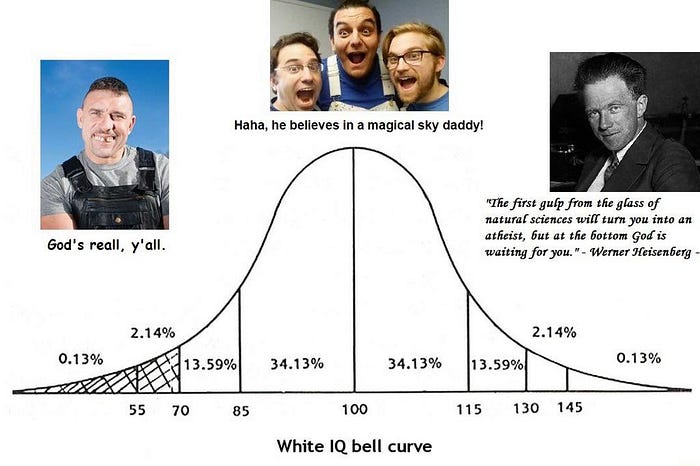
The “midwit” mocking meme below has become stock propaganda used by alt-righters and other counter-enlightenment types (there are many variations, this just happens to be the one I came across today).
It seems to imply that the greater levels of religiosity or theism professed by below average IQ individuals are vindicated by the fact that above average IQ individuals also have higher rates of religiosity or theism.
There are a number of problems with this meme, but the biggest one is that it is simply not true.
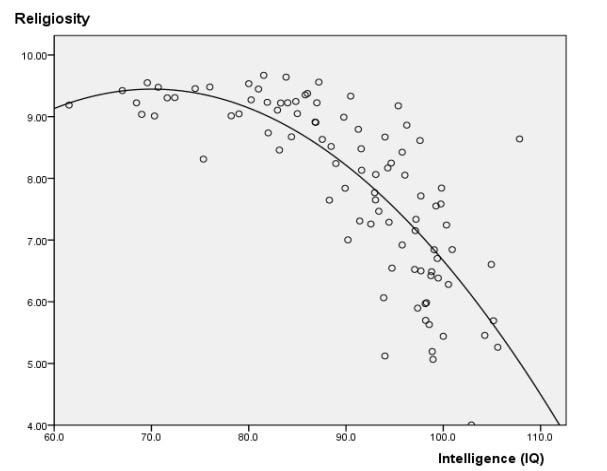
I surveyed psychological and sociological research in several databases to explore this issue. Of all of the rigorous studies I found on IQ and its relationship to religiosity / theism the opposite findings were reported: individuals with above average IQ scores report lower levels of intrinsic religiosity (religious belief, as opposed to religious behavior [e.g., church-going, church involvement] ), theism, and other supernatural beliefs than average or below average cohorts (see Alsan et al., 2020; Kanazawa, 2010; Saroglou et al., 2002; Woellert & Luttig, 2018; Zuckerman et al., 2013).
In other words, religious or theistic belief was negatively correlated with IQ scores — that is, as IQ score rises, religiosity / theism goes down (see the graph below).
Meisenberg et al., 2012
However, let’s make sure we are not strawmanning the implicit argument presented by this meme. In order to avoid this we will steelman it:
Premise 1: Below average IQ individuals report the highest levels of religiosity / theism.
Premise 2: Average IQ individuals report lower levels of religiosity / theism than below average IQ individuals.
Premise 3: Some above average IQ individuals report religious / theistic beliefs.
Conclusion: Therefore, religiosity or theism is not irrational.
This steelmanned version is valid, however, its soundness is questionable due to the complexity of the issue.
For instance, it is important to note that the religious, spiritual, or theistic beliefs of above average IQ individuals tends to be much different than those in the below average IQ cohort.
As discussed in Kanazawa (2010), above average individuals are more likely to have non-conforming or eccentric beliefs. That is to say, the theism or spiritual / religious beliefs professed by above average IQ individuals is much more likely to resemble the nuanced and freethinking views of Epicurus, Spinoza, Einstein, or Thomas Paine, than the dogmatic and supernatural views of the average Bible-believing religious person.
Other Problems:
The question of whether IQ tests fully capture intelligence (considering we don’t have a robust philosophical definition) is unresolved. Also, it is not clear that we have good reasons to consistently expect more epistemic rigor / rationality from high IQ persons, than from, say, high-average IQ persons. In fact, there is some evidence to suggest that a segment of the high IQ population may be predisposed to neuro-psychological epistemic dysfunction. I discuss both of these issues in my article The Fallacy of IQ Obsessiveness.
References:
Alsan, M., Phillips, M. R., & Wang, Q. (2020). Cognitive ability and religious beliefs: Evidence from the United States. Social Science Research, 95, 102336. https://doi.org/10.1016/j.ssresearch.2020.102336
Meisenberg, G., Patel, H., Woodley, M. A., & Rindermann, H. (2012). Is it smart to believe in God? The relationship of religiosity with education and intelligence. Temas em Psicologia, 20(1), 101–120.
Saroglou, V., Delpierre, V., Dernelle, R., & Dapy, X. (2002). Values and religiosity: A meta-analytic review of the nomological network of beliefs. Personality and Individual Differences, 33(5), 757–780. https://doi.org/10.1016/S0191-8869(01)00195-8
Zuckerman, M., Silberman, J., & Hall, J. A. (2013). The relationship between intelligence and religiosity: A meta-analysis and some proposed explanations. Personality and Social Psychology Review, 17(4), 325–354. https://doi.org/10.1177/1088868313491624
High altitude balloons (HABS) or airships (HAA) can be used for more than just surveillance. In fact, they could be (and have been) used as offensive weapons.
Credit: Chase Doak, 2/1/2023. Over Billings, Montana.
China’s explanation for the HAA currently (2/3/2023) loitering over the US is that it is a stray airship for meteorological study that has been blown off course. This may very well be true, but the timing of the event, and its size (around 120 feet in diameter) makes this claim dubious — the largest weather balloons are usually no more than 20 feet in diameter.
If this is not a “spy balloon,” what could it be? Some of the most concerning possibilities for HAA use:
An airship carrying one or more thermonuclear weapons. An HAB or an HAA could be an ideal platform to sneak attack with a nuclear weapon — especially those that are optimized to produce an electro-magnetic pulse (EMP). A nuclear explosion high in the atmosphere would produce an EMP that could destroy a large swathe of the US electrical grid. The Congressional EMP Commission’s report states:
“EMP is one of a small number of threats that can hold our society at risk of catastrophic consequences. EMP will cover the wide geographic region within line of sight to the nuclear weapon. It has the capability to produce significant damage to critical infrastructures and thus to the very fabric of US society, as well as to the ability of the United States and Western nations to project influence and military power.”
2. A biological warfare dispersal system.
3. A drone swarm mothership (imagine a swarm like those seen in professional drone shows, except they are all kamikaze drones; see: https://www.youtube.com/watch?v=Ma3ya_lqCLM). Another possibility: an HAA could be used to release very small surveillance drones that self-destruct or surreptitiously implant into electronic infrastructure.
4. An electronic warfare platform to disrupt communications, radar, etc.
5. A psychological operation to create general disruption or distraction from some other maneuver. Or perhaps to distribute propaganda (though this seems unlikely). A further psychological consideration is that doing this kind of incursion from time to time creates a “boy who cried wolf” effect, which may lower an adversary’s guard for a possible offensive use at a later date.
I do not consider the above possibilities to be highly probable, but they are concerning nonetheless.
Most likely this is an electronic espionage HAA.
Many have asked why China would need “spy balloons” if they have satellites. Some reasons:
Satellites cannot intercept all terrestrial radio signals, and the Chinese government is very curious about US radio chatter right now — considering the current geopolitical situation and the increasing tensions over the Taiwan issue.
A surveillance HAA of this sort would provide greater resolution intelligence imagery of airfields, missile silos, etc.
Spy satellites only have a short window of opportunity in their orbit to view, adversaries can “time” spy satellites and predict when it is concealable to do things like move materiel.
HAA / HAB may evade some radar system capabilities by flying above the detection ceiling.
Time will tell what type of HAA or HAB this is (the US is likely going to shoot it down over the ocean — though any sensitive hardware will have self-destructed before this), however, its use sends a clear signal and reveals a potential weakness in the armor of US defensive capabilities.
The discovery of extraterrestrial intelligence (ETI) would have great implications for humanity. While we may one day discover ETI which possesses lesser technological development than our own civilization, for the purposes of this essay I will only be discussing ETI that is technologically superior — that is, ETI which has advanced to the point where they (or it) can traverse the distance between stars, or communicate scientific / practical knowledge that is more advanced than ours. (Note: all following uses of “ETI” should be taken to imply “advanced ETI”).
Advanced ETI would undermine traditional theistic religious belief in at least two important ways:
The discovery of ETI that does not believe what a great percentage of humans believe about theism, an afterlife, etc., would raise questions about the veracity of these religious claims. This is because it is highly plausible that an advanced ET civilization would know more about major philosophical and scientific questions, such as, the origins of the universe (or multiverse), how life arises, how consciousness emerges, and what happens to individuated consciousness when it is extinguished, etc.
The discovery of ETI would entail that the holy books of some of the world’s most popular religions failed to mention, or provide an accurate account of other intelligent lifeforms in the universe. This would call into question the many other claims in these books.
The possible ways humans might react to this new information would take a variety of forms.
Some religious leaders and believers would scramble to revise their interpretations to make them more compatible with the discovery. (It should be noted that many non-theistic or non-traditional religious views already discuss the existence of ET life.) Others will become more entrenched in their traditional views and propose conspiratorial or denialist explanations of the discovery.
In response to this rupture of their worldview, individuals may resort to psychological coping mechanisms to protect their belief / identity. For example, some will attempt to explain an ETI entity or entities in religious terms (e.g., demons, angels, god/s, jinn, etc.). As is predicted in the novel Contact by Carl Sagan, some may resort to violence to stop further contact with the ETI.
ETI contact may cause further destabilization by initiating a corollary breakdown in traditional value systems. Since secular life philosophies have not diffused widely in most societies, the vacuum left from the dissolution of traditional values may not be filled soon enough to prevent anomie.
An ETI civilization’s knowledge of the possible destabilizing effects that may result from contact presents a compelling explanatory hypothesis for the Fermi paradox. I consider this hypothesis to be a variation of the zoo / laboratory / planetarium hypotheses; I call this the destabilization hypothesis.
In essence, the destabilization hypothesis states that an ETI is currently concealing their existence to prevent mass destabilization of our global civilization. Speculating further on this hypothesis, I believe an ETI would wait to make overt contact until humanity has developed to the point where contact would not cause such massive destabilization. For example, they may be waiting to see if we get past another great filter — such as, not destroying ourselves with our weapons of mass destruction — or they may only step in if we get close to that point. They may also be waiting to contact us when we get close to a technological singularity or merging with artificial intelligence — I wrote about this here.
Whatever the case may be, if we find strong evidence of ETI in the near future, it will further erode traditional theistic religion — that is, unless the ETI happens to share some of the same religious beliefs as traditional theists do; however, this is a possibility that does not seem highly plausible.
The so-called new atheist movement has mostly died out, however, atheism, and other non-religious views, are continuing to grow. Atheists and other “nones” (those that don’t identify with any religion) are largely disorganized, in that they do not belong to communities or groups that may help represent their interests. This article explains why I believe new atheism, and other atheist movements, have failed to inspire mass affiliation and change minds.
The main mistake of the New Atheist movement, in my view, is that its leading proponents gave off the impression that they considered atheism to be a sufficient substitute for religion (except for Sam Harris, who is trying to build a movement for rational spirituality). Their vision of Utopia seemed to be one in which an educated, rational, and mostly atheistic populace would behave prosocially and with stoic equanimity in creating a world without religious conflict, war, bigotry, hunger, and poverty. This simply is not a psychological reality in our current world.
Atheism offers nothing to replace the ethical, practical, and existential framework that religion provides. It is simply an absence of belief in deities. And the stillborn “atheism plus” movement only offered simplistic “woke” virtue signaling, and the divisive / indignant condemnation of others that is characteristic of these new secular social justice movements — rather than a psychologically informed and philosophically grounded theory of social justice (see SJWs the New Moralists).
Although it may sound pessimistic, I don’t believe we are close to seeing dogmatic religion, and the conflict it inspires, disappear from the world. Realistically, there are many people that need the restraint and scaffolding of religion to act prosocially, and to cope with the existential problems entailed by the human condition. Some societies may collapse without this scaffolding (see Does Religion Increase Moral Behavior?).
Religion also offers benefits in the form of ethical and practical instruction, and a possible community to belong to. While some alternatives to religion (e.g., Humanism, modern Epicureanism or Stoicism, secular Buddhism) also provide these benefits, these worldviews or life philosophies are either too vague (for instance, Humanism) or not well known / developed — in addition to having few, if any, established communities outside of the internet.
Many intellectually sophisticated individuals can lead healthy, acceptably prosocial, and happy lives without religion, but the global community is not ready to give up the opium of the masses, nor would the world necessarily be in better shape if they did — at this point in time. It seems highly plausible that some people need the carrot and stick of religion to stay out of habitual antisocial behavior — on the individual and collective level — and to assuage their existential malaise.
In order to reach something approximating an atheistic Utopia, there are many changes that need to be made in education, reproduction, and our socioeconomic systems, etc., but perhaps most importantly, we need to further build alternatives to religion — such as those mentioned above (see Why It Is Important to Have a Philosophy Of Life).
Nearly every philosophical question hinges on ultimate metaphysical questions — such as, “Why does something exist, instead of nothing?” Or, “Is the universe intelligently designed?” How one answers these questions will determine, to a great extent, their views on other metaphysical questions, on epistemology, and on ethics.
Many people throughout history have answered these ultimate questions through various conceptions of theism — that is, various conceptions of an entity or entities possessing higher order intelligence and other extraordinary powers. The most common term used to describe such entities is “god” or “deity”.
When it comes to the origin of theism, or religion / spirituality in general, we do not have a lot of definitive answers. The precise time period and the exact nature of the first religion / spirituality is obscured by the fog of time, however, anthropological evidence suggests that some of the earliest forms of religion or spirituality may have involved sun / lunar worship, ancestor worship, and animal / nature worship. Some of these proto-religions evolved over time to become more organized and explicitly theistic.
Over the millennia, theism and religion have evolved through a selection process similar to that which biological organisms are subjected to. Tens of thousands of gods and religions are dead — no one, or nearly no one, believes in them. The religious belief systems which have outcompeted rival systems usually involve classical theism, a moralistic deity or deities, an afterlife involving rewards and punishments, and duties to proselytize.
Despite the fact that the world’s most successful religions (Islam and Christianity), and increased knowledge of the natural world, have virtually relegated some forms of theism — such as solar / lunar worship — to anthropological history, there are still several other active forms of theism (e.g., deism, polytheism, pantheism, pandeism, etc.).
With so many forms of theism, it does not seem tenable for one to hold just one position. Therefore, the position that I take with regard to theism depends on the form of theism in question.
With regard to the traditional form of theism posited by the world’s most successful religions — Christianity and Islam — I am a strong atheist, and, in a sense, an antitheist.
I take the position of strong atheism because, as I argue in this article, in some instances absence of evidence is evidence of absence. In other words, I object to traditional Christian or Islamic theism on evidentialist grounds. Further, the dominant form of these religions entails classical theism and classical theism entails untenable logical contradictions. I outline some of these in my article on the Epicurean paradox. (Note: There are many other strong arguments that can be leveled against this form of theism, but I consider the arguments stated here to be the primary reasons why I reject this view.)
I take the position of antitheism toward the traditional form of Christian / Islamic theism because I believe it may be harmful on an individual level (depending on the specifics of the belief system), and on a wider, societal level (e.g., stifling scientific progress, inspiring bigotry against sexual minorities, providing rationalizations for systemic animal abuse, etc.). Moreover, the clash of major religions — in the modern age — is a strong contributor to the existential threat posed by global conflict involving weapons of mass destruction. (Note: This doesn’t mean I directly try to get individuals to change their religious beliefs — there are a number of reasons why this is unlikely, and, further, why it may not be helpful. In fact, in some instances, it could be harmful. My take on antitheism is resistance to these belief systems in general — that is, arguing against these belief systems, rather than directing critical arguments toward any specific individual without that person desiring a philosophical discussion on this subject.)
Polytheistic conceptions of gods vary from tradition to tradition and individual to individual. The ancient philosopher Epicurus, for instance, may have believed in the gods of the ancient Greek pantheon, but, as Tom Robinson argues, it seems that he may have conceived of them in a metaphorical or quasi-metaphorical sense — that is, as something similar to Platonic or Jungian archetypes. Also, polytheism does not usually entail the four attributes of classical theism, so the logical contradictions discussed above do not necessarily apply. Depending on the conception of polytheism in question, I would take the position of weak atheism, theological non-cognitivism, or strong atheism.
Stated briefly, I would take the position of theological non-cognitivism if the conceptions posited are unfalsifiable, since if it is not possible to falsify a hypothesis, neither is it possible to prove it; further, if we cannot falsify a hypothesis, then we are discussing a logical absurdity with no actual meaning. Weak atheism stops short of stating that these conceptions of god are existentially impossible, but objects to them on evidentialist grounds (we do not have good epistemological reasons to believe in them). If the form of polytheism in question made falsifiable claims about their conception of gods, then, barring some sufficient evidence, I would take the position of strong atheism.
Regarding more vague conceptions of god — such as those entailed by deism, pantheism, pandeism, or ill-defined “spiritual” conceptions — I am either a theological non-cognitivist or a weak atheist (for the same reasons outlined in the preceding paragraph), depending on the particulars of the conception. Theological non-cognitivism, on my view, would apply to any sort of theism which does not provide a meaningful (clear / intelligible / coherent) or falsifiable definition of god/s.
This common aphorism is usually employed by theists who believe it overrides evidentialist objections to theism. In regards to situations where an occurrence or existence would entail the presence of evidence — for instance, like the existence of a god that interferes or has interfered in human affairs in very salient ways (e.g., disrupting natural laws or causing other types of miraculous events) — it is absolutely false.
Logically, if something is said to have interacted with the world in ways that would produce evidence, and a thorough investigation fails to produce non-controversial evidence, then this becomes strong (probabilistic) evidence against the existence or occurrence being asserted.
When this aphorism is addressing occurrences or existences that would produce no evidence, then it is true, but if something produces no evidence we cannot have a meaningful dialogue about its existence or non-existence because we are dealing with an unfalsifiable absurdity. The only appropriate response to such an absurdity is non-cognitivism. Or, more pragmatically, we could use Hitchen’s razor: “That which can be asserted without evidence, can be dismissed without evidence.”
If a person claims that an occurrence or existence does produce evidence, but that this evidence is somehow cryptic or indirect, then the burden of proof rests on the person making the extraordinary claim (see Russell’s Teapot), not on the person who does not believe the assertion.
In summary: While the aphorism holds true in instances where evidence is likely to be cryptic — this is not the case with most religious conceptions of god/s. The world’s most popular religions posit the existence of a deity which has, and/or continues to, interfere with the known world in striking or noticeable ways; and in such cases, the absence of evidence is strong probabilistic evidence against the existence of such entities.
Regardless of whether the aphorism holds true or not, it does not entail a good reason to believe in something. If the person arguing for the existence of some elusive entity wants to convince others, they must show how this existence can be plausibly inferred in some other way besides direct evidence. This is why we say the burden of proof rests on the person making an extraordinary claim.