Essays, Articles, Videos & News

Tag: culture

Project Blue Beam: A Defense Mechanism Against Ontological Shock

Introduction: What is the Project Blue Beam Conspiracy Theory

Project Blue Beam (not to be confused with Project Blue Book — a real U.S. Air Force program that investigated UFOs from 1952 to 1969) is a conspiracy theory that emerged in the 1990s from the claims of Serge Monast, a Canadian conspiracy theorist influenced by conservative Christian ideology. Monast’s claims varied over time, but his core narrative remained consistent: governments will simulate a global alien invasion using holograms, advanced weapons, and possibly religious imagery to collapse traditional belief systems and institute a tyrannical “one-world government.”

Despite a complete lack of credible evidence, belief in Project Blue Beam has persisted through conspiracy theory forums and celebrity promotion since Monast’s death in 1996.

Photo by Galactic Nikita on Unsplash

Why Project Blue Beam is Implausible on Its Own Terms

Before examining what this conspiracy theory reveals psychologically, we should establish why it fails as an explanatory hypothesis.

First, the technical logistics are absurd. Projecting convincing holograms visible from multiple vantage points across entire cities or regions would require technology that doesn’t exist and likely violates basic principles of optics. Holograms require specific viewing conditions and substrates — you cannot simply project them onto the sky.

Second, the coordination required would involve tens of thousands of individuals across multiple governments, scientific institutions, aerospace companies, and military branches. The operational security challenges alone make this scenario fantastical. Large-scale deceptions invariably leak — see the Pentagon Papers, Watergate, or any number of actual government conspiracies that were exposed precisely because humans are terrible at maintaining secrecy at scale.

Third, the theory offers no coherent explanation for motive. Why would powerful institutions risk destabilizing the very systems that grant them legitimacy and control? The claim that elites want to “destroy religion” ignores that religious institutions have historically been allies of state power, not obstacles to it.

The theory is not just wrong — it is incoherent. But this incoherence is precisely what makes it psychologically revealing.

Blue Beam as a Defense Mechanism Against Ontological Shock

Every time humanity has confronted evidence that it is not metaphysically central, a predictable reaction emerges. Geocentrism collapsed under Copernican astronomy. Special creation fractured under Darwin’s theory of evolution by natural selection. Each displacement triggered denial, suppression, and conspiratorial thinking: “Darwin was a Satanic agent undermining religion.” “Copernicus was an atheist destroying the Church.”

We are approaching another such threshold. The serious study of UAPs (including official government acknowledgments that some observed phenomena remain unexplained), advances in astrobiology, the statistical implications of exoplanet discoveries, and the sheer scale of the observable universe have produced an unmistakable psychological shift. The cosmos no longer looks like a lifeless void designed exclusively for human drama — it looks habitable, and quite possibly inhabited.

For some individuals, this shift culminates in what can be called ontological shock — the jarring experience of confronting evidence that fundamentally challenges one’s categorization of what exists and how entities relate to one another. This is not mere cognitive dissonance, where contradictory beliefs create internal tension. It is the threatened collapse of an entire worldview — the person’s working model of reality itself.

Project Blue Beam functions as a psychological adaptation narrative designed to preemptively neutralize ontological shock.

The idea of extraterrestrial intelligence is not merely scientific; it is metaphysical. It destabilizes deeply rooted assumptions about humanity’s uniqueness, moral centrality, and theological significance. For religious traditionalists committed to literalist interpretations of Abrahamic texts, the existence of non-human intelligence poses an intolerable contradiction. If other intelligences exist, then humanity is not special in the sense of being a deity’s singular creation. This challenges religious narratives, forcing them to either update or become obsolete.

More provocatively: if more advanced civilizations exist and demonstrably do not share our dominant religious beliefs, this severely undermines claims about the universal truth and divine origin of those beliefs, the moral systems derived from them, and the institutions founded upon them.

Blue Beam resolves this tension by reframing the threat. Aliens are not real — belief in aliens is the psyop, a government psychological operation. The cosmos remains empty, humanity remains central, and God remains the exclusive ruler of a human-centric universe. Crisis averted.

This is not a consciously cynical move by most believers. It is a genuine psychological defense mechanism that preserves cognitive coherence at the cost of epistemic accuracy. The narrative provides comfort and stability, particularly for those who lack philosophical training in navigating paradigm shifts or who have been socialized into rigid, non-negotiable truth claims.

To be clear: not all conspiracy thinking is pathological, and institutional distrust has rational historical precedent. Governments do lie, do run psychological operations, and do manipulate public perception. Healthy skepticism is a civic virtue. But there is a categorical difference between evidence-based skepticism and conspiratorial reasoning that retrofits reality to preserve a predetermined conclusion. Blue Beam belongs to the latter category.

Why We Must Move Beyond Human Exceptionalism

Whether or not contact occurs in our lifetimes is almost beside the point. A civilization psychologically incapable of tolerating non-human intelligence is structurally unfit for the future it is already building.

The same anthropocentric rigidity that rejects extraterrestrial intelligence also struggles with artificial intelligence, post-human ethics, synthetic biology, and moral expansion beyond tribal and species boundaries. It cannot imagine sharing the universe. It cannot update its moral circle. It treats the unknown not as a frontier for discovery but as a threat to be denied or destroyed.

This rigidity is not just intellectually limiting — it is existentially reckless. Long-term survival requires epistemic humility, technological advancement, off-world expansion, and the flexibility to incorporate radically new information into our models of reality. We already know that cosmic impact risks (asteroids, comets), supervolcanic eruptions, engineered pandemics, AI misalignment, and large-scale WMD warfare are not speculative fantasies — they represent either inevitabilities on a long enough timeline or events with non-negligible probability.

Remaining Earth-bound is not romantic traditionalism; it is strategic suicide. If we encounter non-human intelligence — whether extraterrestrial or artificial — and our response is denial, hostility, or theological panic, we will have failed the most basic test of adaptive rationality.

Moreover, we can already infer, with reasonable confidence based on astronomical evidence and probabilistic reasoning, that we are likely not alone in the universe. The discovery of thousands of exoplanets, many in habitable zones, combined with the vast number of galaxies and stars, makes the hypothesis of exclusive human intelligence increasingly untenable. We may simply be waiting on empirical confirmation, complicated by vast distances and timescales.

When Ontological Panic Turns Violent

The most serious danger posed by conspiracies like Project Blue Beam is not ignorance — it is radicalization.

History demonstrates that when foundational worldviews collapse, some individuals choose destruction over adaptation. The fictional terrorist attack in the film Contact — where a religious extremist sabotages humanity’s first attempt at interstellar communication — was not narrative contrivance. It was psychologically accurate. For those who experience paradigm collapse as existential annihilation, violence can feel not just justified but righteous.

We have seen this pattern before. The Inquisition’s response to heliocentrism. The violent resistance to evolutionary biology in certain communities. The contemporary attacks on scientists working in fields like climate science or vaccine development. Ontological panic does not always remain rhetorical — it weaponizes.

Preparing for possible contact, therefore, requires more than technological readiness. It requires cultural and philosophical resilience against ontological panic. It requires education systems that teach cognitive flexibility, media literacy that distinguishes skepticism from conspiratorial thinking, and public discourse that can hold space for paradigm shifts without collapsing into tribalism or violence.

Building Ontological Resilience: Practical Steps Forward

So what does productive preparation look like?

Educational reform: Teach philosophy of science, Bayesian reasoning, and the history of paradigm shifts. Help people understand that updating beliefs in light of new evidence is not weakness — it is rationality. Create frameworks for navigating uncertainty without retreating into rigid dogmatism.

Religious and philosophical integration: Religious traditions are not monolithic. Catholic theology, for example, has engaged seriously with the possibility of extraterrestrial life for decades. Progressive interpretations of religious texts have always existed alongside literalist ones. The challenge is not whether religious worldviews can adapt — many already have — but whether those who hold them are willing to engage that flexibility.

Public discourse: Model how to hold strong convictions while remaining epistemically humble. Demonstrate that one can take ideas seriously without treating every question as an apocalyptic crisis. Normalize the statement: “I was wrong, and I have updated my beliefs.”

Media and information literacy: Equip people to distinguish between legitimate institutional critique and conspiratorial thinking. The former relies on evidence, updates with new information, and can be falsified. The latter is unfalsifiable, retroactively reinterprets all evidence, and treats absence of proof as proof itself.

Conclusion: Cosmic Maturity or Cosmic Irrelevance

Humanity is approaching another Copernican moment. We can accept it — expanding our metaphysics, our ethics, and our conception of ourselves to accommodate a universe that does not revolve around us — or we can cling to anthropocentric narcissism and denial.

The universe does not negotiate with denial. It does not care about our psychological comfort or our theological investments. Reality will continue regardless of whether we adapt to it.

The question is not whether non-human intelligence exists. The question is whether we are capable of the intellectual and emotional maturity required to accept that possibility — and to act accordingly.

Project Blue Beam is a symptom of that immaturity. It reveals a civilization still gripping childhood myths in the face of an adult cosmos. We can choose to grow up, or we can choose to remain small. But we cannot remain both small and safe. The universe is already too large for that delusion.


My Thoughts on the Charlie Kirk Assassination

I intend this to be a brief post since I already wrote about my views on political violence in general here.

I am writing this as a form of self-therapy to express my thoughts and emotions about this event.

For me, writing is both a therapeutic form of expression, and a way of organizing and deliberating on my own thoughts. So, I write more for myself than for an audience — which is a helpful way of framing things, since I will probably never be a celebrated “great writer.” Accepting that writing is more for me than for reaching others, or being applauded by others, is a great way to keep me devoted to this beneficial activity. If I thought otherwise — for example, if I thought one should only write if they were exceptionally good at it, or only if they received popular praise for their work — then I would have quit long ago and lost the personal benefits that I gain from writing. Framing things in this way also keeps me authentic — it keeps me from trying too hard to fit into what I think other people want from a writer.

In this case, I found it helpful to write on the topic because I have been somewhat distressed by having to listen to people celebrate the violent death of another person. Given the nature of my professional work, I have mostly kept this to myself, but I wanted to be able to discuss how I feel and why I think this (people celebrating violence) is very concerning.

Photo by Phoebe T on Unsplash

To briefly consider objections, I understand how some people might typically respond to my concern. They might mention other contemporary events that are more harmful in terms of a casualty count (the fallacy of relative privation — a fallacious appeal to “worse problems”), or they might appeal to specious utilitarian reasoning that argues that “hate speech” causes more harm than one death (operating on the false premise that Kirk engaged in hate speech, and assuming the conclusion that using violence to stifle hate speech is less net harmful than hate speech). I don’t intend to seriously consider these objections here, however, if anyone wanted me to expand on my parenthetical responses to these I could do that in the comments.

To return to my concern, I think celebrating any person’s death (outside of some extreme case circumstances) is possibly indicative of indoctrination with toxic ideology, or in some cases, psychopathology. On a human level, I can understand the urge or initial emotion of schadenfreude, relief, or even sadistic/vengeful satisfaction — but I consider these to be harmful impulses that are not in our, or society’s, best interest to assent to. An adaptive philosophy of life can instruct us on how to refrain from automatically reacting to initial thoughts, emotions, and other impulses, but instead to delay our reaction so that we are able to give critical consideration to whether these thoughts/impulses are rational or in-line with our values. (If you are interested in reading more about why I think toxic ideology is harmful to the individual and to society, and why adaptive philosophies of life are beneficial you can read my article on Helpful Philosophies of Life vs. Toxic Ideologies.)

Given how much of this sadistic celebration of Kirk’s death that I have witnessed in my personal life, my professional life, and in social media / on the news, I think there is prima facie justification to consider the possibility that toxic ideology is pervasive in our society and in the world.

This is an obvious concern because toxic ideology that compels individuals to violence could pose an existential threat to our species. We live in the age of weapons of mass destruction, and the same hateful ideology that would compel one individual to assassinate someone could compel another to engage in mass terrorism. In the worst case scenario this mass terrorism would involve the use of CBRN (chemical, biological, radiological, or nuclear) weapons — we might also add electronic or cyber weapons to this list. Terrorist events are not likely to be existential threats in themselves, but they could plausibly contribute to instability and conflict that could escalate to regional and global levels. Even more concerning is the fact that in some cases we see the ruling factions of entire nations being corrupted by these toxic ideologies.

It is largely irrelevant, but in the spirit of full-disclosure, I should note that I did not agree with Charlie Kirk on many issues; from what I have seen of his videos I did not always like his approach to debating, but I mostly found him to be respectful and reasonable — certainly not the hate monger that many have painted him to be. As someone committed to philosophical investigation and discourse, I am opposed, in the strictest sense possible, to any attempt to stifle free expression, and any use of violence that is not legitimately last-resort defensive in nature.

In contrast to amoral or antisocial toxic ideologies that view acts of violence against “enemies” as a legitimate tool of change, an adaptive philosophy of life provides the individual with ethical, epistemic, and practical guidance. An adaptive philosophy of life serves to inoculate the individual against indoctrination or passively accepting erroneous or biased information, and it also inoculates against aggression by restricting the use of violence to only defensive or last resort situations. [Note: I wrote more on this here, on the Ataraxism website.]

My concern extends beyond the realm of pragmatic societal concerns, however. I am also concerned for the psychological wellbeing of people who celebrate violence — those who romanticize hate and anger and who hold onto hate and anger. When I encounter people that are stuck in this way of thinking (as I once was myself) I always think of the fifth century Buddhist scholar and monk Buddhaghosa’s parable on anger:

“By doing this you are like a man who wants to hit another and picks up a burning ember or excrement in his hand and so first burns himself or makes himself stink” (Visuddhimagga IX, 23).

When we hold onto anger or hate we are not only potentially harming others, we are also harming ourselves. This anger and hatred will come out in other areas of our lives and cause harm — it may come out in our relationships, in our general conduct and thinking, and it will cause us to suffer needlessly.

For me, the celebration of another person’s death is not simply tasteless, it reflects the deeper problem of toxic ideology at work in our culture — ideologies which embrace and celebrate anger and hate. While political, economic, and social factors all play a role in violence, I believe toxic ideology remains one of the most dangerous and corrosive forces we face, both for society and for the psychological wellbeing of individuals.

If nothing else, setting these thoughts to paper reminds me of why I write: not to impress others, but to clarify my own thinking and to resist the pull of anger, resentment, and despair. In this way, writing itself becomes an act of cultivating an adaptive philosophy of life — one grounded in reflection, compassion, and an effort toward understanding.

Helpful Philosophies of Life vs. Toxic Ideologies

A philosophy of life is essentially a cognitive framework — a set of principles that guide our thoughts and actions, and, in a less obvious way, our emotions. A coherent and adaptive (psychologically helpful) philosophy of life is critically important to the individual, and, through its distal effects, to society. In addition to providing individuals with ethical and practical guidance, it also helps a person to develop a sense of meaning, purpose, direction, and inspiration.

Additionally, a philosophy of life can foster a sense of connection to others who share similar values — serving as a source of identity and psychological stability. Without at least a rough working philosophy of life, individuals may find themselves adrift — lacking the direction needed to make wise decisions, endure hardship, and pursue self-actualization.

However, not all cognitive frameworks are equally beneficial. Some ideologies or religious systems may be “toxic” to the individual and to society as a whole — in a way that is analogous to how malware disrupts a computer system. Unfortunately, many people adopt toxic ideologies or toxic religious beliefs as their philosophy of life — to the detriment of themselves and society. We see this when people fall into extreme or rigid forms of religious or ideological belief. Often times toxic ideological views may be implicit — for example, a toxic subculture may not explicitly articulate its ideology, but rather signal it in various overt or subtle ways.

While every philosophy of life must rest upon certain “dogmas” or foundational axioms — as Sam Harris argued in one of his early debates with Jordan Peterson — “not all dogmas are equal.” Foundational axioms that are unfalsifiable, metaphysically complex, or disconnected from reason and evidence are more likely to support irrational or harmful conclusions. For example, dogmatic claims such as “divine revelation is the highest form of knowledge,” or “faith is superior to reason in matters of truth,” introduce untestable metaphysical assumptions that violate the principle of parsimony. Because these axioms are not grounded in evidence and logic, they resist revision and they tend to promote absolutistic or black-and-white thinking.

In contrast to these kinds of unfalsifiable or complex dogmas, a foundational axiom of Ataraxist philosophy of life (the philosophy of life I have been developing) holds that “Our understanding of the world is most likely to be accurate and useful when it is grounded in a rational, reliable way of analyzing the best available evidence.” This axiom is metaphysically simple, testable, and self-correcting.

I mentioned the example of dogmatic religion above, but I am not arguing that all religious belief is harmful; in fact, evidence supports the view that it is often beneficial on the individual level — likely because its helpful aspects outweigh its harmful ones, or because individuals adapt their religious beliefs to align with modern, near-consensus secular ethics or personal psychological needs. (Note: Whether a particular religion is adaptive on the individual level depends on a number of factors. The broader question of whether religion benefits society or geopolitical stability lies beyond the scope of this article.)

In addition to being rational and parsimonious, foundational axioms should ideally be helpful — that is, they should align with well-established principles of human flourishing, or at least be revisable in light of new evidence. At a minimum, an adaptive philosophy of life ought to contain a coherent and reasonably prosocial (neutral or beneficial to others/society) normative ethical code and epistemic norms that contain mechanisms for error correction, such as the principle: “No statement should be believed without justification in the form of sufficient evidence or sound reasoning.” This sort of epistemic standard engenders epistemic humility, and helps prevent ideological drift into rigidity, fanaticism, or harm. Put simply, an epistemology grounded in reliable ways of identifying and analyzing solid evidence innoculates the individual against toxic ideology; when a coherent and pro-social ethical code is added, the individual is highly immune to becoming indoctrinated with toxic ideology.

Many ideologies cannot be considered as helpful philosophies of life, either because they contain potentially harmful dogmas, and/or because they lack sufficient structure, in the form of an ethical code or epistemic principles, to guide behavior. Vague ideologies or value systems that emphasize goals without outlining a foundational theory or a rational means to achieve their stated goals are vulnerable to becoming toxic to individuals or society. For example, while feminism may aim for certain valuable goals, it does not, in itself, contain the philosophical foundations to ensure that the movement avoids misandry, and other forms of hatefulness and tribalism. The same could be said of any other goal-focused ideology that lacks a sound philosophical foundation. Similarly, many political and religious ideologies can devolve into hatefulness and promotion of harm if they lack foundational principles that promote reason and unconditional compassion.

Friedrich Nietzsche warned that the collapse of traditional religion — what he called the “death of God” — would leave a moral and spiritual vacuum that modern societies would rush to fill with new, secular ideologies. Without a sound ethical foundation, these ideologies risk becoming toxic secular religions: dogmatic systems that demand conformity and justify persecution.

Nietzsche developed the concept of ressentiment to describe a reactive cultural moral psychology rooted in perceived powerlessness — a festering envy that would engender a mob mentality hatred of those who hold power, or those who are perceived to hold power. Rather than bringing about a more just society, these ressentiment-based mass movements tend to engender a violent inversion of values and perceived power structures — where vengeful condemnation is directed at those who were seen as oppressors. Through the power of the State, the resentful masses enact their mass hatred. In Thus Spoke Zarathustra, Nietzsche famously warned that “the State is the coldest of all cold monsters,” a new idol that claims to embody the will of the people while manipulating them through fear and false virtue. From the struggle sessions of Maoist China to the dogmatic and demagogic excesses of modern cancel culture, we see how social justice movements, which lack philosophical rigor and the restraint provided by a coherent ethical system, can devolve into campaigns of moral absolutism and terror — echoing the very religious zealotry they replaced. The catastrophic death tolls of fascist and communist regimes, driven by such ideological fervor, remain a haunting testament to Nietzsche’s prescience.

As Albert Ellis argued in The Road to Tolerance, a healthy philosophy of life should be grounded in unconditional self-acceptance, other-acceptance, and life-acceptance. These values are not simply moral ideals, but practical cognitive frameworks that promote psychological resilience and ethical conduct. A helpful philosophy of life is rational, self-correcting, empirically grounded, and conducive to human flourishing. Where existing philosophies of life fail to meet these criteria, we would be wise to revise or replace them — and if we are not satisfied with any existing philosophy of life, we may want to consider developing our own.

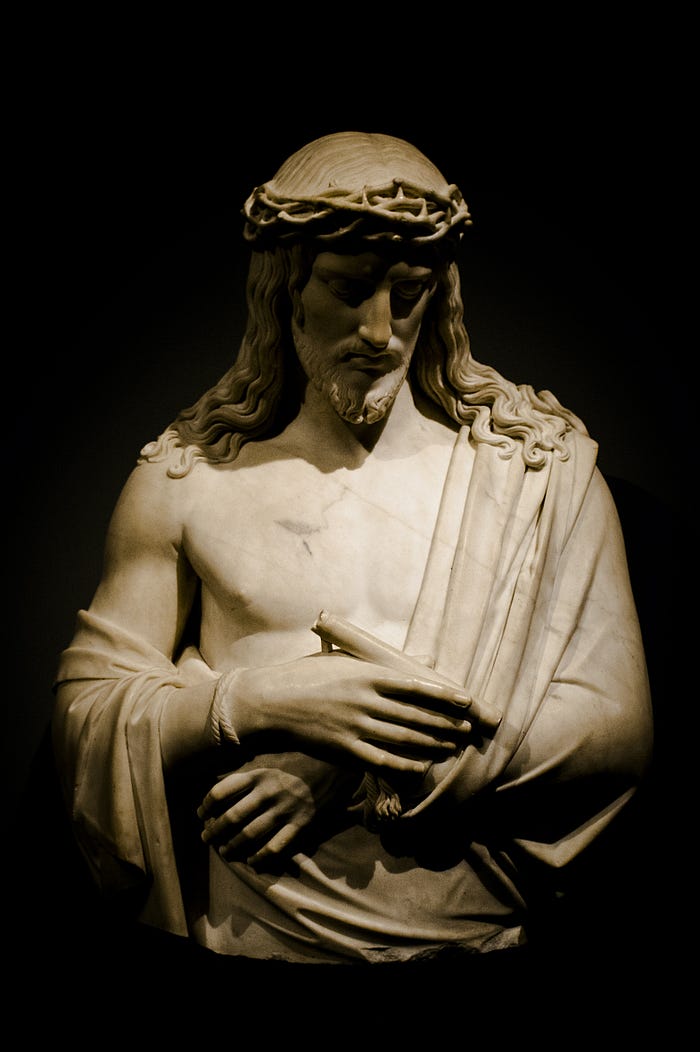
The Jesus Paradox

In the gospels we find in Jesus’ words and deeds some highly noble ethical precepts¹ and acts of beneficence, but also some of the most vile aspects of Judeo-Christian theology².

Photo by Alessandro Bellone on Unsplash

Jesus preached about the hypocrisy of rigid moralism and the importance of understanding and compassion in the story of the adultress³, but he also preached, in many instances, about eternal damnation, with vivid descriptions of never-ending torture, unquenchable flames, and gnashing of teeth.⁴

On the traditional religious view of Christianity this paradox is ultimately irreconcilable. In spite of the attempts of religious apologists and theologians, the idea of an all-loving, all-knowing, and all-powerful god cannot be reconciled with the conception of a universe where sentient beings not only suffer on Earth, but also, potentially, in an eternal hell realm, where the suffering is presumably much worse.

For non-believers the good of Christianity is usually discarded with the bad, unfortunately. (The good being the many admonishments in favor of understanding or forgiveness and against sanctimonious moralism; and that Christianity represented a progressive evolution of morals, a widening of the sphere of concern from the tribe to all persons—even those which you vehemently disagree with—which is best illustrated in the parable of the good Samaritan.)

A rationalist view that seeks to understand the genesis and importance of cultural myths circumvents the need to resolve this paradox. Such a view discards superstition and recognizes that myths are rarely wholly coherent. This view recognizes and preserves the good of Christian mythology, since it represents one of the most important shifts in Western morality—away from strict divine command moralism and toward compassionate humanism. In this view, the Biblical story of Jesus is mostly legendary, and it represents what we might call an archetype, in Jungian terms, rather than an accurate biography of a historical figure.

The symbolism of Jesus dying for humanity, a humanity that essentially votes to put him to death, is powerful, and it illustrates the perniciousness of sanctimonious groupthink—a social phenomenon which continues to inspire anger, hatred, persecution, and vindictive punishment in our time.

Our global society needs the example of Jesus more than ever—not the Jesus of religion, but the myth of the magnanimous and compassionate hero who forgave sinners and enemies, and criticized self-righteous dogmatists; the Jesus who, like Socrates, died in noble defiance of the hatred of the mob.

  1. See the Parable of the Good SamaritanGalatians 5:14Luke 6:31.
  2. This contrast is exemplified by Matthew 35:31–46; in this passage there is a beautiful and noble sentiment about taking care of “the least” of humanity (those without significant social status, those who are suffering the most), and then, in the latter part, Jesus is again discussing the hellfire that awaits the majority of humanity.
  3. Incidentally, this passage is seen by most scholars as being an interpolation — a piece of text added to the original canon at a later date. However, it seems plausible that if Jesus existed as a historical person (rather than a purely legendary figure), which is debatable, then such a story is indicative of his character. Regardless, this has been incorporated as a fundamental part of the Jesus mythos.
  4. Some Christians interpret these passages about Hell to be metaphorical, however, this interpretation does not seem plausible due to the fact that in many cases the language seems to imply literal meaning. For more on the metaphorical interpretation see the religious scholar Bart Ehrman’s work.

Revolution and Evolution: Why Those Seeking Social Change Should Understand Adaptationism

In modern evolutionary biology there is a core concept known as adaptationism (or functionalism). Adaptationism seeks to explain a trait’s existence by describing the adaptive function it serves.

In other words, adaptationism proposes that the most likely explanation for why a particular trait was conserved (i.e., persisted over time), is the one that best demonstrates why it would be adaptive — that is, why the trait serves to increase individual or group fitness. For example, it is hypothesized that dinosaurs first developed feathers for thermoregulation, and later some species developed more specialized feathers — such as those that enhanced gliding abilities. In this case, feathers served a primary adaptive function — to insulate the body; this and other, secondary functions (sexual signaling, gliding enhancement, etc.) helped ensure that the trait was preserved after it appeared.

Cultures, in many ways, are analogous to organisms — a fact that is illustrated well by Richard Dawkin’s concept of a meme, or a unit of cultural information that is analogous to a gene in biology. Due to these analogical similarities we can often develop an understanding of cultures and cultural phenomena by appealing to evolutionary principles.

Image by PublicDomainPictures from Pixabay.

An adaptationist view of cultural evolution holds that a cultural phenomenon is extremely unlikely to have been conserved if it was not advantageous to the population. The adaptationist view, when applied to culture, seeks to describe a cultural phenomenon in terms of its function or adaptive purpose. For example, some hypotheses explain the cultural phenomenon of religion through demonstrating why such a belief system could prove to increase the fitness (the group flourishing and persistence over time) of a culture — or, more precisely, the population which gives rise to the culture (see evolutionary psychology of religion).

[Note: Over time it is possible that successful cultural adaptations are encoded genetically through a culturally mediated selection processes. For example, certain forms of prosociality are socially enforced, which tends to increase the reproductive fitness of those who are predisposed to adhere to them.]

Those who want to do away with worn out cultural norms or create major socioeconomic changes should first seek to develop an adaptationist approach to revolution — that is, before they advocate for eliminating a targeted cultural institution they should seek to understand why it might have come into being, why it persisted, and then propose an alternative that will better serve its societal function/s —that is, if it is indeed found to still be performing important functions.

(Note: It is possible that a cultural institution has never served an important function — rather, that it is a spandrel, however, one must investigate to discover whether this is the case. It is also possible that a cultural institution may be an exaptation — initially developing as a byproduct or for a particular purpose, but finding later utilization for an altogether different purpose.)

The general principle or heuristic that prescribes the above approach is known as Chesterton’s Fence. This principle uses the analogy of a seemingly purposeless fence found on a road to illustrate why it is important to find out if there is a purpose for something before we do away with it. In this analogy it is possible the fence is serving an important purpose — such as, blocking a danger on the road; if we assume the fence is purposeless and hastily tear it down there may be negative consequences.

One prominent example of the above is the critical situation posed by dogmatic religions (and dogmatic ideologies in general). A cogent case can be made that many of these belief systems now constitute a real existential threat to our species — regardless of how adaptive they were at one point in history. It is likely, however, that religions still serve important adaptive functions in peoples’ lives, and in society.

Psychological research has revealed some of the primary adaptive functions of religion. Religion helps to build an individual’s social support network, it serves to provide a scaffolding for personal meaning creation, it provides practical wisdom and ethical guidance, and it functions in a terror management capacity to assuage death anxiety, epistemic uncertainty, and to connect the individual to something bigger than oneself.

If we are to supplant dogmatic religion we must promote rational philosophies of life that can also serve these functions. (For some examples see: secular BuddhismEpicureanismStoicismLiberationism.) Likewise with any other outdated cultural institution, an approach to revolution that is conscious of cultural adaptaptionism is much more likely to succeed than one that only seeks to destroy the existing order.

© 2026 Max Severin

Theme by Anders NorenUp ↑