Essays, Articles, Videos & News

Tag: culture war

My Thoughts on the Charlie Kirk Assassination

I intend this to be a brief post since I already wrote about my views on political violence in general here.

I am writing this as a form of self-therapy to express my thoughts and emotions about this event.

For me, writing is both a therapeutic form of expression, and a way of organizing and deliberating on my own thoughts. So, I write more for myself than for an audience — which is a helpful way of framing things, since I will probably never be a celebrated “great writer.” Accepting that writing is more for me than for reaching others, or being applauded by others, is a great way to keep me devoted to this beneficial activity. If I thought otherwise — for example, if I thought one should only write if they were exceptionally good at it, or only if they received popular praise for their work — then I would have quit long ago and lost the personal benefits that I gain from writing. Framing things in this way also keeps me authentic — it keeps me from trying too hard to fit into what I think other people want from a writer.

In this case, I found it helpful to write on the topic because I have been somewhat distressed by having to listen to people celebrate the violent death of another person. Given the nature of my professional work, I have mostly kept this to myself, but I wanted to be able to discuss how I feel and why I think this (people celebrating violence) is very concerning.

Photo by Phoebe T on Unsplash

To briefly consider objections, I understand how some people might typically respond to my concern. They might mention other contemporary events that are more harmful in terms of a casualty count (the fallacy of relative privation — a fallacious appeal to “worse problems”), or they might appeal to specious utilitarian reasoning that argues that “hate speech” causes more harm than one death (operating on the false premise that Kirk engaged in hate speech, and assuming the conclusion that using violence to stifle hate speech is less net harmful than hate speech). I don’t intend to seriously consider these objections here, however, if anyone wanted me to expand on my parenthetical responses to these I could do that in the comments.

To return to my concern, I think celebrating any person’s death (outside of some extreme case circumstances) is possibly indicative of indoctrination with toxic ideology, or in some cases, psychopathology. On a human level, I can understand the urge or initial emotion of schadenfreude, relief, or even sadistic/vengeful satisfaction — but I consider these to be harmful impulses that are not in our, or society’s, best interest to assent to. An adaptive philosophy of life can instruct us on how to refrain from automatically reacting to initial thoughts, emotions, and other impulses, but instead to delay our reaction so that we are able to give critical consideration to whether these thoughts/impulses are rational or in-line with our values. (If you are interested in reading more about why I think toxic ideology is harmful to the individual and to society, and why adaptive philosophies of life are beneficial you can read my article on Helpful Philosophies of Life vs. Toxic Ideologies.)

Given how much of this sadistic celebration of Kirk’s death that I have witnessed in my personal life, my professional life, and in social media / on the news, I think there is prima facie justification to consider the possibility that toxic ideology is pervasive in our society and in the world.

This is an obvious concern because toxic ideology that compels individuals to violence could pose an existential threat to our species. We live in the age of weapons of mass destruction, and the same hateful ideology that would compel one individual to assassinate someone could compel another to engage in mass terrorism. In the worst case scenario this mass terrorism would involve the use of CBRN (chemical, biological, radiological, or nuclear) weapons — we might also add electronic or cyber weapons to this list. Terrorist events are not likely to be existential threats in themselves, but they could plausibly contribute to instability and conflict that could escalate to regional and global levels. Even more concerning is the fact that in some cases we see the ruling factions of entire nations being corrupted by these toxic ideologies.

It is largely irrelevant, but in the spirit of full-disclosure, I should note that I did not agree with Charlie Kirk on many issues; from what I have seen of his videos I did not always like his approach to debating, but I mostly found him to be respectful and reasonable — certainly not the hate monger that many have painted him to be. As someone committed to philosophical investigation and discourse, I am opposed, in the strictest sense possible, to any attempt to stifle free expression, and any use of violence that is not legitimately last-resort defensive in nature.

In contrast to amoral or antisocial toxic ideologies that view acts of violence against “enemies” as a legitimate tool of change, an adaptive philosophy of life provides the individual with ethical, epistemic, and practical guidance. An adaptive philosophy of life serves to inoculate the individual against indoctrination or passively accepting erroneous or biased information, and it also inoculates against aggression by restricting the use of violence to only defensive or last resort situations. [Note: I wrote more on this here, on the Ataraxism website.]

My concern extends beyond the realm of pragmatic societal concerns, however. I am also concerned for the psychological wellbeing of people who celebrate violence — those who romanticize hate and anger and who hold onto hate and anger. When I encounter people that are stuck in this way of thinking (as I once was myself) I always think of the fifth century Buddhist scholar and monk Buddhaghosa’s parable on anger:

“By doing this you are like a man who wants to hit another and picks up a burning ember or excrement in his hand and so first burns himself or makes himself stink” (Visuddhimagga IX, 23).

When we hold onto anger or hate we are not only potentially harming others, we are also harming ourselves. This anger and hatred will come out in other areas of our lives and cause harm — it may come out in our relationships, in our general conduct and thinking, and it will cause us to suffer needlessly.

For me, the celebration of another person’s death is not simply tasteless, it reflects the deeper problem of toxic ideology at work in our culture — ideologies which embrace and celebrate anger and hate. While political, economic, and social factors all play a role in violence, I believe toxic ideology remains one of the most dangerous and corrosive forces we face, both for society and for the psychological wellbeing of individuals.

If nothing else, setting these thoughts to paper reminds me of why I write: not to impress others, but to clarify my own thinking and to resist the pull of anger, resentment, and despair. In this way, writing itself becomes an act of cultivating an adaptive philosophy of life — one grounded in reflection, compassion, and an effort toward understanding.

Helpful Philosophies of Life vs. Toxic Ideologies

A philosophy of life is essentially a cognitive framework — a set of principles that guide our thoughts and actions, and, in a less obvious way, our emotions. A coherent and adaptive (psychologically helpful) philosophy of life is critically important to the individual, and, through its distal effects, to society. In addition to providing individuals with ethical and practical guidance, it also helps a person to develop a sense of meaning, purpose, direction, and inspiration.

Additionally, a philosophy of life can foster a sense of connection to others who share similar values — serving as a source of identity and psychological stability. Without at least a rough working philosophy of life, individuals may find themselves adrift — lacking the direction needed to make wise decisions, endure hardship, and pursue self-actualization.

However, not all cognitive frameworks are equally beneficial. Some ideologies or religious systems may be “toxic” to the individual and to society as a whole — in a way that is analogous to how malware disrupts a computer system. Unfortunately, many people adopt toxic ideologies or toxic religious beliefs as their philosophy of life — to the detriment of themselves and society. We see this when people fall into extreme or rigid forms of religious or ideological belief. Often times toxic ideological views may be implicit — for example, a toxic subculture may not explicitly articulate its ideology, but rather signal it in various overt or subtle ways.

While every philosophy of life must rest upon certain “dogmas” or foundational axioms — as Sam Harris argued in one of his early debates with Jordan Peterson — “not all dogmas are equal.” Foundational axioms that are unfalsifiable, metaphysically complex, or disconnected from reason and evidence are more likely to support irrational or harmful conclusions. For example, dogmatic claims such as “divine revelation is the highest form of knowledge,” or “faith is superior to reason in matters of truth,” introduce untestable metaphysical assumptions that violate the principle of parsimony. Because these axioms are not grounded in evidence and logic, they resist revision and they tend to promote absolutistic or black-and-white thinking.

In contrast to these kinds of unfalsifiable or complex dogmas, a foundational axiom of Ataraxist philosophy of life (the philosophy of life I have been developing) holds that “Our understanding of the world is most likely to be accurate and useful when it is grounded in a rational, reliable way of analyzing the best available evidence.” This axiom is metaphysically simple, testable, and self-correcting.

I mentioned the example of dogmatic religion above, but I am not arguing that all religious belief is harmful; in fact, evidence supports the view that it is often beneficial on the individual level — likely because its helpful aspects outweigh its harmful ones, or because individuals adapt their religious beliefs to align with modern, near-consensus secular ethics or personal psychological needs. (Note: Whether a particular religion is adaptive on the individual level depends on a number of factors. The broader question of whether religion benefits society or geopolitical stability lies beyond the scope of this article.)

In addition to being rational and parsimonious, foundational axioms should ideally be helpful — that is, they should align with well-established principles of human flourishing, or at least be revisable in light of new evidence. At a minimum, an adaptive philosophy of life ought to contain a coherent and reasonably prosocial (neutral or beneficial to others/society) normative ethical code and epistemic norms that contain mechanisms for error correction, such as the principle: “No statement should be believed without justification in the form of sufficient evidence or sound reasoning.” This sort of epistemic standard engenders epistemic humility, and helps prevent ideological drift into rigidity, fanaticism, or harm. Put simply, an epistemology grounded in reliable ways of identifying and analyzing solid evidence innoculates the individual against toxic ideology; when a coherent and pro-social ethical code is added, the individual is highly immune to becoming indoctrinated with toxic ideology.

Many ideologies cannot be considered as helpful philosophies of life, either because they contain potentially harmful dogmas, and/or because they lack sufficient structure, in the form of an ethical code or epistemic principles, to guide behavior. Vague ideologies or value systems that emphasize goals without outlining a foundational theory or a rational means to achieve their stated goals are vulnerable to becoming toxic to individuals or society. For example, while feminism may aim for certain valuable goals, it does not, in itself, contain the philosophical foundations to ensure that the movement avoids misandry, and other forms of hatefulness and tribalism. The same could be said of any other goal-focused ideology that lacks a sound philosophical foundation. Similarly, many political and religious ideologies can devolve into hatefulness and promotion of harm if they lack foundational principles that promote reason and unconditional compassion.

Friedrich Nietzsche warned that the collapse of traditional religion — what he called the “death of God” — would leave a moral and spiritual vacuum that modern societies would rush to fill with new, secular ideologies. Without a sound ethical foundation, these ideologies risk becoming toxic secular religions: dogmatic systems that demand conformity and justify persecution.

Nietzsche developed the concept of ressentiment to describe a reactive cultural moral psychology rooted in perceived powerlessness — a festering envy that would engender a mob mentality hatred of those who hold power, or those who are perceived to hold power. Rather than bringing about a more just society, these ressentiment-based mass movements tend to engender a violent inversion of values and perceived power structures — where vengeful condemnation is directed at those who were seen as oppressors. Through the power of the State, the resentful masses enact their mass hatred. In Thus Spoke Zarathustra, Nietzsche famously warned that “the State is the coldest of all cold monsters,” a new idol that claims to embody the will of the people while manipulating them through fear and false virtue. From the struggle sessions of Maoist China to the dogmatic and demagogic excesses of modern cancel culture, we see how social justice movements, which lack philosophical rigor and the restraint provided by a coherent ethical system, can devolve into campaigns of moral absolutism and terror — echoing the very religious zealotry they replaced. The catastrophic death tolls of fascist and communist regimes, driven by such ideological fervor, remain a haunting testament to Nietzsche’s prescience.

As Albert Ellis argued in The Road to Tolerance, a healthy philosophy of life should be grounded in unconditional self-acceptance, other-acceptance, and life-acceptance. These values are not simply moral ideals, but practical cognitive frameworks that promote psychological resilience and ethical conduct. A helpful philosophy of life is rational, self-correcting, empirically grounded, and conducive to human flourishing. Where existing philosophies of life fail to meet these criteria, we would be wise to revise or replace them — and if we are not satisfied with any existing philosophy of life, we may want to consider developing our own.

Debunking the Meme: Theism and IQ

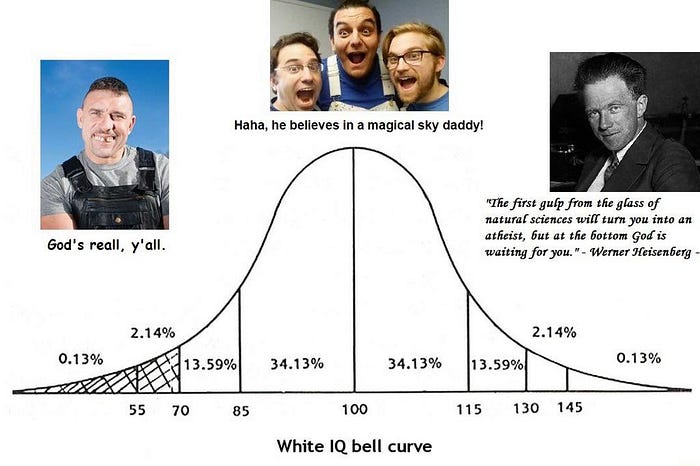
The “midwit” mocking meme below has become stock propaganda used by alt-righters and other counter-enlightenment types (there are many variations, this just happens to be the one I came across today).

It seems to imply that the greater levels of religiosity or theism professed by below average IQ individuals are vindicated by the fact that above average IQ individuals also have higher rates of religiosity or theism.

There are a number of problems with this meme, but the biggest one is that it is simply not true.

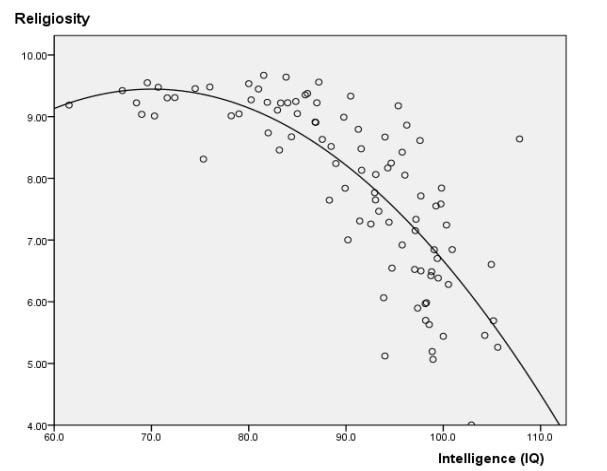
I surveyed psychological and sociological research in several databases to explore this issue. Of all of the rigorous studies I found on IQ and its relationship to religiosity / theism the opposite findings were reported: individuals with above average IQ scores report lower levels of intrinsic religiosity (religious belief, as opposed to religious behavior [e.g., church-going, church involvement] ), theism, and other supernatural beliefs than average or below average cohorts (see Alsan et al., 2020; Kanazawa, 2010; Saroglou et al., 2002; Woellert & Luttig, 2018; Zuckerman et al., 2013).

In other words, religious or theistic belief was negatively correlated with IQ scores — that is, as IQ score rises, religiosity / theism goes down (see the graph below).

Meisenberg et al., 2012

However, let’s make sure we are not strawmanning the implicit argument presented by this meme. In order to avoid this we will steelman it:

Premise 1: Below average IQ individuals report the highest levels of religiosity / theism.

Premise 2: Average IQ individuals report lower levels of religiosity / theism than below average IQ individuals.

Premise 3: Some above average IQ individuals report religious / theistic beliefs.

Conclusion: Therefore, religiosity or theism is not irrational.

This steelmanned version is valid, however, its soundness is questionable due to the complexity of the issue.

For instance, it is important to note that the religious, spiritual, or theistic beliefs of above average IQ individuals tends to be much different than those in the below average IQ cohort.

As discussed in Kanazawa (2010), above average individuals are more likely to have non-conforming or eccentric beliefs. That is to say, the theism or spiritual / religious beliefs professed by above average IQ individuals is much more likely to resemble the nuanced and freethinking views of EpicurusSpinozaEinstein, or Thomas Paine, than the dogmatic and supernatural views of the average Bible-believing religious person.

Other Problems:

The question of whether IQ tests fully capture intelligence (considering we don’t have a robust philosophical definition) is unresolved. Also, it is not clear that we have good reasons to consistently expect more epistemic rigor / rationality from high IQ persons, than from, say, high-average IQ persons. In fact, there is some evidence to suggest that a segment of the high IQ population may be predisposed to neuro-psychological epistemic dysfunction. I discuss both of these issues in my article The Fallacy of IQ Obsessiveness.

References:

Alsan, M., Phillips, M. R., & Wang, Q. (2020). Cognitive ability and religious beliefs: Evidence from the United States. Social Science Research, 95, 102336. https://doi.org/10.1016/j.ssresearch.2020.102336

Kanazawa, S. (2010). Intelligence and religious fundamentalism. Intelligence, 38(6), 669–674. https://doi.org/10.1016/j.intell.2010.06.007

Meisenberg, G., Patel, H., Woodley, M. A., & Rindermann, H. (2012). Is it smart to believe in God? The relationship of religiosity with education and intelligence. Temas em Psicologia, 20(1), 101–120.

Saroglou, V., Delpierre, V., Dernelle, R., & Dapy, X. (2002). Values and religiosity: A meta-analytic review of the nomological network of beliefs. Personality and Individual Differences, 33(5), 757–780. https://doi.org/10.1016/S0191-8869(01)00195-8

Woellert, A., & Luttig, M. (2018). Cognitive ability and religious fundamentalism: Evidence from the UK. Intelligence, 66, 1–7. https://doi.org/10.1016/j.intell.2017.11.009

Zuckerman, M., Silberman, J., & Hall, J. A. (2013). The relationship between intelligence and religiosity: A meta-analysis and some proposed explanations. Personality and Social Psychology Review, 17(4), 325–354. https://doi.org/10.1177/1088868313491624

Social Justice Warriors: The New Moralists

Kenneth Copeland “Wind of God” [Digital Image]. (2020). Retrieved from
https://knowyourmeme.com/memes/kenneth-copelands-wind-of-god / “Triggered Feminist” [Digital Image]. (2017). Retrieved from https://knowyourmeme.com/memes/triggered-feminist–2

Abstract/ TL;DR: Many modern secular moralists act in ways that are counterproductive to the urgent cause of creating a more just society — especially by exhibiting an alienating sanctimoniousness and over-zealousness for morally condemning others. The pejorative term “social justice warrior”, with its connotations toward self-righteousness and officiousness, is often used to describe such individuals. To effectively advocate for social justice we must combat this tendency to hyper-moralize or use morality as a weapon for “canceling” or punishing those who do not share our views; instead, I propose that advocates of social justice should adopt an approach that is more compassionate and more conducive to changing individual minds and changing society.

Social Justice Warriors: The New Moralists

There has always been a tendency in society that leans toward moral obsessiveness. Historically, obsessive moralists were religious theists that believed the creator of the universe had handed down moral imperatives, however, in modern society secular priggishness is just as common as the religious variety. The pejorative and sarcastic term “social justice warrior” (SJW) is commonly used to refer to one of the largest cohorts of secular moralists — as they tend to focus much of their moral scorn on real or perceived social injustices (sexism, racism, ableism, etc.) — and because they exhibit a characteristic over-zealousness and overreach in their approach.

To be clear, I am not criticizing the movement for social justice or prescriptive morality in general, rather I am criticizing the sledgehammer approach to prescriptive morality / social justice (or, colloquially, moralizing) where nearly every aspect of life is scrutinized to absurdity — and in which there is no coherent ethical theory or theory of human psychology to guide this scrutiny. This sledgehammer approach also tends to take the maladaptive approach of globally labelling people as good or bad, rather than their specific acts — an approach which is counterproductive for several reasons.

The most salient examples of this new moralism gone astray invoke Poe’s Law with their tendency toward hyperbole: feminist scorn over the horror of “manspreading”; the interpretation of just about everything as being a “microaggression”, or an overt form of bigotry; the idea that the epistemological and metaphysical foundations of science need to be decolonized; describing even the most benign examples of trans-cultural diffusion as cultural appropriation; the belief that minority groups cannot hold racist views; the belief that the best way to counter prejudices is to invert them (e.g., matriarchy instead of patriarchy, counter-racism instead of anti-racism); etc. An internet search of any of these terms will provide plenty of examples if you haven’t been keeping up on the culture war.

The problem with this moralizing is not that sexism, racism, or other forms of prejudice which contradict human rights do not deserve moral concern — they very much do! — it’s that our approach to correcting these injustices must 1) identify actual cases of unjustified prejudice (rather than what are likely false positives); 2) seek to explain the origin of prejudice cogently, and 3) use this information to combat prejudice effectively — without exacerbating divisiveness and alienating people.

Unfortunately, many proponents of social justice fail in all three of these areas, such as by identifying innocuous behavior as prejudiced or by advancing illogical definitions of prejudice; by misidentifying the causes of prejudice; and by causing alienation and division in various ways (e.g., through the use of hyperbolic or histrionic rhetoric, by advocating cancel culture vindictiveness, by espousing a puritanical and unreasonable set of counter norms [such as hyper-political correctness, hyper-vigilance in calling out perceived wrongs, or ideas similar to vicarious atonement for ancestral sin; etc.].

Irrespective of causative explanations for this moral scrupulosity on the sociological level, the distal origin of this phenomenon, on the individual level, is the human mind itself, which possesses evolved emotional impulses (see moral foundations theory) to engage in moralistic judgement — impulses which may become hyperactive or problematic when they are not restrained by rational faculties or judicious moral codes (see The Danger of Unrestrained Morality). When this scrupulosity is turned inward we might refer to it, in Freudian terms, as an overactive superego — and this form of neurosis frequently leads to a self-defeating and non-productive anxious preoccupation with one’s current or past actions. Such a preoccupation paralyzes the individual in a self-imposed hell of unproductive shame and guilt (see Albert Ellis on guilt/shame), thereby preventing growth.

This self-punishment does not help anyone and harms the individual, perhaps preventing them from making the changes necessary to truly change for the better. The adaptive converse of unproductive shame or guilt does not attach essentializing labels to oneself (you are not defined by your history), and believes in the possibility of reform; such an approach involves the recognition and acceptance of past wrongs, and an earnest commitment to not making the same mistakes in the future.

Just as with inward hyper-moralizing, turning unrestrained moral impulses outward, onto others, leads to a similar type of harm — this time in the form of applying essentializing condemnatory labels to others. Such an approach is likely to cause an amygdala response that results in the accused becoming more entrenched in their position (see reactance), or it may result in a paralyzing shame that prevents the individual from changing for the better; what it is very unlikely to do is to result in critical reflection and/or a positive change in their behavior or beliefs. Further, this approach engenders non-productive anger and retribution, which perpetuates the cycle of conflict between groups. History is replete with such examples. As the proverb states, hurt people hurt people…and so on, ad nauseum. Further exacerbating this harmful moralizing is the moral impulse to in-group loyalty or tribalism — which ironically also drives many of the hateful ideologies which prejudiced individuals cling to.

To draw an analogy with religion, the modern secular moralist resembles the Pharisee or the Sadducee whom Jesus criticized for myopically focusing on the letter of the law, rather than the spirit of the law. And, just as with the hyper-religious moralists in the story of Jesus, the modern secular moralists wield morality like a weapon — with an intent to “cancel”, or psychosocially destroy those who have transgressed. This approach is problematic on multiple levels, but most importantly it is likely to alienate people, including allies, and it is not likely to produce a situation in which an offending individual can grow or reform themselves (if, indeed, they have done anything that is clearly harmful); in other words, it is a punitive and retributive approach to justice. From a rationalist perspective, Christian morality and metaphysics are grossly flawed, but secular moralists would do well to consider the admonishments to forgiveness, compassion, and against moral hypocrisy, which are said to have been espoused by Jesus.

A more effective approach to morality — in terms of inter-subjective sociocultural goals — should, first and foremost, focus on reforming problematic behaviors and dialectically countering hateful ideologies; additionally, it should be grounded in reason (including the consideration of theoretical and evidence-based skepticism towards individual free will; the tenuousness of a permanent concept of personal identity; and a logically parsimonious, constructivist conception of morality — all three of which serve to temper hyper-moralizing), compassionate beneficence, and a non-retributive/non-maleficent conception of justice (social or criminal). A dialectical and non-retributive/non-punitive approach is more likely to circumvent the amygdala response that causes a person to dig in their heels, and is therefore more likely to change minds.

Anger in response to oppression is entirely understandable on an emotional level, however, it is not likely to be effective when it inspires action. Rational understanding is the antidote to untampered anger, and this approach appears to have a better case record of success. When we eliminate the destructive passion of vengeful anger from our minds and from the social sphere we will witness the birth of a less hateful, less violent, and more compassionate world.

© 2026 Max Severin

Theme by Anders NorenUp ↑