Essays, Articles, Videos & News

Tag: ethics

My Thoughts on the Charlie Kirk Assassination

I intend this to be a brief post since I already wrote about my views on political violence in general here.

I am writing this as a form of self-therapy to express my thoughts and emotions about this event.

For me, writing is both a therapeutic form of expression, and a way of organizing and deliberating on my own thoughts. So, I write more for myself than for an audience — which is a helpful way of framing things, since I will probably never be a celebrated “great writer.” Accepting that writing is more for me than for reaching others, or being applauded by others, is a great way to keep me devoted to this beneficial activity. If I thought otherwise — for example, if I thought one should only write if they were exceptionally good at it, or only if they received popular praise for their work — then I would have quit long ago and lost the personal benefits that I gain from writing. Framing things in this way also keeps me authentic — it keeps me from trying too hard to fit into what I think other people want from a writer.

In this case, I found it helpful to write on the topic because I have been somewhat distressed by having to listen to people celebrate the violent death of another person. Given the nature of my professional work, I have mostly kept this to myself, but I wanted to be able to discuss how I feel and why I think this (people celebrating violence) is very concerning.

Photo by Phoebe T on Unsplash

To briefly consider objections, I understand how some people might typically respond to my concern. They might mention other contemporary events that are more harmful in terms of a casualty count (the fallacy of relative privation — a fallacious appeal to “worse problems”), or they might appeal to specious utilitarian reasoning that argues that “hate speech” causes more harm than one death (operating on the false premise that Kirk engaged in hate speech, and assuming the conclusion that using violence to stifle hate speech is less net harmful than hate speech). I don’t intend to seriously consider these objections here, however, if anyone wanted me to expand on my parenthetical responses to these I could do that in the comments.

To return to my concern, I think celebrating any person’s death (outside of some extreme case circumstances) is possibly indicative of indoctrination with toxic ideology, or in some cases, psychopathology. On a human level, I can understand the urge or initial emotion of schadenfreude, relief, or even sadistic/vengeful satisfaction — but I consider these to be harmful impulses that are not in our, or society’s, best interest to assent to. An adaptive philosophy of life can instruct us on how to refrain from automatically reacting to initial thoughts, emotions, and other impulses, but instead to delay our reaction so that we are able to give critical consideration to whether these thoughts/impulses are rational or in-line with our values. (If you are interested in reading more about why I think toxic ideology is harmful to the individual and to society, and why adaptive philosophies of life are beneficial you can read my article on Helpful Philosophies of Life vs. Toxic Ideologies.)

Given how much of this sadistic celebration of Kirk’s death that I have witnessed in my personal life, my professional life, and in social media / on the news, I think there is prima facie justification to consider the possibility that toxic ideology is pervasive in our society and in the world.

This is an obvious concern because toxic ideology that compels individuals to violence could pose an existential threat to our species. We live in the age of weapons of mass destruction, and the same hateful ideology that would compel one individual to assassinate someone could compel another to engage in mass terrorism. In the worst case scenario this mass terrorism would involve the use of CBRN (chemical, biological, radiological, or nuclear) weapons — we might also add electronic or cyber weapons to this list. Terrorist events are not likely to be existential threats in themselves, but they could plausibly contribute to instability and conflict that could escalate to regional and global levels. Even more concerning is the fact that in some cases we see the ruling factions of entire nations being corrupted by these toxic ideologies.

It is largely irrelevant, but in the spirit of full-disclosure, I should note that I did not agree with Charlie Kirk on many issues; from what I have seen of his videos I did not always like his approach to debating, but I mostly found him to be respectful and reasonable — certainly not the hate monger that many have painted him to be. As someone committed to philosophical investigation and discourse, I am opposed, in the strictest sense possible, to any attempt to stifle free expression, and any use of violence that is not legitimately last-resort defensive in nature.

In contrast to amoral or antisocial toxic ideologies that view acts of violence against “enemies” as a legitimate tool of change, an adaptive philosophy of life provides the individual with ethical, epistemic, and practical guidance. An adaptive philosophy of life serves to inoculate the individual against indoctrination or passively accepting erroneous or biased information, and it also inoculates against aggression by restricting the use of violence to only defensive or last resort situations. [Note: I wrote more on this here, on the Ataraxism website.]

My concern extends beyond the realm of pragmatic societal concerns, however. I am also concerned for the psychological wellbeing of people who celebrate violence — those who romanticize hate and anger and who hold onto hate and anger. When I encounter people that are stuck in this way of thinking (as I once was myself) I always think of the fifth century Buddhist scholar and monk Buddhaghosa’s parable on anger:

“By doing this you are like a man who wants to hit another and picks up a burning ember or excrement in his hand and so first burns himself or makes himself stink” (Visuddhimagga IX, 23).

When we hold onto anger or hate we are not only potentially harming others, we are also harming ourselves. This anger and hatred will come out in other areas of our lives and cause harm — it may come out in our relationships, in our general conduct and thinking, and it will cause us to suffer needlessly.

For me, the celebration of another person’s death is not simply tasteless, it reflects the deeper problem of toxic ideology at work in our culture — ideologies which embrace and celebrate anger and hate. While political, economic, and social factors all play a role in violence, I believe toxic ideology remains one of the most dangerous and corrosive forces we face, both for society and for the psychological wellbeing of individuals.

If nothing else, setting these thoughts to paper reminds me of why I write: not to impress others, but to clarify my own thinking and to resist the pull of anger, resentment, and despair. In this way, writing itself becomes an act of cultivating an adaptive philosophy of life — one grounded in reflection, compassion, and an effort toward understanding.

The Real Cause of Political Violence

Violence has always been a problem in human society. Political violence in particular is both a threat to stable society and, in the nuclear age, a possible low-level existential concern — since we know from historical example that it can lead to large-scale war between nations. In this essay I will argue that “toxic ideology” is one of the primary causes of political violence.

Photo by Mapping Memories Cambodia on Unsplash

Various explanations have been proposed to explain the human tendency for political violence and war. The most common explanatory hypotheses seem to be: human nature, socioeconomic conflict, and religion or ideology. [Note: Other, more minor hypotheses have been discussed, such as genetics, hormonal problems, pharmaceutical interventions, gun control issues, etc., but, for the sake of brevity, I will not consider these here.]

Considering the Hypotheses

Human nature. Violence appears deeply rooted in human nature. Primatologists like Richard Wrangham have extensively documented chimpanzee raiding and lethal aggression that resembles primitive warfare — suggesting that our evolutionary cousins share an innate capacity for organized violence. Human history itself testifies to a long and bloody record of conflict. And yet, there is also evidence that societies may have become less violent over time, at least in terms of large-scale warfare and homicide rates. Steven Pinker, in The Better Angels of Our Nature, argues that the long arc of history bends toward relative declines in violence, even if it never fully disappears. Whether one agrees with Pinker’s optimism or not, human nature alone does not explain the variations we see across different societies and eras.

Socioeconomic conflict. Another explanation for violence is socioeconomic struggle. Material deprivation, inequality, and exploitation create fertile ground for resentment and unrest. These conditions undergird political ideologies that promise radical transformation or retribution. Collectivistic movements, populist uprisings, and ethno-nationalist projects all draw strength from real or perceived economic grievances. Socioeconomic conditions are not the sole cause of violence, but they serve as fuel that ideological leaders can ignite.

Religion and ideology. While religious beliefs and ideologies have undeniably been used to justify or drive violence and war, it is not belief systems in themselves that cause violence. Rather, it is a certain type of belief — what I call toxic ideology. It is usually the combination of religion with toxic ideology — or the adoption of toxic ideology alone — that leads to cruelty and bloodshed.

Toxic Ideology as the Primary Driver of Political Violence

To understand what truly drives political violence, we must look beyond superficial or single-cause explanations, and our analysis must be multidimensional (that is, it must account for the complex interplay between the multiple factors involved). The multidimensional perspective I am proposing accepts that all of the above factors are a piece of the overall picture of causation, however, I argue that toxic ideology is one of the primary or leading causal factors, and the one we can most readily do something about.

At the heart of the issue is not simply belief, but the difference between adaptive (healthy on the psychological and sociological level) and toxic philosophies of life. An adaptive philosophy of life provides individuals with meaning, direction, and ethical grounding. It ideally contains three essential components (in a grounded or coherent form):

  • metaphysics (a basic account of reality and our place in it),
  • An epistemology (a standard for deciding what counts as knowledge), and
  • normative ethical theory (principles that guide action).

At the very least, an adaptive philosophy of life ought to contain a coherent and reasonably prosocial (neutral or beneficial to others/society) normative ethical theory and epistemic norms that contain mechanisms for error correction. Without this, people are left adrift and vulnerable to adopting maladaptive frameworks that confuse our thinking, justify cruelty, and erode human compassion. [Note: I wrote more extensively on adaptive philosophies of life vs. toxic ideologies here.]

By contrast, a toxic ideology operates like malware in the human mind. It often rests on unfalsifiable dogmas, fosters rigid black-and-white thinking, and rationalizes violence against outsiders. Toxic ideologies can be secular or religious, “Left-wing” or “Right-wing.” Toxic ideologies are dangerous because they promote a divisive and rigid us-against-them ethical framework, or because they lack an adaptive ethical framework altogether. Amoral toxic ideologies reject intersubjective principles of fairness and compassion and instead embrace the view that “the ends justify the means.”

Ethno-nationalist extremism (e.g., historical forms of fascism that engaged in mass killing), collectivistic extremism (e.g., historical forms of socialism or communism that engaged in mass killing), and certain extremist religious movements engaged in massive atrocities by adopting ends-justify-the-means thinking, and through mobilizing ressentiment, enforcing conformity, and dehumanizing opponents. Such systems do not merely fail to prevent violence — they sanctify it as a tool of purification, revenge, or revolution.

Seeing toxic ideology as one of the primary causes of political violence also challenges the common claim that “religion causes violence.” Religions (outside of those enforced by oppressive theocratic regimes, or new religious movements that haven’t been subjected to centuries-long selective processes that would filter out their most maladaptive elements ) are typically broad and flexible — they can be interpreted in adaptive or maladaptive ways. On the one hand, religious traditions often provide moral frameworks, rituals of compassion, and communal support that strengthen psychological and social well-being. On the other hand, when combined with toxic ideology — or absolutist certainty — religious belief can become divisive, a tool of oppression and violence. In the developed world, it is usually not religion itself, but religion plus toxic ideology, that generates the conditions for cruelty and violence.

Conclusion

If we want to understand — and ultimately reduce — human violence, we must learn to distinguish between adaptive and toxic philosophies of life. As Nietzsche warned, the “death of God” did not eliminate toxic dogmas but cleared the way for new, even more virulent secular ideologies to fill the void — often with catastrophic consequences. Conversely, as modern psychology suggests, adaptive frameworks grounded in rational inquiry, unconditional acceptance, and unconditional compassion can foster resilience, tolerance, and peace.

The problem of violence will likely never be solved — that is, until we transcend our current status quo biology — but it certainly will not be solved by abolishing religion, capitalism or through other simplistic and illusory solutions.

The use of violence proliferates when human beings, searching for meaning and stability, adopt toxic ideologies that confuse moral and general reasoning. The antidote is not dogmatic certainty but philosophical depth: coherent frameworks that integrate metaphysics, epistemology, and ethics in ways that promote humility, compassion, nuance, and balance / flexibility. Only by cultivating adaptive philosophies of life — whether secular or religious — can societies inoculate themselves against the malware of toxic ideology and the violence it engenders.

Helpful Philosophies of Life vs. Toxic Ideologies

A philosophy of life is essentially a cognitive framework — a set of principles that guide our thoughts and actions, and, in a less obvious way, our emotions. A coherent and adaptive (psychologically helpful) philosophy of life is critically important to the individual, and, through its distal effects, to society. In addition to providing individuals with ethical and practical guidance, it also helps a person to develop a sense of meaning, purpose, direction, and inspiration.

Additionally, a philosophy of life can foster a sense of connection to others who share similar values — serving as a source of identity and psychological stability. Without at least a rough working philosophy of life, individuals may find themselves adrift — lacking the direction needed to make wise decisions, endure hardship, and pursue self-actualization.

However, not all cognitive frameworks are equally beneficial. Some ideologies or religious systems may be “toxic” to the individual and to society as a whole — in a way that is analogous to how malware disrupts a computer system. Unfortunately, many people adopt toxic ideologies or toxic religious beliefs as their philosophy of life — to the detriment of themselves and society. We see this when people fall into extreme or rigid forms of religious or ideological belief. Often times toxic ideological views may be implicit — for example, a toxic subculture may not explicitly articulate its ideology, but rather signal it in various overt or subtle ways.

While every philosophy of life must rest upon certain “dogmas” or foundational axioms — as Sam Harris argued in one of his early debates with Jordan Peterson — “not all dogmas are equal.” Foundational axioms that are unfalsifiable, metaphysically complex, or disconnected from reason and evidence are more likely to support irrational or harmful conclusions. For example, dogmatic claims such as “divine revelation is the highest form of knowledge,” or “faith is superior to reason in matters of truth,” introduce untestable metaphysical assumptions that violate the principle of parsimony. Because these axioms are not grounded in evidence and logic, they resist revision and they tend to promote absolutistic or black-and-white thinking.

In contrast to these kinds of unfalsifiable or complex dogmas, a foundational axiom of Ataraxist philosophy of life (the philosophy of life I have been developing) holds that “Our understanding of the world is most likely to be accurate and useful when it is grounded in a rational, reliable way of analyzing the best available evidence.” This axiom is metaphysically simple, testable, and self-correcting.

I mentioned the example of dogmatic religion above, but I am not arguing that all religious belief is harmful; in fact, evidence supports the view that it is often beneficial on the individual level — likely because its helpful aspects outweigh its harmful ones, or because individuals adapt their religious beliefs to align with modern, near-consensus secular ethics or personal psychological needs. (Note: Whether a particular religion is adaptive on the individual level depends on a number of factors. The broader question of whether religion benefits society or geopolitical stability lies beyond the scope of this article.)

In addition to being rational and parsimonious, foundational axioms should ideally be helpful — that is, they should align with well-established principles of human flourishing, or at least be revisable in light of new evidence. At a minimum, an adaptive philosophy of life ought to contain a coherent and reasonably prosocial (neutral or beneficial to others/society) normative ethical code and epistemic norms that contain mechanisms for error correction, such as the principle: “No statement should be believed without justification in the form of sufficient evidence or sound reasoning.” This sort of epistemic standard engenders epistemic humility, and helps prevent ideological drift into rigidity, fanaticism, or harm. Put simply, an epistemology grounded in reliable ways of identifying and analyzing solid evidence innoculates the individual against toxic ideology; when a coherent and pro-social ethical code is added, the individual is highly immune to becoming indoctrinated with toxic ideology.

Many ideologies cannot be considered as helpful philosophies of life, either because they contain potentially harmful dogmas, and/or because they lack sufficient structure, in the form of an ethical code or epistemic principles, to guide behavior. Vague ideologies or value systems that emphasize goals without outlining a foundational theory or a rational means to achieve their stated goals are vulnerable to becoming toxic to individuals or society. For example, while feminism may aim for certain valuable goals, it does not, in itself, contain the philosophical foundations to ensure that the movement avoids misandry, and other forms of hatefulness and tribalism. The same could be said of any other goal-focused ideology that lacks a sound philosophical foundation. Similarly, many political and religious ideologies can devolve into hatefulness and promotion of harm if they lack foundational principles that promote reason and unconditional compassion.

Friedrich Nietzsche warned that the collapse of traditional religion — what he called the “death of God” — would leave a moral and spiritual vacuum that modern societies would rush to fill with new, secular ideologies. Without a sound ethical foundation, these ideologies risk becoming toxic secular religions: dogmatic systems that demand conformity and justify persecution.

Nietzsche developed the concept of ressentiment to describe a reactive cultural moral psychology rooted in perceived powerlessness — a festering envy that would engender a mob mentality hatred of those who hold power, or those who are perceived to hold power. Rather than bringing about a more just society, these ressentiment-based mass movements tend to engender a violent inversion of values and perceived power structures — where vengeful condemnation is directed at those who were seen as oppressors. Through the power of the State, the resentful masses enact their mass hatred. In Thus Spoke Zarathustra, Nietzsche famously warned that “the State is the coldest of all cold monsters,” a new idol that claims to embody the will of the people while manipulating them through fear and false virtue. From the struggle sessions of Maoist China to the dogmatic and demagogic excesses of modern cancel culture, we see how social justice movements, which lack philosophical rigor and the restraint provided by a coherent ethical system, can devolve into campaigns of moral absolutism and terror — echoing the very religious zealotry they replaced. The catastrophic death tolls of fascist and communist regimes, driven by such ideological fervor, remain a haunting testament to Nietzsche’s prescience.

As Albert Ellis argued in The Road to Tolerance, a healthy philosophy of life should be grounded in unconditional self-acceptance, other-acceptance, and life-acceptance. These values are not simply moral ideals, but practical cognitive frameworks that promote psychological resilience and ethical conduct. A helpful philosophy of life is rational, self-correcting, empirically grounded, and conducive to human flourishing. Where existing philosophies of life fail to meet these criteria, we would be wise to revise or replace them — and if we are not satisfied with any existing philosophy of life, we may want to consider developing our own.

Transcending the State of Nature: Technology and the Paradigm Shift in Human-Animal Relations

The concept of the state of nature has long been debated in political philosophy; the state of nature describes the hypothetical or actual condition individuals and groups existed in prior to the formation of formal governance or social contracts. On some views of the state of nature this condition was marked by conflicting interests and a perpetual violent struggle between individuals and groups. While modern, technologically-developed societies have developed norms and social contracts that facilitate relatively harmonious, rights-based interactions among humans, a stark contrast remains when it comes to our relations with non-human animals.

In this essay, I argue that instead of relying solely on ethical persuasion or vegan lifestylism to revolutionize our treatment of animals, we should focus more on abolishing the human-animal state of nature by advocating technological advancements such as in-vitro meat, alternatives to animal research, animal-free entertainment, and substitutes for animal products. By advocating for and embracing these innovations, we can transcend the violent state of nature that characterizes the status-quo of human-animal relations.

Hunter-gatherer Cave Painting — Aleksander Gerasimov

The State of Nature in Human Relations

The first well-known theorist to describe a state of nature characterized by violent conflict was Thomas Hobbes. He referred to this state as the bellum omnium contra omnes, or the “war of all against all.” Hobbes’ theory finds some support from paleoanthropological research (which is discussed in depth here, along with contrary views). According to many political theorists, the emergence of civilized society played a significant role in transitioning from the violent state of nature to a more peaceful order. This transition was facilitated by the establishment of centralized authority that could enforce the laws associated with the social contract.

However, what is often overlooked is the impact of technological advancements, particularly in agriculture, on these civilizational developments. Civilization and the concept of a social contract did not arise spontaneously; instead, technological progress created conditions that enabled the development of agriculture and reduced scarcity. These advancements allowed for the formation of stable and settled societies (the alignment of previously conflicted interests), which in turn facilitated the creation of systems aimed at decreasing interpersonal and inter-tribal violence.

It is my view, then, that technological development is the primary driver of revolutionary changes which eliminate prior conditions. This is essentially the same view taken by Karl Marx in his theory of historical materialism.

The State of Nature in Human-Animal Relations

In our present reality, human interests are usually in conflict with the interests of non-human animals. In other words, a relatively one-sided Hobbesian state of nature prevails in our treatment of non-human animals due to the fundamental conflict of interests and the imbalance of power between these two general groupings. Most non-human animals are subject to exploitation and intense suffering en masse as a result of animal research, animal entertainment, farming (especially industrial farming, also known as “factory farming”) and hunting, fishing, or trapping.

Animal rights advocates have traditionally argued that animal exploitation and harm results from our general indifference to animal suffering, rather than this state of nature / conflict of interests. This view ignores the fact that human survival necessitated killing and exploiting animals for food, clothing, and other needs for the vast majority of our species’ existence— and that this necessity still exists everywhere except in the developed nations of the world, or, at the least, in warm climates that allow for diverse plant-based agriculture.

These necessities guided our evolved psychology as well. Not only did necessity dictate that we not seriously consider the interests of non-humans, we also would not have survived if we evolved to feel deep compassion for those outside of our immediate sphere of similarity and shared interests. Compassion for non-human animals seems to require a high degree of cognitive empathy — something which our ancestors, and many of our contemporaries do not prioritize or have the time to cultivate in depth.

Returning to the pragmatism of a vegan lifestyle, even in the developed world adopting such a lifestyle is debatably difficult. For some individuals a vegan diet may not be sufficient for their nutritional needs, and even healthy individuals on a vegan diet require supplementation of certain nutrients like vitamin B12, and omega-3 fatty acids. These challenges are evidenced by research which indicates that most vegans / vegetarians go back to eating the animal products they chose to stop consuming. It may be argued, then, that the state of nature still persists to a considerable degree even in the developed world.

As long as a conflict of interests exists even those of us who are deeply concerned about non-human animals are forced to compromise our principles. For example, even the most hard-core vegans engage in self-interested activities which they know to cause indirect or direct harm to non-human animals (e.g., purchasing products from companies that invest some of their capital in animal agriculture, using drugs that were developed using animal research, killing problematic “pests”, etc.).

Technological Advancements as Agents of Change

As the suffering abolitionist philosopher David Pearce argues, to transcend this state of nature, we must look beyond traditional approaches centered on ethical persuasion alone. Technological advancements offer immense potential to reshape our relationship with non-human animals and establish a more sustainable future with less intense suffering.

In-Vitro Meat and Animal-Free Alternatives:

In-vitro meat, also known as cultured meat or cellular agriculture, holds the promise of providing a sustainable and ethical alternative that satisfies human dietary preferences and nutritional needs without harming animals en masse or devastating the environment, as animal agriculture does. By investing in and advocating for cellular agriculture, we can force agriculture corporations to adapt or fail. Additionally, advancements in plant-based alternatives, such as meat substitutes and dairy-free products, offer viable options to replace animal-derived foods without compromising taste or nutrition.

Alternatives to Animal Research and Entertainment:

Emerging technologies are also paving the way for alternatives to animal research and entertainment. Innovations like organs-on-chips, computer modeling, and in-silico testing methods provide alternatives to traditional animal testing, reducing the need for animal experimentation while still ensuring the safety and efficacy of products. Likewise, virtual reality exhibits offer engaging and cruelty-free alternatives to zoos, promoting empathy and awareness without exploiting or harming sentient beings.

Transcending the State of Nature

By embracing these technological advancements, we can create the preconditions which makes it feasible for us to abolish the state of nature which characterizes our current human-animal relations. Focusing on the development and adoption of these alternatives allows us to address the root causes of animal exploitation and suffering, bypassing the need to rely solely on ethical persuasion — which has been limited in its effectiveness, not only on this issue, but with regard to other moral issues such as slavery. [Consider that it was not just the ethics of slavery abolitionists that ended mass slavery; rather, it is likely that the technological means to industrialize production and use wage slaves (rent laborers) instead of chattel slaves (own laborers) was a greater factor in the abolition of slavery — at least in the US.]

Rather than relying solely on convincing others of the soundness of vegan or animal rights ethics, we should embrace technological advancement as a transformative force that enables us to transcend the state of nature and forge a realistic path toward animal liberation.

Does The Bible Offer Sound Moral Guidance?

Image by StockSnap from Pixabay

Without question the Christian Bible contains some timeless and sound moral principles.

For one, there is the golden rule — a moral maxim that predates Christianity, and is common to most of the world’s religions and life philosophies, in one form or another. In the Bible, the golden rule is expressed in a variety of ways. Most succinctly it is stated as: “And as ye would that men should do to you, do ye also to them likewise” (Luke 6:31).

The principle of universal beneficence to other humans is also expressed in Galatians 5:14: “For all the law is fulfilled in one word, even in this; Thou shalt love thy neighbor as thyself.” The Parable of the Good Samaritan (Luke 10:25–37), makes it clear that all people are to be considered “thy neighbor”.

There are many admonishments in the New Testament against self-righteous judgement of others, and hypocrisy (e.g., Matthew 7:3–5; Matthew 23:24Jesus and the woman taken in adultery). Many of our modern over-zealous moralists could benefit from reading these passages. There are also many passages on the importance of forgiveness and compassion (e.g., Ephesians 4:31–32) — two things that the world definitely needs more of.

In contradiction of this noble wisdom stands the fact that most of the Bible is devoted to hatefulness and commandments to violence. Below are several examples.

The Bible prescribes the death penalty for actions that our society does not even consider criminal.

“If a man lies with a male as with a women, both of them shall be put to death for their abominable deed; they have forfeited their lives” (Leviticus 20:13 NAB).

“All who curse their father or mother must be put to death. They are guilty of a capital offense” (Leviticus 20:9 NLT).

“If a man commits adultery with another man’s wife, both the man and the woman must be put to death” (Leviticus 20:10 NLT).

“A priest’s daughter who loses her honor by committing fornication and thereby dishonors her father also, shall be burned to death” (Leviticus 21:9 NAB).

“If a man have a stubborn and rebellious son, which will not obey the voice of his father, or the voice of his mother, and that, when they have chastened him, will not hearken unto them: Then shall his father and his mother lay hold on him, and bring him out unto the elders of his city, and unto the gate of his place; And they shall say unto the elders of his city, This our son is stubborn and rebellious, he will not obey our voice; he is a glutton, and a drunkard. And all the men of his city shall stone him with stones, that he die: so shalt thou put evil away from among you; and all Israel shall hear, and fear” (Deuteronomy 21:18–21 KJV).

“But if this charge is true (that she wasn’t a virgin on her wedding night), and evidence of the girl’s virginity is not found, they shall bring the girl to the entrance of her father’s house and there the men of her town shall stone her to death, because she committed a crime against Israel by her unchasteness in her father’s house. Thus shall you purge the evil from your midst” (Deuteronomy 22:20–21 NAB).

The Bible is degrading to women.

“When a man sells his daughter as a slave, she will not be freed at the end of six years as the men are” (Exodus 21:7 NLT).

“When a woman has her regular flow of blood, the impurity of her monthly period will last seven days, and anyone who touches her will be unclean till evening. Anything she lies on during her period will be unclean, and anything she sits on will be unclean. Whoever touches her bed must wash his clothes and bathe with water, and he will be unclean till evening. Whoever touches anything she sits on must wash his clothes and bathe with water, and he will be unclean till evening” (Leviticus 15:19–22 NIV).

“But I would have you know, that the head of every man is Christ; and the head of every woman is the man; and the head of Christ is god. For man did not come from woman, but woman from man; neither was man created for woman, but woman for man” (I Corinthians 11:3, 8–9 KJV). *Note: New Testament verse.

“Thy desire shall be to thy husband, and he shall rule over thee” (Genesis 3:16 KJV).

“If a man is caught in the act of raping a young woman who is not engaged, he must pay fifty pieces of silver to her father. Then he must marry the young woman because he violated her, and he will never be allowed to divorce her” (Deuteronomy 22:28–29 NLT).

“Let your women keep silence in the churches; for it is not permitted unto them to speak; but they are commanded to be under obedience, as also sayeth the law” (I Corinthians 14:34–35 KJV). *Note: This is a New Testament verse.

“Let the woman learn in silence in all subjection. But I suffer not a woman to teach, nor to usurp authority over the man, but to be in silence. For Adam was first formed then Eve. And Adam was not deceived, but the woman being deceived was in transgression” (I Timothy 2:11–14 KJV). *Note: This is a New Testament verse.

“’Have you allowed all the women to live?’ he asked them. ‘They were the ones who followed Balaam’s advice and were the means of turning the Israelites away from the LORD in what happened at Peor, so that a plague struck the LORD’s people. Now kill all the boys. And kill every woman who has slept with a man, but save for yourselves every girl who has never slept with a man’” (Numbers 31:15–17 NIV).

“If two men are fighting and the wife of one of them comes to rescue her husband from his assailant, and she reaches out and seizes him by his private parts, you shall cut off her hand. Show her no pity” (Deuteronomy 25:11–12 NIV).

The Bible is not tolerant of other religions.

“Suppose you hear in one of the towns the LORD your God is giving you that some worthless rabble among you have led their fellow citizens astray by encouraging them to worship foreign gods. In such cases, you must examine the facts carefully. If you find it is true and can prove that such a detestable act has occurred among you, you must attack that town and completely destroy all its inhabitants, as well as all the livestock. Then you must pile all the plunder in the middle of the street and burn it. Put the entire town to the torch as a burnt offering to the LORD your God. That town must remain a ruin forever; it may never be rebuilt. Keep none of the plunder that has been set apart for destruction. Then the LORD will turn from his fierce anger and be merciful to you. He will have compassion on you and make you a great nation, just as he solemnly promised your ancestors. The LORD your God will be merciful only if you obey him and keep all the commands I am giving you today, doing what is pleasing to him” (Deuteronomy 13:13–19 NLT).

“If your own full brother, or your son or daughter, or your beloved wife, or you intimate friend, entices you secretly to serve other gods, whom you and your fathers have not known, gods of any other nations, near at hand or far away, from one end of the earth to the other: do not yield to him or listen to him, nor look with pity upon him, to spare or shield him, but kill him. Your hand shall be the first raised to slay him; the rest of the people shall join in with you. You shall stone him to death, because he sought to lead you astray from the Lord, your God, who brought you out of the land of Egypt, that place of slavery. And all Israel, hearing of this, shall fear and never do such evil as this in your midst” (Deuteronomy 13:7–12 NAB).

“Suppose a man or woman among you, in one of your towns that the LORD your God is giving you, has done evil in the sight of the LORD your God and has violated the covenant by serving other gods or by worshiping the sun, the moon, or any of the forces of heaven, which I have strictly forbidden. When you hear about it, investigate the matter thoroughly. If it is true that this detestable thing has been done in Israel, then that man or woman must be taken to the gates of the town and stoned to death” (Deuteronomy 17:2–5 NLT).

“He that sacrificeth unto any god, save unto the LORD only, he shall be utterly destroyed” (Exodus 22:20 KJV).

The Bible does not condemn slavery.

“Slaves, obey your earthly masters with deep respect and fear. Serve them sincerely as you would serve Christ” (Ephesians 6:5 NLT). *Note: This is a New Testament verse.

“When a man strikes his male or female slave with a rod so hard that the slave dies under his hand, he shall be punished. If, however, the slave survives for a day or two, he is not to be punished, since the slave is his own property” (Exodus 21:20–21 NAB).

“If you buy a Hebrew slave, he is to serve for only six years. Set him free in the seventh year, and he will owe you nothing for his freedom. If he was single when he became your slave and then married afterward, only he will go free in the seventh year. But if he was married before he became a slave, then his wife will be freed with him. If his master gave him a wife while he was a slave, and they had sons or daughters, then the man will be free in the seventh year, but his wife and children will still belong to his master. But the slave may plainly declare, ‘I love my master, my wife, and my children. I would rather not go free.’ If he does this, his master must present him before God. Then his master must take him to the door and publicly pierce his ear with an awl. After that, the slave will belong to his master forever” (Exodus 21:2–6 NLT).

“All who are under the yoke of slavery should consider their masters worthy of full respect, so that God’s name and our teaching may not be slandered. Those who have believing masters are not to show less respect for them because they are brothers. Instead, they are to serve them even better, because those who benefit from their service are believers, and dear to them. These are the things you are to teach and urge on them” (1 Timothy 6:1–2 NIV). *Note: This is a New Testament verse.

The God of the Bible desires animal sacrifice.

“The Lord called to Moses and spoke to him from the tent of meeting. He said, ‘Speak to the Israelites and say to them: When anyone among you brings an offering to the Lord, bring as your offering an animal from either the herd or the flock. If the offering is a burnt offering from the herd, you are to offer a male without defect. You must present it at the entrance to the tent of meeting so that it will be acceptable to the Lord. You are to lay your hand on the head of the burnt offering, and it will be accepted on your behalf to make atonement for you. You are to slaughter the young bull before the Lord, and then Aaron’s sons the priests shall bring the blood and splash it against the sides of the altar at the entrance to the tent of meeting. You are to skin the burnt offering and cut it into pieces. The sons of Aaron the priest are to put fire on the altar and arrange wood on the fire. Then Aaron’s sons the priests shall arrange the pieces, including the head and the fat, on the wood that is burning on the altar. You are to wash the internal organs and the legs with water, and the priest is to burn all of it on the altar. It is a burnt offering, a food offering, an aroma pleasing to the Lord’” (Leviticus 1:1–9).

— — — — — — — — — — — — — —

Many Argue that Jesus does away with the Old Testament Law, but, in fact, he seems to support it — at the least, he does not seem to oppose it.

“It is easier for Heaven and Earth to pass away than for the smallest part of the letter of the law to become invalid” (Luke 16:17 NAB).

“Do not think that I have come to abolish the law or the prophets. I have come not to abolish but to fulfill. Amen, I say to you, until heaven and earth pass away, not the smallest part or the smallest part of a letter will pass from the law, until all things have taken place” (Matthew 5:17 NAB).

Further, the Trinitarian doctrine — which most Christians espouse — confusingly holds that the Old Testament God, Yahweh, and Jesus are but different manifestations of the same entity.

— — — — — — — — — — — — — —

Clearly the Bible does not accord with our modern consensus morality on most issues. Nor does it give much consideration to the suffering of non-human animals. It is easy to see how some of these passages may have inspired the historical atrocities committed by believers.

Fortunately, there are many life philosophies that offer an alternative to Christianity and traditional religion in general (e.g., secular humanismEpicureanismStoicismUnitarian Universalismsecular Buddhism, etc.).

The Danger of Unrestrained Morality

Moral foundations theory describes how humans evolved to possess innate moral impulses. These impulses drive us to value:

  • fairness
  • purity
  • in-group loyalty
  • liberty
  • caring for others
  • respect for authority

These six moral foundations are found across all human cultures, however, they are expressed and understood in various ways depending on the particular culture or subculture in question.

Image by Anil John from Pixabay

Moral impulses were selected for in our evolutionary history due to the fact that they are essential to a social species, and because they tend to enhance group fitness. In a society these moral impulses are codified into laws and moral norms —what we generally refer to as morality.

Morality, however, is often a double-edged sword.

While moral impulses and moral norms tend to enhance group fitness, some moral systems may harm group fitness. And unrestrained morality, in any society, has the potential to be a serious threat to the well-being and liberty of the individual.

Those who run afoul of popular morality have been treated with extreme cruelty throughout human history — either by a retributive (rather than remedial) legal system or through vigilante acts. Morality has also been used to drum up support for various forms of violent aggression (e.g., pogroms, terrorism, wars of aggression, etc.), and it has been weaponized in order to persecute those who have simply been accused of wrongdoing.

In recent times we see this type of abuse associated with “cancel culture”, however, this phenomenon is nothing new (for historical example see: McCarthyismwitch hunts, the Inquisition).

A modern philosophically and scientifically informed view of morality demonstrates the complexity of moral questions, and it confirms descriptive moral relativism — that is, it shows that what is considered morally good (or bad) in regards to particular issues changes over time and varies from culture to culture. This fact provides prima facie grounds for being skeptical about moral realism, and at the very least it should make us question the epistemological status of generally accepted morality.

A philosophically informed view also provides prima facie reasons (at the least) to be skeptical about free will. If humans do indeed lack metaphysical freedom of will, then no one can be said to be deserving of punishment. Even if we assume some degree of free will, there are many reasons to oppose cruel punishments, and any sort of aggressive violence in general. Additionally, ignorance and neuro- or psychopathology are much more parsimonious explanations of antisocial behavior than metaphysical evil (all of which are possibly remediable).

In consideration of this view, one may be tempted to give up on the project of morality entirely (that is, to accept a passive form of moral nihilism), but this would be a mistake. Morality is necessary for the practical functioning of human society.

What is needed is a system of morality that is grounded in compassionate understanding, and which is appropriately restrained by philosophical reason.

Plato, and Freud — who borrowed from Plato in his work — wrote about why morality must be restrained or guided by reason. Both Plato and Freud viewed the human psyche as being divided into three parts: a rational part, a primitive desire-driven part, and a moral part. Plato uses the analogy of a charioteer (reason) who has to restrain and coordinate the actions of a white horse (morality) and a black horse (primitive desire). Freud describes a tripartite psyche divided into the ego (the organism’s conception of self — which uses reason to understand the world), a superego (morality), and an id (primitive desire). These conceptions are helpful when we think about the influence of morality on the individual, and on society.

Both of these thinkers emphasized the importance of reason as a moderating force to restrain or guide these two instinctual drives. If either of these instinctual drives is given too much freedom the individual will be in peril (as will be those they interact with).

Reason, for example, informs us that retribution and cruel punishment are not actions that have clear justifications (see my point about free will above). Rational analysis also shows us that we should withhold assent to some moral impulses — such as those to purity — since they are outmoded in light of a modern understanding (such as a modern understanding of disease causation).

If one’s moral impulses are not restrained by reason, they may become an inspiration for cruelty in the form of retribution, hate, and aggressive violence. History is rife with examples of aggrieved groups standing up to injustice, only to end up matching or overshadowing the injustice of those they opposed. We see this today in some of the most zealous segments of the cultural Right and Left.

Generally speaking, certain segments of the cultural Left want to enact violence on those who do not share their conceptions of the moral foundations — their egalitarian view of care and fairness, and their emphasis on positive conceptions of liberty; whereas those in certain segments of the radical Right want to enact violence on those who do not share their in-group loyalty / care, their meritocratic conception of fairness, and their emphasis on negative liberty.

If one’s moral code can be used to justify a non-defensive infliction of harm, then it is not sufficiently restrained by reason. And without reason we have no hope of arriving at significant intersubjectivity about moral questions — we will only have competing systems of morality based on epistemically suspect cultural conventions like dogmatic religion or folk wisdom.

If we do not challenge priggishness on the individual level we risk developing a judgmental attitude that results in conflict and possible social alienation; similarly, internally focused judgment can harm us by engendering unproductive guilt and shame. On the societal level we risk the possibility of letting anger and vindictiveness grow until violent conflict is unavoidable. Only critical thought and reason can prevent these damaging consequences.

Social Justice Warriors: The New Moralists

Kenneth Copeland “Wind of God” [Digital Image]. (2020). Retrieved from
https://knowyourmeme.com/memes/kenneth-copelands-wind-of-god / “Triggered Feminist” [Digital Image]. (2017). Retrieved from https://knowyourmeme.com/memes/triggered-feminist–2

Abstract/ TL;DR: Many modern secular moralists act in ways that are counterproductive to the urgent cause of creating a more just society — especially by exhibiting an alienating sanctimoniousness and over-zealousness for morally condemning others. The pejorative term “social justice warrior”, with its connotations toward self-righteousness and officiousness, is often used to describe such individuals. To effectively advocate for social justice we must combat this tendency to hyper-moralize or use morality as a weapon for “canceling” or punishing those who do not share our views; instead, I propose that advocates of social justice should adopt an approach that is more compassionate and more conducive to changing individual minds and changing society.

Social Justice Warriors: The New Moralists

There has always been a tendency in society that leans toward moral obsessiveness. Historically, obsessive moralists were religious theists that believed the creator of the universe had handed down moral imperatives, however, in modern society secular priggishness is just as common as the religious variety. The pejorative and sarcastic term “social justice warrior” (SJW) is commonly used to refer to one of the largest cohorts of secular moralists — as they tend to focus much of their moral scorn on real or perceived social injustices (sexism, racism, ableism, etc.) — and because they exhibit a characteristic over-zealousness and overreach in their approach.

To be clear, I am not criticizing the movement for social justice or prescriptive morality in general, rather I am criticizing the sledgehammer approach to prescriptive morality / social justice (or, colloquially, moralizing) where nearly every aspect of life is scrutinized to absurdity — and in which there is no coherent ethical theory or theory of human psychology to guide this scrutiny. This sledgehammer approach also tends to take the maladaptive approach of globally labelling people as good or bad, rather than their specific acts — an approach which is counterproductive for several reasons.

The most salient examples of this new moralism gone astray invoke Poe’s Law with their tendency toward hyperbole: feminist scorn over the horror of “manspreading”; the interpretation of just about everything as being a “microaggression”, or an overt form of bigotry; the idea that the epistemological and metaphysical foundations of science need to be decolonized; describing even the most benign examples of trans-cultural diffusion as cultural appropriation; the belief that minority groups cannot hold racist views; the belief that the best way to counter prejudices is to invert them (e.g., matriarchy instead of patriarchy, counter-racism instead of anti-racism); etc. An internet search of any of these terms will provide plenty of examples if you haven’t been keeping up on the culture war.

The problem with this moralizing is not that sexism, racism, or other forms of prejudice which contradict human rights do not deserve moral concern — they very much do! — it’s that our approach to correcting these injustices must 1) identify actual cases of unjustified prejudice (rather than what are likely false positives); 2) seek to explain the origin of prejudice cogently, and 3) use this information to combat prejudice effectively — without exacerbating divisiveness and alienating people.

Unfortunately, many proponents of social justice fail in all three of these areas, such as by identifying innocuous behavior as prejudiced or by advancing illogical definitions of prejudice; by misidentifying the causes of prejudice; and by causing alienation and division in various ways (e.g., through the use of hyperbolic or histrionic rhetoric, by advocating cancel culture vindictiveness, by espousing a puritanical and unreasonable set of counter norms [such as hyper-political correctness, hyper-vigilance in calling out perceived wrongs, or ideas similar to vicarious atonement for ancestral sin; etc.].

Irrespective of causative explanations for this moral scrupulosity on the sociological level, the distal origin of this phenomenon, on the individual level, is the human mind itself, which possesses evolved emotional impulses (see moral foundations theory) to engage in moralistic judgement — impulses which may become hyperactive or problematic when they are not restrained by rational faculties or judicious moral codes (see The Danger of Unrestrained Morality). When this scrupulosity is turned inward we might refer to it, in Freudian terms, as an overactive superego — and this form of neurosis frequently leads to a self-defeating and non-productive anxious preoccupation with one’s current or past actions. Such a preoccupation paralyzes the individual in a self-imposed hell of unproductive shame and guilt (see Albert Ellis on guilt/shame), thereby preventing growth.

This self-punishment does not help anyone and harms the individual, perhaps preventing them from making the changes necessary to truly change for the better. The adaptive converse of unproductive shame or guilt does not attach essentializing labels to oneself (you are not defined by your history), and believes in the possibility of reform; such an approach involves the recognition and acceptance of past wrongs, and an earnest commitment to not making the same mistakes in the future.

Just as with inward hyper-moralizing, turning unrestrained moral impulses outward, onto others, leads to a similar type of harm — this time in the form of applying essentializing condemnatory labels to others. Such an approach is likely to cause an amygdala response that results in the accused becoming more entrenched in their position (see reactance), or it may result in a paralyzing shame that prevents the individual from changing for the better; what it is very unlikely to do is to result in critical reflection and/or a positive change in their behavior or beliefs. Further, this approach engenders non-productive anger and retribution, which perpetuates the cycle of conflict between groups. History is replete with such examples. As the proverb states, hurt people hurt people…and so on, ad nauseum. Further exacerbating this harmful moralizing is the moral impulse to in-group loyalty or tribalism — which ironically also drives many of the hateful ideologies which prejudiced individuals cling to.

To draw an analogy with religion, the modern secular moralist resembles the Pharisee or the Sadducee whom Jesus criticized for myopically focusing on the letter of the law, rather than the spirit of the law. And, just as with the hyper-religious moralists in the story of Jesus, the modern secular moralists wield morality like a weapon — with an intent to “cancel”, or psychosocially destroy those who have transgressed. This approach is problematic on multiple levels, but most importantly it is likely to alienate people, including allies, and it is not likely to produce a situation in which an offending individual can grow or reform themselves (if, indeed, they have done anything that is clearly harmful); in other words, it is a punitive and retributive approach to justice. From a rationalist perspective, Christian morality and metaphysics are grossly flawed, but secular moralists would do well to consider the admonishments to forgiveness, compassion, and against moral hypocrisy, which are said to have been espoused by Jesus.

A more effective approach to morality — in terms of inter-subjective sociocultural goals — should, first and foremost, focus on reforming problematic behaviors and dialectically countering hateful ideologies; additionally, it should be grounded in reason (including the consideration of theoretical and evidence-based skepticism towards individual free will; the tenuousness of a permanent concept of personal identity; and a logically parsimonious, constructivist conception of morality — all three of which serve to temper hyper-moralizing), compassionate beneficence, and a non-retributive/non-maleficent conception of justice (social or criminal). A dialectical and non-retributive/non-punitive approach is more likely to circumvent the amygdala response that causes a person to dig in their heels, and is therefore more likely to change minds.

Anger in response to oppression is entirely understandable on an emotional level, however, it is not likely to be effective when it inspires action. Rational understanding is the antidote to untampered anger, and this approach appears to have a better case record of success. When we eliminate the destructive passion of vengeful anger from our minds and from the social sphere we will witness the birth of a less hateful, less violent, and more compassionate world.

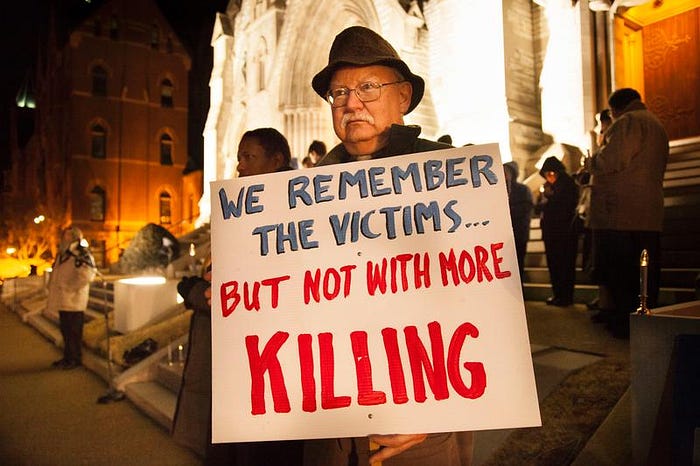
The Ethical Case Against the Death Penalty

Image from National Coalition to Abolish the Death Penalty — http://www.ncadp.org/

There are a number of arguments that have been used to challenge the death penalty. For example, many have argued that the criminal justice system is flawed by biases and other errors of judgement. Due to this fact, innocent people have been put to death in the past.

According to one study, 4% of those sentenced to death are wrongfully convicted.

Since humans are prone to bias, and because mistakes can be made, more people will undoubtedly be executed for crimes they did not commit in the future.

Opponents of the death penalty have also pointed out that there is racial bias in capital punishment sentencing, and that there is no definitive evidence to support the hypothesis that the death penalty is a more effective deterrent than non-lethal options.

These arguments, like those that appeal to the comparable costs between capital punishment and life-long imprisonment, are largely pragmatic arguments — that is, they show that there are problems associated with using capital punishment, rather than showing why it should not be considered as an option on ethical grounds (even if there were no problems involved in its administration).

In this article, I will focus on what I find to be the most compelling ethical arguments against the death penalty . These arguments appeal to generally agreed upon human values such as compassion and fairness .

I believe one of the strongest ethical arguments against the death penalty is that it runs counter to the idea of reforming individuals; rather, the death penalty gives up on the hope of changing a person for the better.

As our understanding of the mind and human behavior increases it is likely that we will one day come to better understand the causes of antisocial behavior, and effectively eradicate these causes or their effects. For example, we now understand that head trauma and environmental factors like abuse and toxins can result in neurological injury that predisposes individuals to impulsive and violent behaviors.

Additionally, neuroscience has discovered that executive function, including impulse controlrelies on a degree of frontal lobe development which may not occur until the mid-thirties (and can be retarded by chronic substance use, toxins, physical or psychological trauma, etc.).

The fact that the state has executed a number of minors (including 14 year-old George Stinney, whose guilty verdict was posthumously overturned) and intellectually disabled persons becomes even more depressing in light of this awareness.

Dramatization of 14 year-old George Stinney being strapped into the electric chair in the movie Carolina Skeletons.

A more informed and rational view of severe antisocial behavior makes it apparent that we should regard this behavior not as incorrigible evil, but as neurological or psychological pathology — pathology which we currently may not be able to effectively treat, but which we one day will. [Note: For a beautifully done theatrical exposition of this argument view Star Trek: Voyager “Repentance” Season 7, Episode 13.]

Another strong ethical argument against the death penalty points out the hypocrisy of the act, and the effect it has on society of promoting retribution and cruelty.

If we are to take a morally legitimate stand against non-defensive violence, we have to oppose such acts in all instances. Since an incarcerated individual is in a situation where they are unlikely to continue to harm others, there is no justification for committing an act of violence against them. To do so would be to act in aggression, rather than in defense. Further, a cogent case can be made that state uses of aggressive violence help to foster a culture that sees the use of violence as an acceptable, morally defensible way to deal with conflicts or perceived injustices.

It may, of course, be argued that chronically violent individuals still pose a threat when they are incarcerated — to other inmates, and, possibly, to the general public if they were to escape. This, however, is only a practical argument which points out one potential negative consequence of death penalty abolition. Rather than viewing this as a strong argument for the death penalty, it would make more sense to see this as an argument against allowing individuals predisposed to extreme violence to have unsupervised or unrestrained contact with others — and for taking stronger measures to prevent the escape of individuals who pose a danger to others.

A civilized society must, if it is to be ethically consistent, oppose all uses of violence that are not justifiably defensive in nature. The state has no moral legitimacy in condemning murder if it engages in acts that could also be seen as murderous or torturous by rational persons. As long as we allow the state to use aggressive violence we are all complicit in these unjustified killings.

Please take action by donating to the National Coalition to Abolish the Death Penalty or Amnesty International.

© 2026 Max Severin

Theme by Anders NorenUp ↑