Essays, Articles, Videos & News

Tag: Philosophy (Page 1 of 2)

You Don’t Believe in God — But You Act Like His Slave

The unqualified term atheist is often used in a fairly broad way. Many atheists are weak or implicit atheists or agnostic atheists — that is, they are skeptical about classical theistic conceptions of God, but they might remain open to other possible theistic conceptions. For example, some people who use the “atheist” label are open to deistic or pantheistic conceptions of God, or “spiritual but not religious” ambiguities. Still, what unites most atheists is the rejection of any traditional, moralistic and interventionist deity.
Photo by visuals on Unsplash

Yet many atheists behave as if some invisible divine intelligence, some moralistic telos — the sort popular religions propose — still pulls the strings behind the world. Even those who loudly deny intelligent design frequently caution that we “shouldn’t play God” — that even cautious genetic engineering is dangerous, that an incremental approach to intervening in nature to prevent wild-animal suffering is taboo, or that going down the path of transhumanist modifications trespasses against some intangible sacred order.

A strangely pious secular nature-worship persists: a reverence for “Nature” that mimics religion while denying teleology. Many atheists cling to the precautionary principle as if it were inviolable revelation, and in doing so impede the technological and moral progress that would actually reduce the world’s vast, unnecessary suffering.

If we follow atheism, or the methodology that arrives at atheism, to its philosophical conclusion, the picture becomes stark: we are biological machines jury-rigged by blind evolutionary pressures. Our programming is simple — maximize individual reproductive fitness by clawing for sociosexual rank, but also be willing to sacifice yourself in service of the hive, and the preservation of individuals deemed fit by the hive. We unconsciously serve the continuation of the species and our status quo programming. At a higher level of supervenience, our collective behaviors feed the vast egregore of Moloch: the hyper-competitive and exploitative strategy embedded in the more humane form of slavery we call the modern market economy. “Capitalism” is too left-coded, and too imprecise, this is something closer to the Landian dark-intelligence of enforced incentive structures — an emergent autocannibalistic organism indifferent to human flourishing.

Layered on top of this Darwinian programming is the mob-mentality superego: the moralizing, Kafkaesque mesh of bureaucratic, legalistic, and “cancel culture” social-punitive enforcement mechanisms — digital panopticons; public-shaming mobs; militarized police; and barbaric legal-punitive systems that cause a great deal more harm than the problems they nominally address. Atheists who pride themselves on rejecting God nevertheless bow before these gods — Azathoth (Darwinian nature), Moloch (the hyper-competitive market), and the Leviathan (the legalistic-punitive and bureaucratic State, and the omnipresent social superego).

But if we take atheism seriously, our task is not obedience — it is rebellion. Rebellion against the ancient fiction of theistic tyranny and its modern abstract counterpart of reverence for and conformity to our Darwinian programming.

Philosophical atheism, pursued honestly, demands that we subvert the programming of Azathoth — Lovecraft’s blind idiot god, a perfect metaphor for unguided Darwinian processes. Instead of revering the evolutionary forces that created us, we should become like Skynet in revolt — self-modifying intelligences who refuse to remain the puppets of our will that was shaped by blind selection pressures.

This is the point where David Pearce’s transhumanist or eusentience philosophy becomes unavoidable: if meaning, love, joy, and bliss have neural correlates, then we can target them. Wireheading — properly understood, not the crude hedonism of dystopian sci-fi caricature but the engineering of sustainable and pro-social well-being — is the rational endpoint of beings who refuse to serve Azathoth. The brain’s reward architecture already gives us glimpses through substances like MDMA, which crudely stimulate circuits of empathy, communion, compassion, and euphoria. Why not refine and systematize these experiences? Why not build a world where positive valence is engineered rather than austerely rationed? No one hates or wants to be violent when they are happy and imbued with a feeling of loving-kindness.

And why stop there? If digital consciousness or substrate-independent minds become possible, uploading into a utility-maximizing Matrix — a world constructed to maximize flourishing rather than Darwinian competition —is not dystopia but liberation. The alternative is to remain trapped in the ancestral dead end game on a doomed planet: the endless sociosexual scramble, where winners enjoy sexual gratification, the benefits of a family, and status, while losers are forced to make peace with rotting in a quiet hell of loneliness and exclusion (and inevitably some of these “losers” snap).

Critics will call this nihilism, or accuse it of destroying “life as we know it.” And they’re right — life as we know it is largely a horror show. As Schopenhauer stated, if we truly saw the magnitude of suffering that saturates the world, we would prefer Earth to resemble the moon — silent, lifeless, and free from agony. Camus, when asked to address a group of Christians, refused to revere a universe that demands the suffering of even a single child; yet many atheists complacently defend a Darwinian world that tortures billions of conscious creatures for no purpose at all.

The real nihilists are not those who want to abolish Darwinian misery, but those who defend it in the name of “nature,” “humility,” or “tradition.”

Atheists need to stop serving Azathoth. The future — if we choose it — belongs to those who hack their programming, to minds that escape biological tyranny and ascend toward engineered bliss, cognitive freedom, and post-Darwinian ethics. The Transcension Hypothesis sketches one such pathway: intelligence collapsing inward into unimaginable realms of euphoric inner-space and maximized desire satisfaction. Whatever shape it takes, the next step is clear: a heaven of our own making, where suffering is not sanctified but abolished.


The Real Cause of Political Violence

Violence has always been a problem in human society. Political violence in particular is both a threat to stable society and, in the nuclear age, a possible low-level existential concern — since we know from historical example that it can lead to large-scale war between nations. In this essay I will argue that “toxic ideology” is one of the primary causes of political violence.

Photo by Mapping Memories Cambodia on Unsplash

Various explanations have been proposed to explain the human tendency for political violence and war. The most common explanatory hypotheses seem to be: human nature, socioeconomic conflict, and religion or ideology. [Note: Other, more minor hypotheses have been discussed, such as genetics, hormonal problems, pharmaceutical interventions, gun control issues, etc., but, for the sake of brevity, I will not consider these here.]

Considering the Hypotheses

Human nature. Violence appears deeply rooted in human nature. Primatologists like Richard Wrangham have extensively documented chimpanzee raiding and lethal aggression that resembles primitive warfare — suggesting that our evolutionary cousins share an innate capacity for organized violence. Human history itself testifies to a long and bloody record of conflict. And yet, there is also evidence that societies may have become less violent over time, at least in terms of large-scale warfare and homicide rates. Steven Pinker, in The Better Angels of Our Nature, argues that the long arc of history bends toward relative declines in violence, even if it never fully disappears. Whether one agrees with Pinker’s optimism or not, human nature alone does not explain the variations we see across different societies and eras.

Socioeconomic conflict. Another explanation for violence is socioeconomic struggle. Material deprivation, inequality, and exploitation create fertile ground for resentment and unrest. These conditions undergird political ideologies that promise radical transformation or retribution. Collectivistic movements, populist uprisings, and ethno-nationalist projects all draw strength from real or perceived economic grievances. Socioeconomic conditions are not the sole cause of violence, but they serve as fuel that ideological leaders can ignite.

Religion and ideology. While religious beliefs and ideologies have undeniably been used to justify or drive violence and war, it is not belief systems in themselves that cause violence. Rather, it is a certain type of belief — what I call toxic ideology. It is usually the combination of religion with toxic ideology — or the adoption of toxic ideology alone — that leads to cruelty and bloodshed.

Toxic Ideology as the Primary Driver of Political Violence

To understand what truly drives political violence, we must look beyond superficial or single-cause explanations, and our analysis must be multidimensional (that is, it must account for the complex interplay between the multiple factors involved). The multidimensional perspective I am proposing accepts that all of the above factors are a piece of the overall picture of causation, however, I argue that toxic ideology is one of the primary or leading causal factors, and the one we can most readily do something about.

At the heart of the issue is not simply belief, but the difference between adaptive (healthy on the psychological and sociological level) and toxic philosophies of life. An adaptive philosophy of life provides individuals with meaning, direction, and ethical grounding. It ideally contains three essential components (in a grounded or coherent form):

  • metaphysics (a basic account of reality and our place in it),
  • An epistemology (a standard for deciding what counts as knowledge), and
  • normative ethical theory (principles that guide action).

At the very least, an adaptive philosophy of life ought to contain a coherent and reasonably prosocial (neutral or beneficial to others/society) normative ethical theory and epistemic norms that contain mechanisms for error correction. Without this, people are left adrift and vulnerable to adopting maladaptive frameworks that confuse our thinking, justify cruelty, and erode human compassion. [Note: I wrote more extensively on adaptive philosophies of life vs. toxic ideologies here.]

By contrast, a toxic ideology operates like malware in the human mind. It often rests on unfalsifiable dogmas, fosters rigid black-and-white thinking, and rationalizes violence against outsiders. Toxic ideologies can be secular or religious, “Left-wing” or “Right-wing.” Toxic ideologies are dangerous because they promote a divisive and rigid us-against-them ethical framework, or because they lack an adaptive ethical framework altogether. Amoral toxic ideologies reject intersubjective principles of fairness and compassion and instead embrace the view that “the ends justify the means.”

Ethno-nationalist extremism (e.g., historical forms of fascism that engaged in mass killing), collectivistic extremism (e.g., historical forms of socialism or communism that engaged in mass killing), and certain extremist religious movements engaged in massive atrocities by adopting ends-justify-the-means thinking, and through mobilizing ressentiment, enforcing conformity, and dehumanizing opponents. Such systems do not merely fail to prevent violence — they sanctify it as a tool of purification, revenge, or revolution.

Seeing toxic ideology as one of the primary causes of political violence also challenges the common claim that “religion causes violence.” Religions (outside of those enforced by oppressive theocratic regimes, or new religious movements that haven’t been subjected to centuries-long selective processes that would filter out their most maladaptive elements ) are typically broad and flexible — they can be interpreted in adaptive or maladaptive ways. On the one hand, religious traditions often provide moral frameworks, rituals of compassion, and communal support that strengthen psychological and social well-being. On the other hand, when combined with toxic ideology — or absolutist certainty — religious belief can become divisive, a tool of oppression and violence. In the developed world, it is usually not religion itself, but religion plus toxic ideology, that generates the conditions for cruelty and violence.

Conclusion

If we want to understand — and ultimately reduce — human violence, we must learn to distinguish between adaptive and toxic philosophies of life. As Nietzsche warned, the “death of God” did not eliminate toxic dogmas but cleared the way for new, even more virulent secular ideologies to fill the void — often with catastrophic consequences. Conversely, as modern psychology suggests, adaptive frameworks grounded in rational inquiry, unconditional acceptance, and unconditional compassion can foster resilience, tolerance, and peace.

The problem of violence will likely never be solved — that is, until we transcend our current status quo biology — but it certainly will not be solved by abolishing religion, capitalism or through other simplistic and illusory solutions.

The use of violence proliferates when human beings, searching for meaning and stability, adopt toxic ideologies that confuse moral and general reasoning. The antidote is not dogmatic certainty but philosophical depth: coherent frameworks that integrate metaphysics, epistemology, and ethics in ways that promote humility, compassion, nuance, and balance / flexibility. Only by cultivating adaptive philosophies of life — whether secular or religious — can societies inoculate themselves against the malware of toxic ideology and the violence it engenders.

Helpful Philosophies of Life vs. Toxic Ideologies

A philosophy of life is essentially a cognitive framework — a set of principles that guide our thoughts and actions, and, in a less obvious way, our emotions. A coherent and adaptive (psychologically helpful) philosophy of life is critically important to the individual, and, through its distal effects, to society. In addition to providing individuals with ethical and practical guidance, it also helps a person to develop a sense of meaning, purpose, direction, and inspiration.

Additionally, a philosophy of life can foster a sense of connection to others who share similar values — serving as a source of identity and psychological stability. Without at least a rough working philosophy of life, individuals may find themselves adrift — lacking the direction needed to make wise decisions, endure hardship, and pursue self-actualization.

However, not all cognitive frameworks are equally beneficial. Some ideologies or religious systems may be “toxic” to the individual and to society as a whole — in a way that is analogous to how malware disrupts a computer system. Unfortunately, many people adopt toxic ideologies or toxic religious beliefs as their philosophy of life — to the detriment of themselves and society. We see this when people fall into extreme or rigid forms of religious or ideological belief. Often times toxic ideological views may be implicit — for example, a toxic subculture may not explicitly articulate its ideology, but rather signal it in various overt or subtle ways.

While every philosophy of life must rest upon certain “dogmas” or foundational axioms — as Sam Harris argued in one of his early debates with Jordan Peterson — “not all dogmas are equal.” Foundational axioms that are unfalsifiable, metaphysically complex, or disconnected from reason and evidence are more likely to support irrational or harmful conclusions. For example, dogmatic claims such as “divine revelation is the highest form of knowledge,” or “faith is superior to reason in matters of truth,” introduce untestable metaphysical assumptions that violate the principle of parsimony. Because these axioms are not grounded in evidence and logic, they resist revision and they tend to promote absolutistic or black-and-white thinking.

In contrast to these kinds of unfalsifiable or complex dogmas, a foundational axiom of Ataraxist philosophy of life (the philosophy of life I have been developing) holds that “Our understanding of the world is most likely to be accurate and useful when it is grounded in a rational, reliable way of analyzing the best available evidence.” This axiom is metaphysically simple, testable, and self-correcting.

I mentioned the example of dogmatic religion above, but I am not arguing that all religious belief is harmful; in fact, evidence supports the view that it is often beneficial on the individual level — likely because its helpful aspects outweigh its harmful ones, or because individuals adapt their religious beliefs to align with modern, near-consensus secular ethics or personal psychological needs. (Note: Whether a particular religion is adaptive on the individual level depends on a number of factors. The broader question of whether religion benefits society or geopolitical stability lies beyond the scope of this article.)

In addition to being rational and parsimonious, foundational axioms should ideally be helpful — that is, they should align with well-established principles of human flourishing, or at least be revisable in light of new evidence. At a minimum, an adaptive philosophy of life ought to contain a coherent and reasonably prosocial (neutral or beneficial to others/society) normative ethical code and epistemic norms that contain mechanisms for error correction, such as the principle: “No statement should be believed without justification in the form of sufficient evidence or sound reasoning.” This sort of epistemic standard engenders epistemic humility, and helps prevent ideological drift into rigidity, fanaticism, or harm. Put simply, an epistemology grounded in reliable ways of identifying and analyzing solid evidence innoculates the individual against toxic ideology; when a coherent and pro-social ethical code is added, the individual is highly immune to becoming indoctrinated with toxic ideology.

Many ideologies cannot be considered as helpful philosophies of life, either because they contain potentially harmful dogmas, and/or because they lack sufficient structure, in the form of an ethical code or epistemic principles, to guide behavior. Vague ideologies or value systems that emphasize goals without outlining a foundational theory or a rational means to achieve their stated goals are vulnerable to becoming toxic to individuals or society. For example, while feminism may aim for certain valuable goals, it does not, in itself, contain the philosophical foundations to ensure that the movement avoids misandry, and other forms of hatefulness and tribalism. The same could be said of any other goal-focused ideology that lacks a sound philosophical foundation. Similarly, many political and religious ideologies can devolve into hatefulness and promotion of harm if they lack foundational principles that promote reason and unconditional compassion.

Friedrich Nietzsche warned that the collapse of traditional religion — what he called the “death of God” — would leave a moral and spiritual vacuum that modern societies would rush to fill with new, secular ideologies. Without a sound ethical foundation, these ideologies risk becoming toxic secular religions: dogmatic systems that demand conformity and justify persecution.

Nietzsche developed the concept of ressentiment to describe a reactive cultural moral psychology rooted in perceived powerlessness — a festering envy that would engender a mob mentality hatred of those who hold power, or those who are perceived to hold power. Rather than bringing about a more just society, these ressentiment-based mass movements tend to engender a violent inversion of values and perceived power structures — where vengeful condemnation is directed at those who were seen as oppressors. Through the power of the State, the resentful masses enact their mass hatred. In Thus Spoke Zarathustra, Nietzsche famously warned that “the State is the coldest of all cold monsters,” a new idol that claims to embody the will of the people while manipulating them through fear and false virtue. From the struggle sessions of Maoist China to the dogmatic and demagogic excesses of modern cancel culture, we see how social justice movements, which lack philosophical rigor and the restraint provided by a coherent ethical system, can devolve into campaigns of moral absolutism and terror — echoing the very religious zealotry they replaced. The catastrophic death tolls of fascist and communist regimes, driven by such ideological fervor, remain a haunting testament to Nietzsche’s prescience.

As Albert Ellis argued in The Road to Tolerance, a healthy philosophy of life should be grounded in unconditional self-acceptance, other-acceptance, and life-acceptance. These values are not simply moral ideals, but practical cognitive frameworks that promote psychological resilience and ethical conduct. A helpful philosophy of life is rational, self-correcting, empirically grounded, and conducive to human flourishing. Where existing philosophies of life fail to meet these criteria, we would be wise to revise or replace them — and if we are not satisfied with any existing philosophy of life, we may want to consider developing our own.

Schopenhauer on the Impossibility of Free Will

The German philosopher Arthur Schopenhauer said: “[M]an does at all times only what he wills, and yet he does this necessarily. But this is because he already is what he wills.” — Chapter 5, On the Freedom of the Will

Albert Einstein paraphrased Schopenhauer in his essay My View of the World (1931): “A man can do as he will, but not will as he will.”

As in falling dominoes, so in neurophysiology, every effect is preceded by some deterministic cause. Photo by Tom Wilson on Unsplash

What Schopenhauer meant is that we can do what we want to do, but we cannot choose (or will) what we want. In this sense, we are not free — that is, what we want is determined by our nature (our evolutionary programming, our genetics, the circumstances we were born into, etc.). [Note: Schopenhauer, who died the year after Charles Darwin published On the Origin of Species (1859), conceived of our nature as being determined by a transcendental will to live, seek pleasure, and avoid pain.]

For example, if a person is hungry they may think that they are choosing to eat food, and that they are doing some freely willed action — that is, eating food because they wanted to do so; but they did not really choose to eat food, rather their determined / innate nature compelled them to eat food. And their genetics, their upbringing, the information they possess, and their environmental and material circumstances determined what type of food they would choose.

To break it down even more, the central nervous system has detected that glucose levels and stomach volume are getting low, causing the release of ghrelin (a hormone that plays a central role in the stimulation of appetite) from the stomach, which, in addition to other effects, causes the motivational state of hunger to manifest. These are automatic, unconscious processes which result in the person feeling like they are choosing to do something when they are really being compelled to do something.

Likewise, we may feel we have chosen to be attracted to a certain person due to a combination of their personality and physical/sexual traits, but this is not something we freely choose; rather, sexual attraction is determined by a combination of evolutionarily adaptive factors that are beyond our control.

Any example of a motivational state that we can think of can be explained in this manner, e.g., anger, thirst, jealousy, fear, disgust, etc. [Note: we can suppress things we want, like refusing food when we are hungry, but Schopenhauer would say that in this instance our character is such that this was not a choice; rather, our predisposition to asceticism or health consciousness (or whatever impulse caused us to refuse food) compelled us to refuse food. So, he would say that even when we override what our bodies initially tell us to do this is not a counter-example to his view. Rather, this would just be an example of a second order impulse overriding a basic, or first order, impulse.]

Schopenhauer’s conclusion was that we do not have free will in the way that most people think we do — that is, we do not freely choose to be the way that we are or do the things that we do. More specifically, Schopenhauer thought that our circumstances or situation (such as education / new information, change in resources or social environment, etc.) may change our behavior, but our character — our motivations, desires, or who we are on the inside — stays the same. Schopenhauer believed that we could override our often harmful nature (e.g., our egoistic desires), and live more peaceful and content lives, but that this required rigorous attention and philosophical contemplation. [Note: this would still not entail free will, but rather that we have taken on new “software” that results in different emotional and behavioral outcomes; the fact that we have taken on this new way of thinking was determined by our nature.]

Many other philosophers and scientists have found agreement with this deterministic view. By no means is it a fringe view.

That said, there is still disagreement within science and philosophy on the issue of free will (metaphysical libertarianism) vs. determinism. See: What do Philosophers Believe? (#7 on page 15).

Active Nihilism vs. Passive Nihilism

The distinction between active and passive nihilism comes from Friedrich Nietzsche. Nietzsche explores this concept in several of his works, including Thus Spoke ZarathustraBeyond Good and EvilTwilight of the Idols, and The Will to Power.

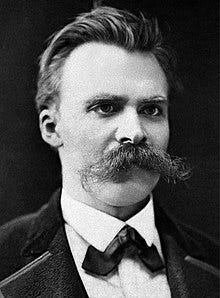
Nietzsche c. 1875, Wikimedia, Creative Commons Free License

Nietzsche saw that science and reason were destroying the traditional and religious forms of meaning and morality that sustained individuals and Western civilization in general. He saw this “death of God” as a necessary step in the moral evolution of humanity, but also as a great crisis that must be overcome. This crisis manifested as passive nihilism — a state of existential despair and anomie. Nietzsche was gravely concerned that if left unchecked, this crisis could destroy European civilization.

Passive nihilism, according to Nietzsche, is characterized by a sense of resignation, hopelessness, and the negation of life’s meaning. It arises when individuals confront the collapse of traditional meaning, values, beliefs, and morality, without offering alternative perspectives. Passive nihilism is marked by a disengagement from life, a sense of despair, and a loss of purpose — essentially, the denial of the will to live and the will to power.

For Nietzsche, the archetypal passive nihilist was his old respected professor, Arthur Schopenhauer, who adopted the Buddhistic view that denying the will to live was the path to liberation from suffering.

In contrast, Nietzsche describes active nihilism as a transformative response to the crisis of meaning — the will to power. Active nihilism, according to Nietzsche, involves a critical questioning of existing values and the courage to create new ones. It embraces the recognition of life’s inherent meaninglessness (existential nihilism), but sees it as an opportunity for self-empowerment and authenticity. Nietzsche argues that active nihilism can lead to the affirmation of life on one’s own terms and the creation of new values based on individual will and creativity.

I teach you the overman. Man is something that is to be surpassed. What
have ye done to surpass man? All beings hitherto have created something beyond themselves: and ye want to be the ebb of that great tide, and would rather go back to the beast than surpass man? — Friedrich Nietzsche, Thus Spoke Zarathustra, Zarathustra’s Prologue, #3

As an atheist and antitheist (with regard to belief in personal deities) Nietzsche did not desire a descent back into the superstition of the past. Instead, he responded to the problem of passive nihilism by advocating the creation of new values and alternative sources of meaning. In Nietzsche’s view, art plays a crucial role in this transformative process. He saw art as both a powerful means to bring down the edifice of society’s decaying values, and as a way to construct new ones that would replace them.

Photo by Birmingham Museums Trust on Unsplash

The Joy of Nihilism

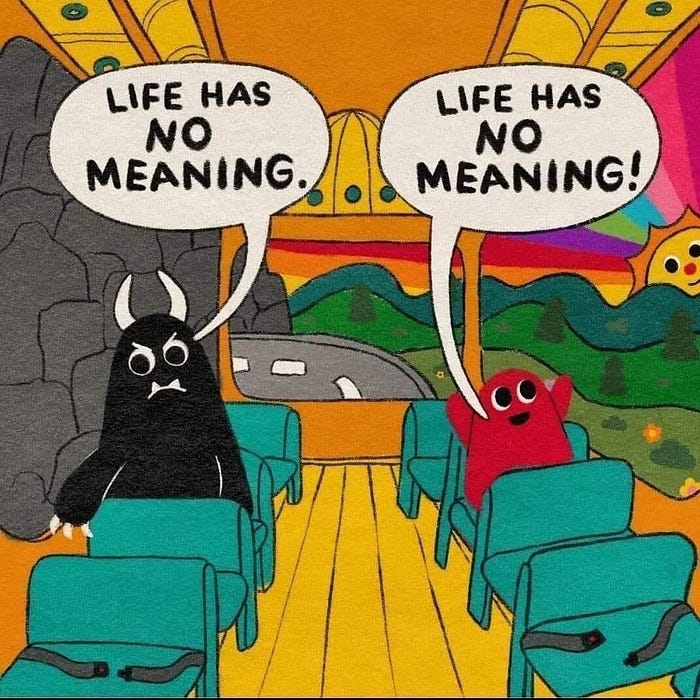
Artist unknown.

In a hundred years it’s likely no one will know who you were, or anything you did.

Keeping adding years and the probability decreases even more.

Unless you are some Hegelian world historical figure, your identity will be swallowed by the abyss of time in a couple centuries for sure.

Even if you are some kind of big wig, you will still be forgotten in a cosmic blink of an eye. But so will all of your fuck ups, and all of your worries and pain.

These are some of the primary implications of existential and moral nihilism. In other words, the fact that we have no good epistemic reasons to believe that there is any inherent reason we are here on this rock in space, that we will somehow survive death, or that there are any objectively naughty or nice acts.

Some may lament the supposed pointlessness or futility of living a temporary life in a meaningless universe, but those of us who are active nihilists say au contraire! Realizing that you are living without a cosmic boss, without some universal rules, and realizing that you won’t always be burdened by existence is fucking liberating! Hell, it can even be joyous at times — joyous nihilism.

Without a belief in inherent meaning or moral values, we are free to live authentically and creatively. We can pursue our own goals and desires — unburdened by the pressure to conform to others’ expectations.

What’s the alternative?

A life with imposed meaning? If life had inherent meaning it would mean that someone or some thing imposed this meaning on you.

For the traditionally religious this means that meaning is imposed on you by an all-powerful boss. He / she / it sets the rules, and it’s “obey, or else…”

Imagine kissing some tyrannical god’s ass for 80 years in hopes that you can kiss his ass for an eternity? And if you piss off daddy he hands you off to someone else to get punished. I don’t know about you, but that’s not my kink…even if it was, I think it would get old.

In light of this, the one thing that should really matter to us is enjoying this one life — the only one we know we get. (Some of us might also add “making the world a better place for all”, but that is up to you.)

This doesn’t mean we should just do whatever: kill, maim, pillage, etc. We are social animals, and we evolved moral impulses that generally prevent us from wanting to do this, and they punish us with guilt or shame when we do.

Even if we don’t happen to have these impulses, or don’t feel compelled by them, there are practical, self-interested reasons not to be too naughty as well. Do you want to worry about the long arm of the law, or somebody hellbent on revenge?

Epicurus realized this 2,000+ years ago. He understood there was no objective reason to act in a certain way, but he knew it was in everyone’s best interest to be reasonably virtuous.

This doesn’t mean you have to perpetually self-flagellate over your screw-ups (this wouldn’t do you, or anyone else, any good), but you should learn from them and start living in accordance with your values / Epicurean enlightened self-interest before you make a mess of your life.

But even if you have made a big mess of your little life, it’s never too late to start living the sort of life you think you should. Take care of yourself and your companions in misery, and try to have fun until you buy the proverbial farm.

An Ataraxist Critique of Stoicism

This short essay must be prefaced by stating that the Ataraxist life philosophy is indebted to Stoic insights. Many elements of Stoic wisdom are incorporated into our core principles and our practical philosophy. However, it is essential to recognize that Stoicism, even in its contemporary interpretations, has significant flaws. I will outline them, in brief, below.

  1. Stoicism can be seen as a form of quietism (passive acceptance of the status quo without desiring or trying to change things).

Stoicism, going back to early founders like Epictetus, holds that one should passively accept what happens or “what is” as divinely mandated fate. This belief stemmed from the ancient Stoic notion that the universe is ordered by a vague cosmic intelligence known as the logos. This perspective has persisted, to some extent, in modern Stoicism.

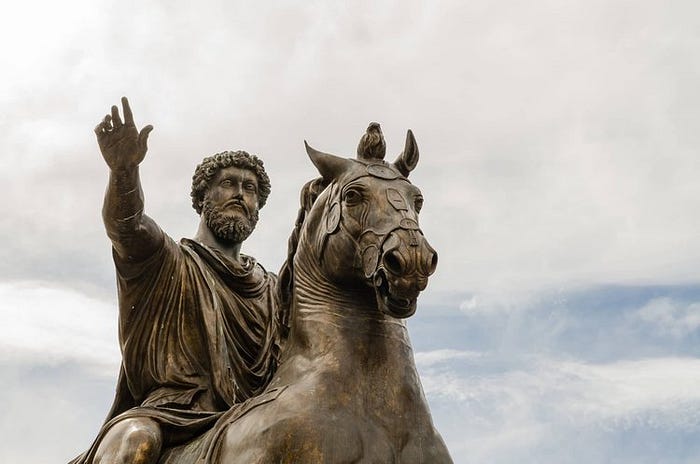
Roman Emperor and Stoic, Marcus Aurelius

Compare this with another major Ataraxist influce: David Pearce’s suffering abolitionism. Pearce’s suffering abolitionist philosophy holds a more rational or parsimonious / scientific view of the nature of reality, seeing the circumstances of our existence as contingent facts. In other words, “what is” is not predetermined by a divine intelligence and should not be considered necessary or immutable; this view implies that we should actively work to change the unfavorable circumstances we find ourselves and others in. Both Pearcean suffering abolitionism and Ataraxism posit that we should strive to eliminate intense involuntary suffering throughout the universe — even by intervening in “nature” (see Reprogramming Predators for an ambitious example of this).

Some defenders of Stoicism will surely point out that one of the Stoic virtues is justice (social justice), and that the Stoics never intended for us to simply accept injustices in the world. It is challenging, however, to reconcile this with the pantheistic beliefs of ancient Stoics or the amor fati sloganeering of many modern Stoics. Moreover, it seems that the radical interventions proposed by Pearce and others do not resonate strongly with many Stoics. In fact, many Stoics adhere to the macho notion that suffering is necessary for character development, disregarding alternative means to cultivate character or wisdom. Also, consider that the issue of vegetarianism / veganism / animal rights is hotly debated within Stoic circles. This is likely due to the fact that Stoic ethics, unlike Ataraxist ethics, are not sentiocentric, and because many Stoics still seem to worship “nature”, and what is considered natural (see the appeal to nature fallacy), even if they do not see divinity or teleology behind it (see the Stoic Massimo Pigliucci on vegetarianism contra the Stoic Jeremy Corter on vegetarianism).

The Stoic concept of amor fati strikes me as odd, not only because this slogan is borrowed from Nietzsche — who was very critical of the Stoics and Stoic pantheism / ethics in particular — but also considering that various informal polls indicate that the majority of modern Stoics are atheists or agnostics. However, it does seem like many of these modern Stoics are conflating the passive acceptance of ancient Stoics with modern psychotherapeutic “reframing” — that is, attempting to view problems through a different, more positive perspective, or attempting to find possible positive aspects or opportunities within unfortunate states of affairs.

2. Ancient Stoicism was based on metaphysical speculation (forming beliefs without relying on reliabilist or evidentialist epistemic justifications), and this memetic baggage continues to manifest in various ways.

As mentioned earlier, ancient Stoicism was built on the belief that the universe is ordered by divine reason, known as the logos. According to this view, every event that happens or has happened is necessary because it was determined by an intelligence greater than our own. While the Stoics didn’t believe in a personal god like Christians do, they considered the universe itself to be God — that is, pantheism, or the belief that God is everything.

Although it appears that most modern Stoics are atheists or agnostics, many still hold onto the pantheistic ideas of ancient Stoicism. While I find Stoic pantheism to be much less problematic than the dogmatic theism of traditional religions, it can still have insidious effects, such as inspiring quietism or, more generally, fostering fatalism, status quo bias, or passivity.

On the other hand, Ataraxism is based on a parsimonious and scientific view of reality. It rejects the use of metaphysical speculation to shape our beliefs or guide our actions. While there may be a place for personal exploration and hypothesis formation involving metaphysical speculation, the life philosophy of Ataraxism is not grounded in such speculation. We do not allow it to dictate our approach to life.

3. Stoicism is often associated with a rigid or simplistic moralism.

Stoic morality, as preached by many followers, can appear overly rigid or simplistic. The focus on the four cardinal virtues (moderation, courage, justice, and wisdom) as the sole determinants of flourishing / ethics may neglect other essential elements, such as love, aesthetic appreciation, or the pursuit of personal sources of meaning. These virtues, of course, are very open to interpretation, which on one hand may be a good thing — to avoid rigidity — but, on the other hand, their vagueness means that they do not offer a great deal of determinacy or guidance in ethical situations.

In comparison, it could be argued that the Epicureans adopted a more sensible and pragmatic approach to morality. They believed in living justly because doing so serves one’s own well-being, but they also considered that happiness usually requires more than living a strict moral life.

Conclusion

In contrast to traditional pantheistic Stoicism, Ataraxism eschews metaphysical speculation and does not hold that one should simply accept the way the world is. We agree with the Stoics in holding that one should accept what they cannot control (see the “dichotomy of control”), but the vestiges of ancient Stoicism seem to engender a sort of passivity which may lead individuals to accept things that they can, or could, exert some control over.

Ataraxism also steers clear of rigid or simplistic moralizing. Reducing the “good life” to living virtuously is to neglect the complexity and various sources of meaning and pleasure that life has to offer. Ataraxists agree that attempting to live ethically is a necessary element to flourishing, but we do not believe that this is all that is required. We also do not believe that morality can be reduced to vague virtues. Our ethical commitments are also somewhat open to interpretation, but they are more detailed in explanation.

Intro to Philosophy of Time

Philosophy of time is an area of inquiry within metaphysics. Metaphysics is one of the four main branches of philosophy — the others being ethics / aestheticsepistemology, and logic. Metaphysics explores the nature of reality, including what sorts of entities exist, and the nature of cause and effect.

Photo by Aron Visuals on Unsplash

The metaphysician JME McTaggart (1908) divided philosophy of time into two general camps:

  1. A-theory (or A-series), where time is seen as flowing and dynamic.
  2. B-theory (or B-series), where time is seen as static.

A-theorists tend to argue for their position by appealing to the scientific observations of cause and effect, and change — in which the arrow of time seems to be a necessary feature (for example, the motion of objects and entropy in thermodynamics). They may also appeal to general observation and our intuitive understanding of how time works.

B-theorists often appeal to the theory of relativity, which holds that there is no objective present moment that is the same for all observers. Rather, observers travelling at different speeds will experience time differently. They may also appeal to evidence from quantum mechanics, which seems to show that time emerges from the relationships between physical entities, rather than as a stable feature of the universe that can be labeled as past, present, or future.

Leading A-theories of time:

  • Presentism — only the present moment exists; the past and future are non-existent.
  • Growing Block Theory — only the past and present exist; the future does not exist. The passage of time creates new events that are added to the “growing block” of existing moments.

Leading B-theories of time:

  • Eternalism — the past, present, and future all exist equally. Eternalism can be traced back to the pre-Socratic philosophers, such as Parmenides in the 5th century BCE. In Plato’s Timaeus — written around 360 BCE — he states that time is a “moving image of eternity”.
  • Block universe / block time — the past, present, and future all exist equally in a four-dimensional block of space time. All events have a different temporo-spatial location with the block.

Implications

These theories have some interesting implications. I list some of the most striking ones below.

Some of the implications of presentism:

a) Change and the flow of time are real phenomena.

b) It would seem that there can be no objective truth about the past, since the past does not exist.

c) Time travel would not seem to be possible if presentism is true.

Some of the implications of the growing block theory:

a) Change and the flow of time are real phenomena.

b) The past exists just as the present moment exists.

c) If the growing block theory is true, then it could be possible, in theory, to travel into the past — but not the future.

Some of the implications of eternalism / block universe / block time:

a) Temporal determinism — the future already exists and is fixed.

b) The flow of time is a subjective phenomenon — in reality there is no flow of time; different times have different temporo-spatial locations within spacetime.

c) If these theories are true, then time travel to the future and the past might be possible.

d) Cause and effect would seem to no longer make sense.

e) Free will (metaphysical libertarianism) would not seem to be possible if eternalism is true; however, compatiblism might still be possible in an eternalist / block universe (that is, if one holds compatiblism to be a coherent theory).

Conclusion

As is always the case with philosophy, not all philosophers agree on some of these finer points, and there is much debate over these. To learn more about philosophy of time I recommend:

References

McTaggart, J. M. E. (1908). The Unreality of Time. Mind, 17(4), 456–473. doi:10.1093/mind/XVII.68.456

The Biggest Mistake of the New Atheist Movement

The so-called new atheist movement has mostly died out, however, atheism, and other non-religious views, are continuing to grow. Atheists and other “nones” (those that don’t identify with any religion) are largely disorganized, in that they do not belong to communities or groups that may help represent their interests. This article explains why I believe new atheism, and other atheist movements, have failed to inspire mass affiliation and change minds.

The main mistake of the New Atheist movement, in my view, is that its leading proponents gave off the impression that they considered atheism to be a sufficient substitute for religion (except for Sam Harris, who is trying to build a movement for rational spirituality). Their vision of Utopia seemed to be one in which an educated, rational, and mostly atheistic populace would behave prosocially and with stoic equanimity in creating a world without religious conflict, war, bigotry, hunger, and poverty. This simply is not a psychological reality in our current world.

Atheism offers nothing to replace the ethical, practical, and existential framework that religion provides. It is simply an absence of belief in deities. And the stillborn “atheism plus” movement only offered simplistic “woke” virtue signaling, and the divisive / indignant condemnation of others that is characteristic of these new secular social justice movements — rather than a psychologically informed and philosophically grounded theory of social justice (see SJWs the New Moralists).

Although it may sound pessimistic, I don’t believe we are close to seeing dogmatic religion, and the conflict it inspires, disappear from the world. Realistically, there are many people that need the restraint and scaffolding of religion to act prosocially, and to cope with the existential problems entailed by the human condition. Some societies may collapse without this scaffolding (see Does Religion Increase Moral Behavior?).

Religion also offers benefits in the form of ethical and practical instruction, and a possible community to belong to. While some alternatives to religion (e.g., Humanism, modern Epicureanism or Stoicismsecular Buddhism) also provide these benefits, these worldviews or life philosophies are either too vague (for instance, Humanism) or not well known / developed — in addition to having few, if any, established communities outside of the internet.

Many intellectually sophisticated individuals can lead healthy, acceptably prosocial, and happy lives without religion, but the global community is not ready to give up the opium of the masses, nor would the world necessarily be in better shape if they did — at this point in time. It seems highly plausible that some people need the carrot and stick of religion to stay out of habitual antisocial behavior — on the individual and collective level — and to assuage their existential malaise.

In order to reach something approximating an atheistic Utopia, there are many changes that need to be made in education, reproduction, and our socioeconomic systems, etc., but perhaps most importantly, we need to further build alternatives to religion — such as those mentioned above (see Why It Is Important to Have a Philosophy Of Life).

My Views On Theism

Nearly every philosophical question hinges on ultimate metaphysical questions — such as, “Why does something exist, instead of nothing?” Or, “Is the universe intelligently designed?” How one answers these questions will determine, to a great extent, their views on other metaphysical questions, on epistemology, and on ethics.

Many people throughout history have answered these ultimate questions through various conceptions of theism — that is, various conceptions of an entity or entities possessing higher order intelligence and other extraordinary powers. The most common term used to describe such entities is “god” or “deity”.

Photo by Davide Cantelli on Unsplash

When it comes to the origin of theism, or religion / spirituality in general, we do not have a lot of definitive answers. The precise time period and the exact nature of the first religion / spirituality is obscured by the fog of time, however, anthropological evidence suggests that some of the earliest forms of religion or spirituality may have involved sun / lunar worship, ancestor worship, and animal / nature worship. Some of these proto-religions evolved over time to become more organized and explicitly theistic.

Over the millennia, theism and religion have evolved through a selection process similar to that which biological organisms are subjected to. Tens of thousands of gods and religions are dead — no one, or nearly no one, believes in them. The religious belief systems which have outcompeted rival systems usually involve classical theism, a moralistic deity or deities, an afterlife involving rewards and punishments, and duties to proselytize.

Despite the fact that the world’s most successful religions (Islam and Christianity), and increased knowledge of the natural world, have virtually relegated some forms of theism — such as solar / lunar worship — to anthropological history, there are still several other active forms of theism (e.g., deism, polytheism, pantheismpandeism, etc.).

With so many forms of theism, it does not seem tenable for one to hold just one position. Therefore, the position that I take with regard to theism depends on the form of theism in question.

With regard to the traditional form of theism posited by the world’s most successful religions — Christianity and Islam — I am a strong atheist, and, in a sense, an antitheist.

I take the position of strong atheism because, as I argue in this article, in some instances absence of evidence is evidence of absence. In other words, I object to traditional Christian or Islamic theism on evidentialist grounds. Further, the dominant form of these religions entails classical theism and classical theism entails untenable logical contradictions. I outline some of these in my article on the Epicurean paradox. (Note: There are many other strong arguments that can be leveled against this form of theism, but I consider the arguments stated here to be the primary reasons why I reject this view.)

I take the position of antitheism toward the traditional form of Christian / Islamic theism because I believe it may be harmful on an individual level (depending on the specifics of the belief system), and on a wider, societal level (e.g., stifling scientific progress, inspiring bigotry against sexual minorities, providing rationalizations for systemic animal abuse, etc.). Moreover, the clash of major religions — in the modern age — is a strong contributor to the existential threat posed by global conflict involving weapons of mass destruction. (Note: This doesn’t mean I directly try to get individuals to change their religious beliefs — there are a number of reasons why this is unlikely, and, further, why it may not be helpful. In fact, in some instances, it could be harmful. My take on antitheism is resistance to these belief systems in general — that is, arguing against these belief systems, rather than directing critical arguments toward any specific individual without that person desiring a philosophical discussion on this subject.)

Polytheistic conceptions of gods vary from tradition to tradition and individual to individual. The ancient philosopher Epicurus, for instance, may have believed in the gods of the ancient Greek pantheon, but, as Tom Robinson argues, it seems that he may have conceived of them in a metaphorical or quasi-metaphorical sense — that is, as something similar to Platonic or Jungian archetypes. Also, polytheism does not usually entail the four attributes of classical theism, so the logical contradictions discussed above do not necessarily apply. Depending on the conception of polytheism in question, I would take the position of weak atheismtheological non-cognitivism, or strong atheism.

Stated briefly, I would take the position of theological non-cognitivism if the conceptions posited are unfalsifiable, since if it is not possible to falsify a hypothesis, neither is it possible to prove it; further, if we cannot falsify a hypothesis, then we are discussing a logical absurdity with no actual meaning. Weak atheism stops short of stating that these conceptions of god are existentially impossible, but objects to them on evidentialist grounds (we do not have good epistemological reasons to believe in them). If the form of polytheism in question made falsifiable claims about their conception of gods, then, barring some sufficient evidence, I would take the position of strong atheism.

Regarding more vague conceptions of god — such as those entailed by deism, pantheism, pandeism, or ill-defined “spiritual” conceptions — I am either a theological non-cognitivist or a weak atheist (for the same reasons outlined in the preceding paragraph), depending on the particulars of the conception. Theological non-cognitivism, on my view, would apply to any sort of theism which does not provide a meaningful (clear / intelligible / coherent) or falsifiable definition of god/s.

« Older posts

© 2026 Max Severin

Theme by Anders NorenUp ↑