Essays, Articles, Videos & News

Tag: Psychology

The Fallacy of IQ Obsessiveness

The Intelligence Quotient (IQ) — as measured by empirically studied and generally accepted tests (most commonly the Wechsler Adult Intelligence Scale or the Wechsler Intelligence Scale for Children) — is one of the most predictive psychometrics available. In psychological jargon we would say that bona fide IQ tests have predictive validity.

Nevertheless, we cannot say that IQ tests have construct validity — that is, we do not know that they truly measure “intelligence”, because we do not have an agreed upon theory or definition of intelligence.

What we can say is that IQ is positively correlated with success in other academic domains, academics in general — and to a lesser degree, with occupational placement in cognitively challenging fields, life expectancy, and income. It would therefore be more fitting to refer to IQ as an academic / life “success” quotient (where success is very narrowly defined).

One could argue that success in academics, or at least the ability to be successful in academics, is a necessary condition for our most intersubjective definitions of intelligence, however, there are flaws with this argument.

To be brief, the biggest flaw with the above argument is that intelligence is a multidimensional and amorphous concept. Even our intersubjective definitions may be missing something that is fundamental to a philosophically sophisticated definition of intelligence.

In order to arrive at a more precise and comprehensive definition of intelligence the meta-discourse must move beyond the operational definition of intelligence that is confined to narrow measures of success. For example, a comprehensive definition of intelligence might include other facets of cognition that are disregarded by currently accepted IQ tests (e.g., creativity, social / emotional cognition, practical intelligence, wisdom, kinesthetic intelligence, knowledge integration, epistemic rigor, etc.).

Another major problem with IQ obsessiveness is highlighted by a recent trend seen in counter-enlightenment circles: the mocking of so-called “midwits” — that is, those with average IQ scores.
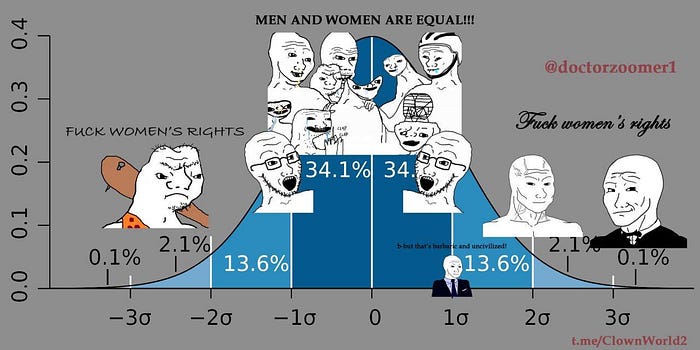
Meme posted by doctorzoomer1

The general idea here is that our most reflexive human instincts are actually wise. In the above example, the implicit argument goes like this:

Premise 1) People with below average IQs tend to oppose women’s rights.
Premise 2) People with average IQs tend to support women’s rights.
Premise 3) People with above average IQs do not support women’s rights. Conclusion: Therefore, primitive impulses are vindicated by higher order intelligence, and women should not have rights.

According to this line of thinking, it is the persons with average or just-barely-above-average IQ that are confused by their superficial understanding of things; if they were really smart they would understand that there is logic and wisdom in the instincts of those whose thinking is not clouded by the dogma of modern secular progressivism. (The general idea is that those who are smart enough to comprehend ideologies and basic facts — but are not smart enough to think critically and deeply about the world — are confounded by a dearth of knowledge or an inability to integrate knowledge, a lack of comprehension, or by their indoctrination.)

Another example:
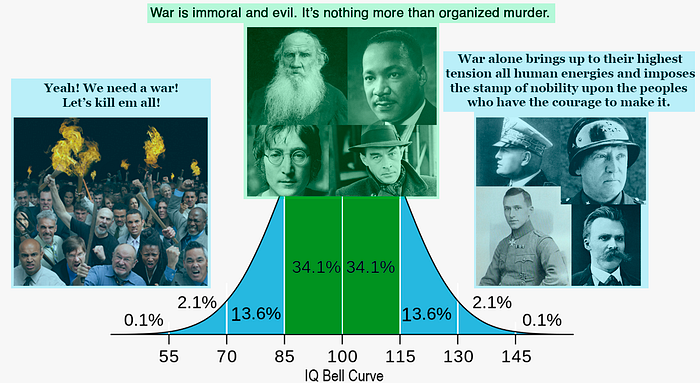
Meme posted by connect_government_7 on Reddit

Here the poster is arguing that war is actually a noble endeavor, and that the war frenzy of those the “midwits” consider to be ignorant / stupid is actually wise.

There are a number of problems with the implicit arguments here, but first, I want to concede that there is a kernel of truth here, too. Yes, it seems that in many instances, those with a limited understanding do not recognize the wisdom of our evolved instincts, and instead are led astray by ideology or a merely superficial understanding. Nietzsche was making this claim when he stated, “There is more wisdom in your body than in your deepest philosophy” (Thus Spoke Zarathustra, Part 1, Chapter 4).

However, it is not always the case that our evolved heuristics and impulses are wise, nor is it always the case that individuals with average IQs have only a superficial understanding. The above examples hint at some vague defense of non-meritocratic patriarchy and militaristic fascism, respectively. These are, of course, ideologies that we have prima facie reasons to be skeptical of, just based on their historical record — not to mention the fact that war is an existential threat to our species, and any romanticization of war only serves to bolster this existential risk. [Note: these are just implicit arguments hinted at by the limited symbolic content of the memes; a steelmanned version of these arguments might have more cogency, however, this has not been the case in my experience in online interactions with counter-enlightenment figures.]

These “midwit” memes also consistently commit the fallacy of assuming the conclusion. Is it really the case that most above average IQ individuals support war, oppose women’s rights, believe in God…or whatever else is being claimed? Out of all of the “midwit” memes that I have surveyed they are almost always false — in that, there is either not enough quality data to support their claims, or the data clearly contradict their claims (see Debunking the Meme: Theism and IQ). Likewise, some of the claims made about below average IQ individuals are also dubious.

Another assumed conclusion in these “midwit” memes is that individuals with high IQs have more veridical views or possess more practical or ethical wisdom than individuals with average IQs. While it is likely that a certain degree of g factor intelligence is a necessary condition for rationality or epistemic rigor, it is not clear that above average IQ entails more epistemic rigor in all cases. In other words, a certain amount of intelligence as measured by IQ (presumably, at least average) is a necessary condition for rationality, but intelligence greater than or equal to this level is not a sufficient condition for rationality.

Interestingly, there is some evidence which suggests that higher than average IQ is positively correlated with cluster A traits or cluster A personality disorders (schizotypal, schizoid, paranoid), which are characterized by delusional, eccentric, odd, and / or paranoid beliefs (no link; see Weinberger, Farmer & Keilp, 2002 in the Journal of Clinical Psychology). This data underscores the fact that rationality is sufficient for a certain level of intelligence, but not the other way around (i.e., this sufficient condition is not reciprocal — that is, it is not biconditional). This correlation suggests that neuro-psychological epistemic dysfunction affects a certain segment of the high IQ population (hypotheses that might warrant investigation: problems due to over-confidence; overactive pattern detection/threat detection; an inability to utilize other modes of cognition beyond the analytical mode).

The issue of practical or ethical wisdom and its relationship to IQ would require another article, however, I think a case can be made that high IQ and its positive correlation with autistic traits might result in a delay or impede the development of what is generally considered to be wisdom in some individuals. Nor does IQ account for things like intellectual curiousity, which is necessary for the development of broad crystalized intelligence.

Further, as is evidenced by religious apologetics, and other forms of sophistic lawyering, we sometimes see that a high IQ affords individuals with the ability to rationalize more effectively or to take pleasure in the contrarian challenge of “making the weaker argument stronger” — perhaps for practical or emotional reasons, in addition to the association between high IQ and an affinity for novelty. There are a number of personality factors and cognitive styles that influence whether one places epistemic justifications for belief over pragmatic justifications, and it isn’t entirely clear how these relate to general cognitive ability.

Overall, this is a pretty silly propaganda technique that wouldn’t deserve this much proverbial ink if it weren’t so common. A bit of comical irony is that truly high IQ individuals should be able to spot the shoddy reasoning involved in these memes, so it doesn’t seem that they are likely progenitors. [Note: even high IQ individuals with a problematic epistemology can usually spot simple logical errors readily, and because of this they would seem less likely to include basic logical fallacies in their arguments.]

In summary, the obsession with IQ is misguided, and narrow-minded. In my view, a better way to conceptualize intelligence might resemble personality taxonomies like the Big Five, where cognitive abilities are measured in various domains — including some of those currently ignored by accepted IQ tests — to render a cognitive profile. This approach would be more conducive to acceptance of a variety of cognitive styles, and foster greater sociological understanding and self-knowledge.


Active Nihilism vs. Passive Nihilism

The distinction between active and passive nihilism comes from Friedrich Nietzsche. Nietzsche explores this concept in several of his works, including Thus Spoke ZarathustraBeyond Good and EvilTwilight of the Idols, and The Will to Power.

Nietzsche c. 1875, Wikimedia, Creative Commons Free License

Nietzsche saw that science and reason were destroying the traditional and religious forms of meaning and morality that sustained individuals and Western civilization in general. He saw this “death of God” as a necessary step in the moral evolution of humanity, but also as a great crisis that must be overcome. This crisis manifested as passive nihilism — a state of existential despair and anomie. Nietzsche was gravely concerned that if left unchecked, this crisis could destroy European civilization.

Passive nihilism, according to Nietzsche, is characterized by a sense of resignation, hopelessness, and the negation of life’s meaning. It arises when individuals confront the collapse of traditional meaning, values, beliefs, and morality, without offering alternative perspectives. Passive nihilism is marked by a disengagement from life, a sense of despair, and a loss of purpose — essentially, the denial of the will to live and the will to power.

For Nietzsche, the archetypal passive nihilist was his old respected professor, Arthur Schopenhauer, who adopted the Buddhistic view that denying the will to live was the path to liberation from suffering.

In contrast, Nietzsche describes active nihilism as a transformative response to the crisis of meaning — the will to power. Active nihilism, according to Nietzsche, involves a critical questioning of existing values and the courage to create new ones. It embraces the recognition of life’s inherent meaninglessness (existential nihilism), but sees it as an opportunity for self-empowerment and authenticity. Nietzsche argues that active nihilism can lead to the affirmation of life on one’s own terms and the creation of new values based on individual will and creativity.

I teach you the overman. Man is something that is to be surpassed. What
have ye done to surpass man? All beings hitherto have created something beyond themselves: and ye want to be the ebb of that great tide, and would rather go back to the beast than surpass man? — Friedrich Nietzsche, Thus Spoke Zarathustra, Zarathustra’s Prologue, #3

As an atheist and antitheist (with regard to belief in personal deities) Nietzsche did not desire a descent back into the superstition of the past. Instead, he responded to the problem of passive nihilism by advocating the creation of new values and alternative sources of meaning. In Nietzsche’s view, art plays a crucial role in this transformative process. He saw art as both a powerful means to bring down the edifice of society’s decaying values, and as a way to construct new ones that would replace them.

Photo by Birmingham Museums Trust on Unsplash

The Danger of Unrestrained Morality

Moral foundations theory describes how humans evolved to possess innate moral impulses. These impulses drive us to value:

  • fairness
  • purity
  • in-group loyalty
  • liberty
  • caring for others
  • respect for authority

These six moral foundations are found across all human cultures, however, they are expressed and understood in various ways depending on the particular culture or subculture in question.

Image by Anil John from Pixabay

Moral impulses were selected for in our evolutionary history due to the fact that they are essential to a social species, and because they tend to enhance group fitness. In a society these moral impulses are codified into laws and moral norms —what we generally refer to as morality.

Morality, however, is often a double-edged sword.

While moral impulses and moral norms tend to enhance group fitness, some moral systems may harm group fitness. And unrestrained morality, in any society, has the potential to be a serious threat to the well-being and liberty of the individual.

Those who run afoul of popular morality have been treated with extreme cruelty throughout human history — either by a retributive (rather than remedial) legal system or through vigilante acts. Morality has also been used to drum up support for various forms of violent aggression (e.g., pogroms, terrorism, wars of aggression, etc.), and it has been weaponized in order to persecute those who have simply been accused of wrongdoing.

In recent times we see this type of abuse associated with “cancel culture”, however, this phenomenon is nothing new (for historical example see: McCarthyismwitch hunts, the Inquisition).

A modern philosophically and scientifically informed view of morality demonstrates the complexity of moral questions, and it confirms descriptive moral relativism — that is, it shows that what is considered morally good (or bad) in regards to particular issues changes over time and varies from culture to culture. This fact provides prima facie grounds for being skeptical about moral realism, and at the very least it should make us question the epistemological status of generally accepted morality.

A philosophically informed view also provides prima facie reasons (at the least) to be skeptical about free will. If humans do indeed lack metaphysical freedom of will, then no one can be said to be deserving of punishment. Even if we assume some degree of free will, there are many reasons to oppose cruel punishments, and any sort of aggressive violence in general. Additionally, ignorance and neuro- or psychopathology are much more parsimonious explanations of antisocial behavior than metaphysical evil (all of which are possibly remediable).

In consideration of this view, one may be tempted to give up on the project of morality entirely (that is, to accept a passive form of moral nihilism), but this would be a mistake. Morality is necessary for the practical functioning of human society.

What is needed is a system of morality that is grounded in compassionate understanding, and which is appropriately restrained by philosophical reason.

Plato, and Freud — who borrowed from Plato in his work — wrote about why morality must be restrained or guided by reason. Both Plato and Freud viewed the human psyche as being divided into three parts: a rational part, a primitive desire-driven part, and a moral part. Plato uses the analogy of a charioteer (reason) who has to restrain and coordinate the actions of a white horse (morality) and a black horse (primitive desire). Freud describes a tripartite psyche divided into the ego (the organism’s conception of self — which uses reason to understand the world), a superego (morality), and an id (primitive desire). These conceptions are helpful when we think about the influence of morality on the individual, and on society.

Both of these thinkers emphasized the importance of reason as a moderating force to restrain or guide these two instinctual drives. If either of these instinctual drives is given too much freedom the individual will be in peril (as will be those they interact with).

Reason, for example, informs us that retribution and cruel punishment are not actions that have clear justifications (see my point about free will above). Rational analysis also shows us that we should withhold assent to some moral impulses — such as those to purity — since they are outmoded in light of a modern understanding (such as a modern understanding of disease causation).

If one’s moral impulses are not restrained by reason, they may become an inspiration for cruelty in the form of retribution, hate, and aggressive violence. History is rife with examples of aggrieved groups standing up to injustice, only to end up matching or overshadowing the injustice of those they opposed. We see this today in some of the most zealous segments of the cultural Right and Left.

Generally speaking, certain segments of the cultural Left want to enact violence on those who do not share their conceptions of the moral foundations — their egalitarian view of care and fairness, and their emphasis on positive conceptions of liberty; whereas those in certain segments of the radical Right want to enact violence on those who do not share their in-group loyalty / care, their meritocratic conception of fairness, and their emphasis on negative liberty.

If one’s moral code can be used to justify a non-defensive infliction of harm, then it is not sufficiently restrained by reason. And without reason we have no hope of arriving at significant intersubjectivity about moral questions — we will only have competing systems of morality based on epistemically suspect cultural conventions like dogmatic religion or folk wisdom.

If we do not challenge priggishness on the individual level we risk developing a judgmental attitude that results in conflict and possible social alienation; similarly, internally focused judgment can harm us by engendering unproductive guilt and shame. On the societal level we risk the possibility of letting anger and vindictiveness grow until violent conflict is unavoidable. Only critical thought and reason can prevent these damaging consequences.

The Ethical Case Against the Death Penalty

Image from National Coalition to Abolish the Death Penalty — http://www.ncadp.org/

There are a number of arguments that have been used to challenge the death penalty. For example, many have argued that the criminal justice system is flawed by biases and other errors of judgement. Due to this fact, innocent people have been put to death in the past.

According to one study, 4% of those sentenced to death are wrongfully convicted.

Since humans are prone to bias, and because mistakes can be made, more people will undoubtedly be executed for crimes they did not commit in the future.

Opponents of the death penalty have also pointed out that there is racial bias in capital punishment sentencing, and that there is no definitive evidence to support the hypothesis that the death penalty is a more effective deterrent than non-lethal options.

These arguments, like those that appeal to the comparable costs between capital punishment and life-long imprisonment, are largely pragmatic arguments — that is, they show that there are problems associated with using capital punishment, rather than showing why it should not be considered as an option on ethical grounds (even if there were no problems involved in its administration).

In this article, I will focus on what I find to be the most compelling ethical arguments against the death penalty . These arguments appeal to generally agreed upon human values such as compassion and fairness .

I believe one of the strongest ethical arguments against the death penalty is that it runs counter to the idea of reforming individuals; rather, the death penalty gives up on the hope of changing a person for the better.

As our understanding of the mind and human behavior increases it is likely that we will one day come to better understand the causes of antisocial behavior, and effectively eradicate these causes or their effects. For example, we now understand that head trauma and environmental factors like abuse and toxins can result in neurological injury that predisposes individuals to impulsive and violent behaviors.

Additionally, neuroscience has discovered that executive function, including impulse controlrelies on a degree of frontal lobe development which may not occur until the mid-thirties (and can be retarded by chronic substance use, toxins, physical or psychological trauma, etc.).

The fact that the state has executed a number of minors (including 14 year-old George Stinney, whose guilty verdict was posthumously overturned) and intellectually disabled persons becomes even more depressing in light of this awareness.

Dramatization of 14 year-old George Stinney being strapped into the electric chair in the movie Carolina Skeletons.

A more informed and rational view of severe antisocial behavior makes it apparent that we should regard this behavior not as incorrigible evil, but as neurological or psychological pathology — pathology which we currently may not be able to effectively treat, but which we one day will. [Note: For a beautifully done theatrical exposition of this argument view Star Trek: Voyager “Repentance” Season 7, Episode 13.]

Another strong ethical argument against the death penalty points out the hypocrisy of the act, and the effect it has on society of promoting retribution and cruelty.

If we are to take a morally legitimate stand against non-defensive violence, we have to oppose such acts in all instances. Since an incarcerated individual is in a situation where they are unlikely to continue to harm others, there is no justification for committing an act of violence against them. To do so would be to act in aggression, rather than in defense. Further, a cogent case can be made that state uses of aggressive violence help to foster a culture that sees the use of violence as an acceptable, morally defensible way to deal with conflicts or perceived injustices.

It may, of course, be argued that chronically violent individuals still pose a threat when they are incarcerated — to other inmates, and, possibly, to the general public if they were to escape. This, however, is only a practical argument which points out one potential negative consequence of death penalty abolition. Rather than viewing this as a strong argument for the death penalty, it would make more sense to see this as an argument against allowing individuals predisposed to extreme violence to have unsupervised or unrestrained contact with others — and for taking stronger measures to prevent the escape of individuals who pose a danger to others.

A civilized society must, if it is to be ethically consistent, oppose all uses of violence that are not justifiably defensive in nature. The state has no moral legitimacy in condemning murder if it engages in acts that could also be seen as murderous or torturous by rational persons. As long as we allow the state to use aggressive violence we are all complicit in these unjustified killings.

Please take action by donating to the National Coalition to Abolish the Death Penalty or Amnesty International.

© 2026 Max Severin

Theme by Anders NorenUp ↑