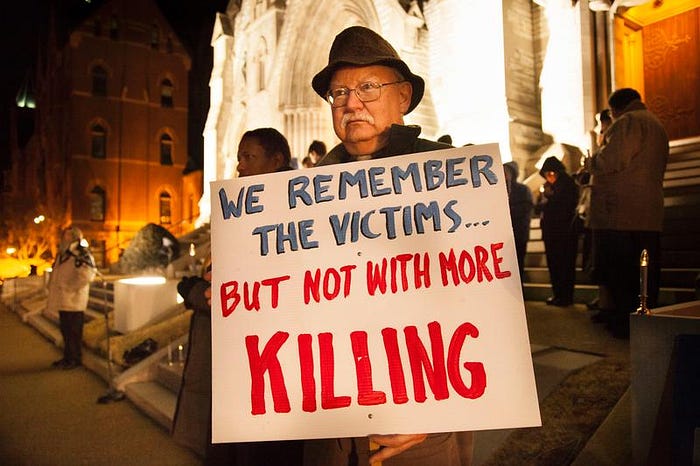
Violence has always been a problem in human society. Political violence in particular is both a threat to stable society and, in the nuclear age, a possible low-level existential concern — since we know from historical example that it can lead to large-scale war between nations. In this essay I will argue that “toxic ideology” is one of the primary causes of political violence.

Various explanations have been proposed to explain the human tendency for political violence and war. The most common explanatory hypotheses seem to be: human nature, socioeconomic conflict, and religion or ideology. [Note: Other, more minor hypotheses have been discussed, such as genetics, hormonal problems, pharmaceutical interventions, gun control issues, etc., but, for the sake of brevity, I will not consider these here.]
Considering the Hypotheses
Human nature. Violence appears deeply rooted in human nature. Primatologists like Richard Wrangham have extensively documented chimpanzee raiding and lethal aggression that resembles primitive warfare — suggesting that our evolutionary cousins share an innate capacity for organized violence. Human history itself testifies to a long and bloody record of conflict. And yet, there is also evidence that societies may have become less violent over time, at least in terms of large-scale warfare and homicide rates. Steven Pinker, in The Better Angels of Our Nature, argues that the long arc of history bends toward relative declines in violence, even if it never fully disappears. Whether one agrees with Pinker’s optimism or not, human nature alone does not explain the variations we see across different societies and eras.
Socioeconomic conflict. Another explanation for violence is socioeconomic struggle. Material deprivation, inequality, and exploitation create fertile ground for resentment and unrest. These conditions undergird political ideologies that promise radical transformation or retribution. Collectivistic movements, populist uprisings, and ethno-nationalist projects all draw strength from real or perceived economic grievances. Socioeconomic conditions are not the sole cause of violence, but they serve as fuel that ideological leaders can ignite.
Religion and ideology. While religious beliefs and ideologies have undeniably been used to justify or drive violence and war, it is not belief systems in themselves that cause violence. Rather, it is a certain type of belief — what I call toxic ideology. It is usually the combination of religion with toxic ideology — or the adoption of toxic ideology alone — that leads to cruelty and bloodshed.
Toxic Ideology as the Primary Driver of Political Violence
To understand what truly drives political violence, we must look beyond superficial or single-cause explanations, and our analysis must be multidimensional (that is, it must account for the complex interplay between the multiple factors involved). The multidimensional perspective I am proposing accepts that all of the above factors are a piece of the overall picture of causation, however, I argue that toxic ideology is one of the primary or leading causal factors, and the one we can most readily do something about.
At the heart of the issue is not simply belief, but the difference between adaptive (healthy on the psychological and sociological level) and toxic philosophies of life. An adaptive philosophy of life provides individuals with meaning, direction, and ethical grounding. It ideally contains three essential components (in a grounded or coherent form):
- A metaphysics (a basic account of reality and our place in it),
- An epistemology (a standard for deciding what counts as knowledge), and
- A normative ethical theory (principles that guide action).
At the very least, an adaptive philosophy of life ought to contain a coherent and reasonably prosocial (neutral or beneficial to others/society) normative ethical theory and epistemic norms that contain mechanisms for error correction. Without this, people are left adrift and vulnerable to adopting maladaptive frameworks that confuse our thinking, justify cruelty, and erode human compassion. [Note: I wrote more extensively on adaptive philosophies of life vs. toxic ideologies here.]
By contrast, a toxic ideology operates like malware in the human mind. It often rests on unfalsifiable dogmas, fosters rigid black-and-white thinking, and rationalizes violence against outsiders. Toxic ideologies can be secular or religious, “Left-wing” or “Right-wing.” Toxic ideologies are dangerous because they promote a divisive and rigid us-against-them ethical framework, or because they lack an adaptive ethical framework altogether. Amoral toxic ideologies reject intersubjective principles of fairness and compassion and instead embrace the view that “the ends justify the means.”
Ethno-nationalist extremism (e.g., historical forms of fascism that engaged in mass killing), collectivistic extremism (e.g., historical forms of socialism or communism that engaged in mass killing), and certain extremist religious movements engaged in massive atrocities by adopting ends-justify-the-means thinking, and through mobilizing ressentiment, enforcing conformity, and dehumanizing opponents. Such systems do not merely fail to prevent violence — they sanctify it as a tool of purification, revenge, or revolution.
Seeing toxic ideology as one of the primary causes of political violence also challenges the common claim that “religion causes violence.” Religions (outside of those enforced by oppressive theocratic regimes, or new religious movements that haven’t been subjected to centuries-long selective processes that would filter out their most maladaptive elements ) are typically broad and flexible — they can be interpreted in adaptive or maladaptive ways. On the one hand, religious traditions often provide moral frameworks, rituals of compassion, and communal support that strengthen psychological and social well-being. On the other hand, when combined with toxic ideology — or absolutist certainty — religious belief can become divisive, a tool of oppression and violence. In the developed world, it is usually not religion itself, but religion plus toxic ideology, that generates the conditions for cruelty and violence.
Conclusion
If we want to understand — and ultimately reduce — human violence, we must learn to distinguish between adaptive and toxic philosophies of life. As Nietzsche warned, the “death of God” did not eliminate toxic dogmas but cleared the way for new, even more virulent secular ideologies to fill the void — often with catastrophic consequences. Conversely, as modern psychology suggests, adaptive frameworks grounded in rational inquiry, unconditional acceptance, and unconditional compassion can foster resilience, tolerance, and peace.
The problem of violence will likely never be solved — that is, until we transcend our current status quo biology — but it certainly will not be solved by abolishing religion, capitalism or through other simplistic and illusory solutions.
The use of violence proliferates when human beings, searching for meaning and stability, adopt toxic ideologies that confuse moral and general reasoning. The antidote is not dogmatic certainty but philosophical depth: coherent frameworks that integrate metaphysics, epistemology, and ethics in ways that promote humility, compassion, nuance, and balance / flexibility. Only by cultivating adaptive philosophies of life — whether secular or religious — can societies inoculate themselves against the malware of toxic ideology and the violence it engenders.